
 E-Paper



Chinese Imports Fell During Trump’s First Term. It’s Happening Again.
As other Asian countries ramp up manufacturing, the U.S. snaps up fewer Chinese goods.


 Prefer HTon Google


President Trump recently delayed for 90 days raising tariffs on China to give the two sides more time to negotiate a trade deal. Where the sides ultimately end up is an open question: The president hasn’t said how much more he will impose on China beyond the 30% currently in place if a deal isn’t reached.
But this much is clear: The U.S.’s reliance on Chinese goods has fallen off since Trump first put tariffs on China in 2018.
China now accounts for only about 12% of all U.S. imports, down from a peak of 22% in 2018, according to 12-month rolling data from the U.S. Census. The U.S. deficit with China, which Trump has often railed against, has shrunk to about $280 billion, based on 12-month rolling data. The peak was $418 billion in December 2018.
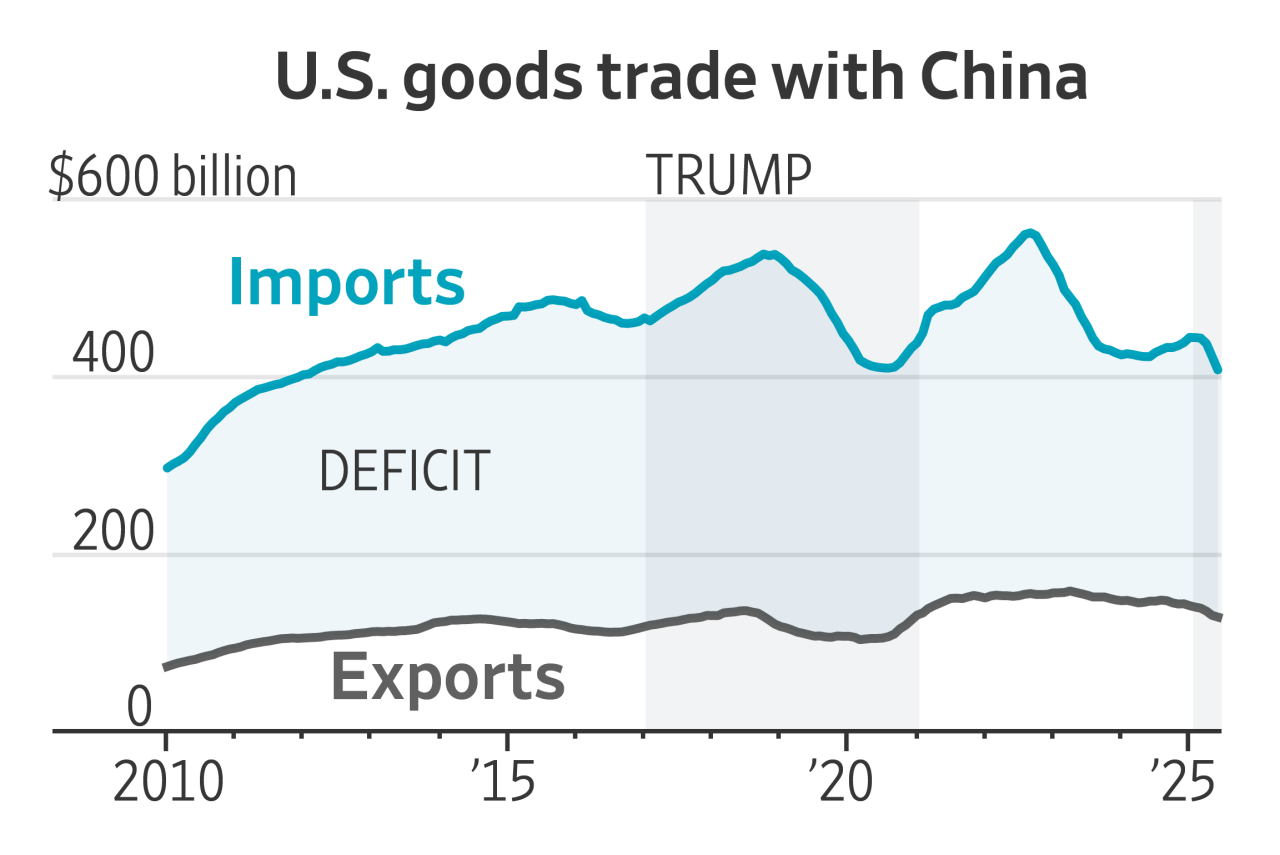
During Trump’s first term, U.S. imports of Chinese goods declined soon after tariffs were imposed, and bottomed out during the pandemic.
Earlier this year, at the start of his second term, many American companies loaded up on imports before most tariffs took effect, then stepped on the brakes this spring after the bulk of levies hit.
Tariffs have prompted other American businesses to cancel orders from China.
Goods that once came from China are also being made in other Asian countries, including Vietnam, Indonesia and India. In recent years, these countries have rushed to build up their manufacturing capacities.
The statistics might understate the true level of Chinese imports, although it’s difficult to gauge by how much. Some products that get labeled as coming from Vietnam or elsewhere actually originate in China and are largely made there. Their manufacturers have no legitimate reason to ship them through Vietnam beyond trying to dodge tariffs.
In an effort to crack down on so-called transshipping, the U.S. is charging 40% on goods from other countries that pass through Vietnam on their way to the U.S. That compares with the 20% duties that the U.S. is charging on Vietnamese goods in general.
It will be “a game of enforcement,” says Mary E. Lovely of the Peterson Institute for International Economics. How well customs authorities can catch transshipped items, as well as what exactly they consider a transshipment, are yet to be seen.
Most key categories of Chinese imports have fallen, including smartphones, toys and furniture. One counterexample: imports of batteries for use in consumer electronics and electric vehicles. They have soared in the past year, due to China’s continued hold on the industry’s supply chain and strong U.S. demand.
Former President Joe Biden largely kept Trump’s first-term tariffs in place while rolling out some of his own.
Early this year, Trump added 10% on all Chinese imports, citing the country’s alleged role in illicit fentanyl trading. He added another 10% for the same reason. A third layer of 125% duties brought the total imposed on China this year to 145%. The beginning of trade talks between the two countries in May then brought it down to 30%, where it still sits.
Even higher tariffs could encourage more companies to move out of China, further lowering Chinese imports to the U.S. But the process becomes harder for higher-value manufacturing, like machinery and electronics.
Write to Chao Deng at chao.deng@wsj.com and Peter Santilli at peter.santilli@wsj.com


