
 E-Paper



Reimagining role of govt in business
Three decades after India began its economic reforms, more than a decade after global capitalism faced its biggest crisis after the great depression of the 1930s and even as the world battles a once-in-a-century pandemic, there is good reason to reimagine the role of the state in the economy.

 Prefer HTon Google


Manomohan Singh and Montek Singh Ahluwalia are widely believed to have led the intellectual and bureaucratic push behind India’s economic reforms. However, the reforms would not have materialised if Prime Minister PV Narsimha Rao had not provided political cover to the programme.
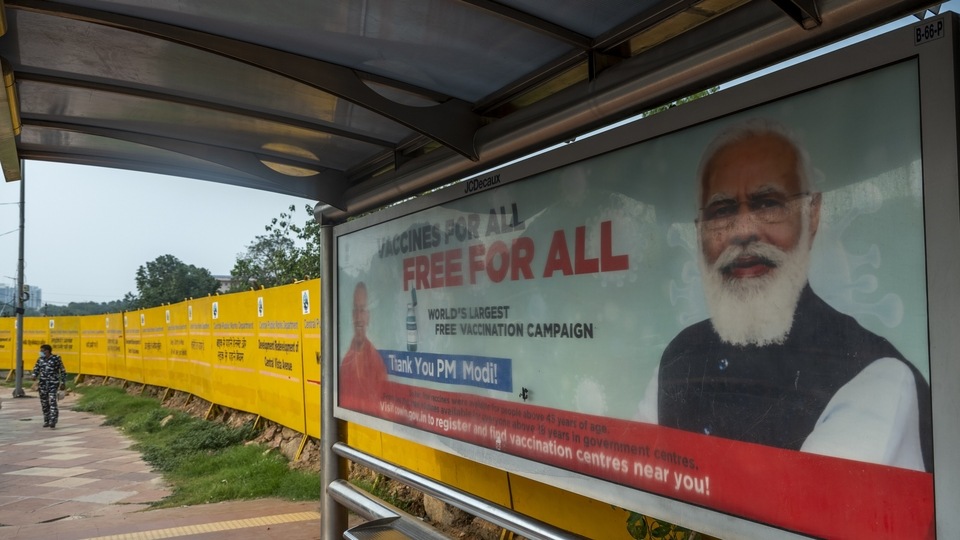
The political argument for reforms in India was not on the lines of the neo-liberalism of the 1970s, best captured by the promarket and anti-government rhetoric of Ronald Regan and Margaret Thatcher in the US and Britain. Instead, Rao sold the reforms to his own party as a continuation of the Nehruvian project of nation-building. It would take a decade before the Atal Bihari Vajpayee government would set up a disinvestment ministry to start moving the government out of business. Some of these debates, especially the privatisation of India’s public sector banks and insurance companies, continue to be sharply polarised even today. However, three decades after India began its economic reforms, more than a decade after global capitalism faced its biggest crisis after the great depression of the 1930s and even as the world battles a once-in-a-century pandemic, there is good reason to reimagine the role of the state in the economy.
1. In terms of spending, the Centre has been losing its importance
The Union Budget is the most important annual economic policy event in India. Actually, it should not get as much importance as it used to for two reasons. Before the Goods and Services Tax (GST) was rolled out, common people had a reason to be interested in the budget. Tweaks to union excise duties used to be a major determinant of price of various commodities. With GST subsuming most domestic indirect taxes of the Centre and states — petrol and diesel are still outside its ambit — this is not the case anymore. To be sure, customs duty changes can still affect prices, but not as widely as GST or its predecessors could. The indirect tax change notwithstanding, there is another reason why the Union Budget should not matter as much as it used to. Central government spending, which is what the budget decides, as a share of GDP has been coming down in India.
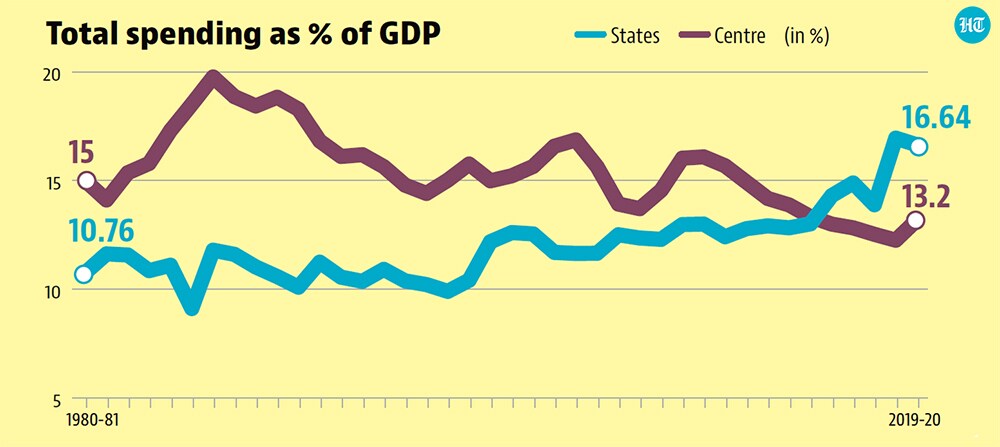
Data from the Centre for Monitoring Indian Economy (CMIE) shows that central government spending, as a share of GDP, peaked in the late 1980s and has been coming down since then. This number was 19.76% in 1986-87 and came down to 12.26% by 2018-19. While the 2020-21 numbers show a big jump — it has gone up to 17.47% again — this is largely an effect of contraction in GDP. To be sure, general government spending is much higher because of state governments. CMIE data shows that spending by state governments actually overtook that of the Centre in the second half of the last decade. While this was also a result of the 14th Finance Commission increasing the share of states to 42% in the divisible pool of taxes, this important shift in nature of spending needs more attention going forward. Given the nature of political competition in India, we have a single-party majority since 2014 for the first time since 1984, this question cannot be divorced from politics at large.
2. A regressive turn in tax burden
Even though the Indian economy has undergone a radical transformation in the last three decades, popular imagination around corruption and tax evasion has not changed much. The biggest proof of this came during demonetisation, when the present government scrapped 86% of the currency in circulation on the (failed) pretext of targeting unaccounted cash deposits for windfall fiscal gains. A simple statistical analysis shows that India’s biggest tax problem is not tax evasion — tax growth has largely been in sync with overall economic growth — but the fact that the tax burden is steadily taking a regressive turn, something which existed during the pre-liberalisation days.
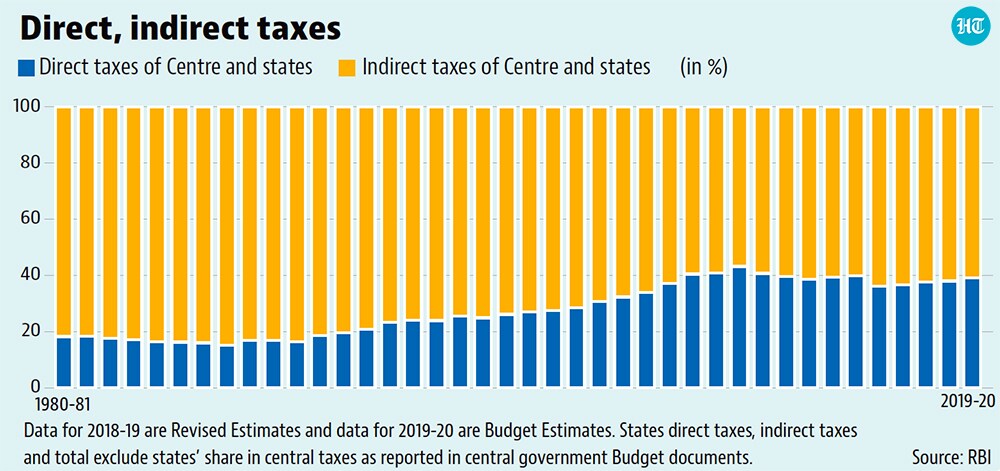
Indirect taxes, unlike the progressive income tax slabs, treat the rich and poor alike and therefore put a bigger burden on the latter. This is bad for both inequality as well as demand, given the relatively larger squeeze on purchasing powers of the poor. At a time when states have surrendered most of their fiscal sovereignty in the post-GST regime (the GST regime itself is struggling on many counts), when the Centre has cut corporation tax rates (it did so in 2019), and when the pandemic has caused significant economic disruption, the task of finding a balance between revenue realisation and ensuring that the tax burden stays progressive will increasingly pose a politically difficult choice.
3. The challenge of balancing short-term relief with long-termgains
Speaking in Parliament in 2015, dismissing the concerns of his government possibly discontinuing the Mahatma Gandhi Rural Employment Guarantee Scheme (MGNREGS), Prime Minister Narendra Modi termed the scheme as a living monument of the Congress’s failures which forced it to send people to dig holes in the ground. The scheme has since proved its counter-cyclical utility and the the government more than doubled the spending on it when the pandemic struck. However, Modi’s larger point is worth pondering upon. The Indian state has finite resources and it often struggles to allocate them across competing demands. India’s democratic set-up necessitates that governments are sensitive to the pain of even the poorest. Modi himself announced the PM-KISAN scheme, a direct cash transfer to farmers, before the 2019 general elections. An HT analysis had shown that the ₹6,000 per annum which farmers get under the scheme is about 6% of an average farmer’s income. The total amount under the programme is almost the same as what it spent on MGNREGS. While this is not to undermine the relief programmes such as MGNREGS and PM-KISAN provide to the poorest of the poor, state spending continues to be woefully inadequate in critical sectors such as health.
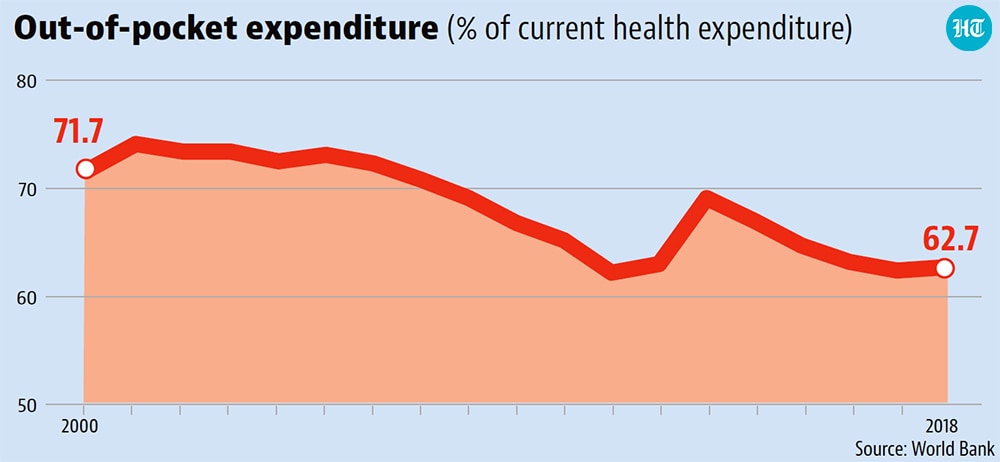
The people at large, once again the poor more than rich, bear a disproportionate burden here, given their low access to health insurance, health care facilities and the probability of a larger health shock to household budgets. World Bank data shows that Indians have a disproportionately large share of out-of-pocket spending when it comes to health expenditure. The Indian state, during the last 30 years of reforms, has done well to deal with the challenge of ensuring that people stay above subsistence margins. This is what programmes such as MGNREGS, widening of coverage under the Public Distribution System and PM-KISAN have achieved. What needs to be seen is whether the state can give a push to well-being levels of a much wider population by investing in social sectors such as health and education, which are crucial to exploiting India’s demographic dividend before the opportunity expires.


