E-Paper



Surat Diamond Bourse sets a new Diwali target after missed deadlines
SDB has only 5-10 functional offices where the occupants moved in around Diwali last year but this is set to change, said spokesperson Laljibhai Patel


AHMEDABAD: Gujarat’s Surat Diamond Bourse (SDB), touted as the world’s largest office building complex, has a new target of getting 400-500 occupants by early July after slipping on several deadlines following its grand inauguration by Prime Minister Narendra Modi in December last year, people familiar with the matter said.
“By July 7, we have a target of starting 400-500 offices, and we have got confirmation from the majority of diamond companies for the same,” said Laljibhai Patel, SDB spokesperson.
Patel, who is also the chairman of Dharmanandan Diamonds Pvt Ltd, a diamond manufacturing company with an annual revenue of around $1.5 billion, added that SDB currently had only 5-10 functional offices where the occupants moved in around Diwali last year but this was set to change.
“By Diwali (November 1, 2024), 1,000 offices will be on…. Everyone is very happy and very excited about the project. By Diwali, we are very hopeful that the diamond bourse will be bustling with activity,” Patel added about the ₹3,400 crore ($411 million) project.
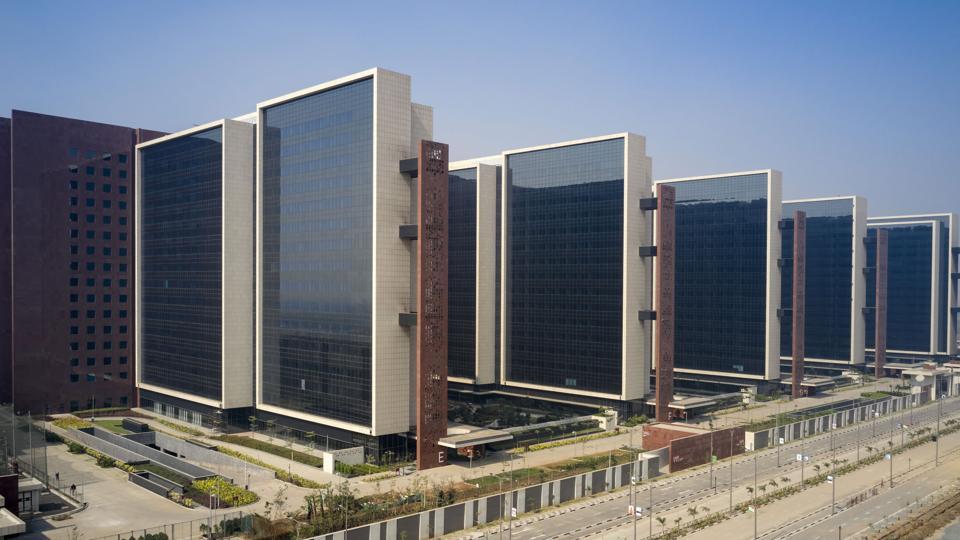
In all, SDB has 4,500 offices, ranging from 300sq feet to 115,000sq feet, that can accommodate 67,000 people. The bourse is part of the Diamond Research and Mercantile City spread over about 2,000 acres on the outskirts of Surat at Khajod.
The bourse, constructed over 6.7 million square feet, is larger than the Pentagon which has an area of 6.5 million square feet. It was pitched as a one-stop shop for artisans and businessmen with facilities such as international banking, safe vaults and a jewellery mall.
Russian invasion dims industry sparkle
A diamond merchant, who spoke on the condition of anonymity, said he wasn’t sure if the bourse would be able to meet its new deadlines given the headwinds facing Surat’s diamond trade. “The diamond business is going through an extremely rough patch, and traders are being very cautious about making major investments. Small diamond traders have either shut down shops or cut on work hours,” he said.
The SDB’s struggles reflect the challenges facing Surat’s diamond industry which is battling a slowdown in global demand.
The city’s diamond industry, which employs 800,000 people, handles cutting and polishing 80% of the country’s rough diamonds at its over 5,000 diamond processing units.
The industry’s challenges became more difficult after the Russia-Ukraine war that led the US to impose sanctions on Russian diamonds. Earlier this year, the US banned imports of polished diamonds made from Russian rough stones above certain carat weights, regardless of the processing location.
The prohibition hit Surat particularly hard since 4% of the diamonds that it receives are directly from Russia, while another 29% of Russian-mined diamonds reach Surat through other sanctioned nations. A third of Surat’s polished diamonds are exported to the US and EU, and more than half to Hong Kong and China.
Dip in demand for diamonds in China
Vipul Shah, chairman of the government-supported industry body, Gem & Jewellery Export Promotion Council (GJEPC), said the industry was beginning the financial year on a “very cautious note”.
“The overall demand for diamonds is down by almost 30-35%. One of the major factors for this is China, where the demand went down post-Covid recession. They consumed almost 30% of the world’s demand. They faced liquidity issues during Covid, as a result of which they are buying gold but not diamonds. The interest cost is another major factor, and if the interest rates need to come down substantially this year, it could give a boost to business and exports,” told HT over the phone.
According to GJEPC, the overall gross exports of gems and jewellery declined by 15% to $32.02 billion ( ₹2.63 lakh crore) while gross imports fell by 14% to $22.27 billion ( ₹1.83 lakh crore).
The slump was particularly pronounced in the cut and polished diamonds segment, with exports plunging by a staggering 27.58% to $15.97 billion ( ₹1.31 lakh crore). Conversely, imports of cut and polished diamonds witnessed a sharp 46.12% increase, reaching $1.91 billion ( ₹15,700 crore).
The import of rough diamonds, a crucial raw material for the industry, also declined by 17.85% to $14.27 billion ( ₹1.17 lakh crore), indicating a slowdown in manufacturing activity, according to GJEPC data.
Surat Diamond Bourse (SDB) vs Bharat Diamond Bourse (BDB)
To be sure, the effort to promote the SDB was never expected to be a cakewalk. Already, the industry has the Bharat Diamond Bourse located in Mumbai’s Bandra Kurla Complex and it was a big challenge to get businesses to shift their offices from BDB to SDB. The effort received a setback when Vallabh Lakhani of Kiran Gems and Diamonds, who was among the founding figures and the SDB chairman, decided to relocate his offices back to Mumbai in January this year.
In June 2023, it was chairman Vallabh Lakhani who offered firms space in the new complex at a discount - they won’t have to pay maintenance for a year. In September 2023, Lakhani’s company also moved its office and most employees from Mumbai to Surat.
SDB officials insist that the Lakhani’s firm had only temporarily shifted back to Mumbai and would return later this year when the bourse is fully operational. Diamond baron and Rajya Sabha MP Govind Dholakia, who founded Shree Ram Krishna Exports, was appointed as SDB chairman in March after Lakhani stepped down.
Shah insisted that it was not right to interpret SDB’s teething troubles as a competition between the two bourses. “Both Surat and Mumbai are important diamond trading hubs. The coming up of SDB should not be seen as a shifting process but more of an expansion. Business is shrinking at the moment and this is one of the reasons why the process of setting up SDB is slow. One should not expect it to be a runaway success overnight, but in the long run, it will come up very well,” the GJEPC chairman said.
To be sure, many diamond barons maintain expansive corporate offices in Surat, that resemble luxurious star hotels in both amenities and size and have booked spaces at SDB even though they prefer to operate from their existing premises, for now.
Surat has about 10,000 diamond offices in the established hubs of Varachha, Mahidhapura, and Katargam, locations that are 30 kilometres from SDB and present a logistical challenge for staffers in the absence of public transport.
 ABOUT THE AUTHORMaulik Pathak
He is an Ahmedabad-based journalist with more than two decades of experience. His career spans business journalism and general news, with reporting across politics, crime, governance, public policy, business, industry, infrastructure, energy, ports, aviation, the environment, wildlife and social issues. He began his career in feature writing before moving into business journalism, reporting on companies and sectors including energy, infrastructure, pharmaceuticals, automobiles and real estate. Over the years, his work expanded to politics, courts, crime, public policy, civic affairs, the environment and wildlife. His reporting has taken him from government offices and courtrooms to factory floors, ports, forests and remote villages, covering stories that range from industrial investments and financial markets to elections, conservation and issues affecting everyday life. While many assignments demand the pace of the daily news cycle, others require sustained reporting over months and years to follow developments beyond the headlines. He started his journalism career with the Asian Age in Ahmedabad in 2002 as a feature writer and sub-editor. Since 2022, he has been working with Hindustan Times. Earlier, he worked with Business Standard, DNA, The Economic Times, Mint and The Times of India. His longest stint was with Mint, where he spent more than eight years reporting across multiple beats. During his career, he has worked in both reporting and editing roles, contributing to page planning, local editions and special editorial projects as newsrooms evolved from print-first operations to digital publishing. Early in his career, he also worked on media and documentary projects with an NGO and as a copywriter at a communications agency before returning to journalism. Away from work, he sometimes makes time for a pair of binoculars, table tennis, cinema and the occasional poem.Read More