
 E-Paper



Tariff refunds are here—and turbocharging earnings
Apple, Nike and FedEx are just some of the companies that are recovering big sums relatively quickly.


 Prefer HTon Google


Tariff refunds have begun rolling in to big U.S. companies—in some cases providing a solid boost to earnings.
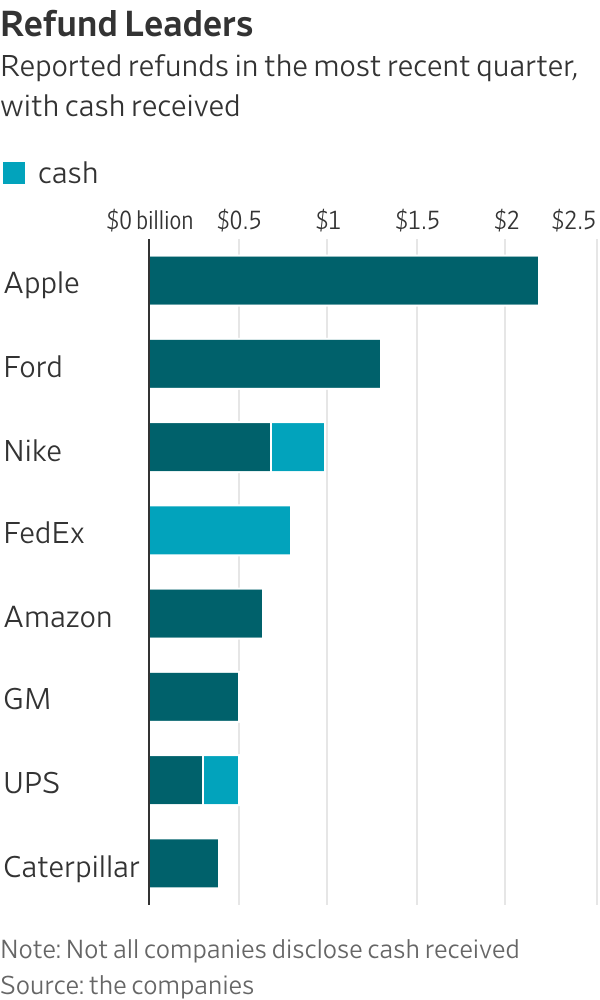
Contrary to warnings that the refund process could prove slow and messy, many companies appear to have received the money with remarkable speed. So far, over 40 S&P 500 companies have reported some $9.6 billion in refunds in the past quarter or so, including at least $2.1 billion in cash already received.
Among the biggest refunds reported so far: Apple, at nearly $2.2 billion; Nike, at $986 million; FedEx, at about $800 million; Amazon, at $640 million; and General Motors, at $500 million.
U.S. Customs and Border Protection had received just over 252,000 refund applications as of July 31 for tariffs declared unlawful by the Supreme Court. The customs agency accepted $128.7 billion in refunds for processing, an agency official told a federal court last week.
Several companies noted they have already received the full amount they sought, or expect to.
Nike said it had received $302 million in refunds in the last quarter of its fiscal year ended May 31—and received almost all of the remaining $684 million by July 15, when it issued its annual report to shareholders.
Other companies have made clear they are still awaiting the outcome of some refund claims. Fortive, which makes industrial-measurement equipment and automation technology, recognized a $4.5 million benefit for tariff refunds received but said it expected as much as $25 million more in coming periods.
Reported refunds don’t always reflect money in the bank, and companies are handling the sums in different ways on their financial statements. Some record them only as cash arrives, while others are also reflecting likely payments in their financials.
Zebra Technologies, which makes bar code scanners and printers, concluded in the second quarter that it was likely to get a refund of all $73 million in past tariff payments. By the end of its quarter ended July 4, it had received $14 million in cash but booked the remainder as a receivable. By July 31, the company said, it had received another $27 million in payments.
In some cases, refunds have contributed handily to quarterly results. Apple said its tariff refunds contributed 11 cents to per-share earnings in the most recent quarter—about 5% of the quarter’s total.
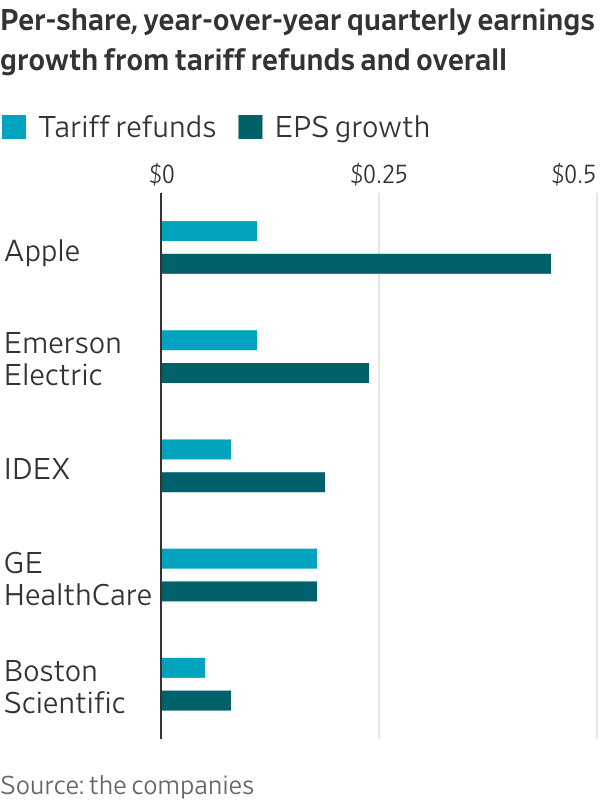
GE HealthCare Technologies said tariff refunds had contributed 18 cents of the $1.24-a-share it reported in earnings for the quarter ended June 30. The company said it had received $107 million in refunds and expected $38 million more.
Yet for many companies, even sizable benefits from tariff refunds are offset or overshadowed by the tariffs they continue to pay. Caterpillar recorded $392 million in expected tariff recoveries in the most recent quarter and said it doesn’t expect to book more in 2026. It does expect to incur a total of $2.2 billion in tariff payments for the year, not considering the recoveries.
So far, technology hardware companies have reported the highest refunds, at $2.5 billion across half a dozen companies. Nearly 90% of that reflects Apple alone.
More than a dozen capital-goods companies reported about $1.3 billion in refunds, including heavy equipment makers Caterpillar and Deere ($272 million), defense contractor Lockheed Martin ($140 million over six months) and toolmaker Stanley Black & Decker ($118 million).
Several companies have said they’ll share refunds with customers. FedEx said it would start disbursing its $800 million in refunds to shippers and consumers in August.
FedEx said it functions as a pass-through for customers and is required to collect duties and taxes. The company said customers can track the status of their tariff refunds on FedEx’s website.
Costco—one of many companies hit by class-action lawsuits from refund-seeking consumers—has said it plans to pass tariff refunds to customers “in some form” and at levels similar to the tariff costs it had passed on to them. The company said the federal refund process on its own could take months.
IDEX, which sells pumps and valves to a range of industries, said it expected to rebate $14.7 million to customers. That is about two-thirds of the more than $20 million it received.
Some companies were less clear about the source of their expected recoveries. Ford Motor said it expected around $3 billion in tariff reimbursement from the federal government and suppliers combined, of which about $1.3 billion stemmed from the Supreme Court’s decision invalidating President Trump’s emergency tariffs.
Amazon said it had identified a “limited set of circumstances” in which it could trace the cost of tariffs passed on to customers and would contact those customers to issue refunds once they receive the cash.
“Otherwise,” CFO Brian T. Olsavsky said in a July earnings call, “we’ll utilize refunds to continue to invest in low prices for customers.”
Write to Theo Francis at theo.francis@wsj.com and Celia Bernhardt at celia.bernhardt@wsj.com


