
 E-Paper



Your Money: A budget that quietly builds lasting wealth
Budgeting can feel restrictive, but it helps identify spending habits while balancing everyday enjoyment with savings for long-term financial well-being.

 Prefer HTon Google


Most of us know precisely how much we earn every month. Far fewer can estimate with equal accuracy how much they spend. Can this gap be filled by having a suitable monthly budget?

A budget sounds harsh and inflexible, but in reality, it is simply a way to measure what you spend.
According to Vishal Dhawan, founder and CEO, Plan Ahead Wealth Advisors Pvt Ltd, “The gap between your income and expenses is the delta on your savings and investments. Knowing the gap is how you can accelerate wealth creation.”
Budgets are often difficult to follow not because expenses cannot be adjusted, but because they feel restrictive and punitive. The inertia that sets in often outweighs any positive budgeting action.
Also Read | How to build better money habits that actually stick, without giving up the life you love
Behaviour that holds you back
Spending ₹5,000 on a movie outing with your family brings immediate satisfaction. Investing that same ₹5,000 every month could grow to ₹10 lakh over 10 years at an assumed annual return of 10%, but that future reward rarely provides the same emotional satisfaction today. More often than not, instant gratification wins over invisible future gains.
According to Chaitali Shah, CFP and Consultant Advisor, International Money Matters, “Often people are in denial to accept what’s wrong with one’s personal finances or where expenses are overtaking. While the younger generation are more open to working on this, the older ones are less willing.”
The pain of overspending is also being numbed by digital payments. Multiple ₹500 spends do not pinch because the cumulative cost is not immediately visible. You no longer see money physically leaving your hands or even your bank account until you deliberately review your spending.
Then there are social obligations. Real life rarely follows a budget. Milestone birthdays, weddings, festivals, helping relatives and spontaneous weekend getaways can easily push spending beyond plan.
“A socially active individual is likely to have proportionately higher expenses which are difficult to predict in advance,” says Dhawan.
Is the answer simply more discipline? Behaviour rarely changes through willpower alone. The answer lies in building a system that makes budgeting easy, automated and visibly rewarding.
Three steps towards successful budgeting
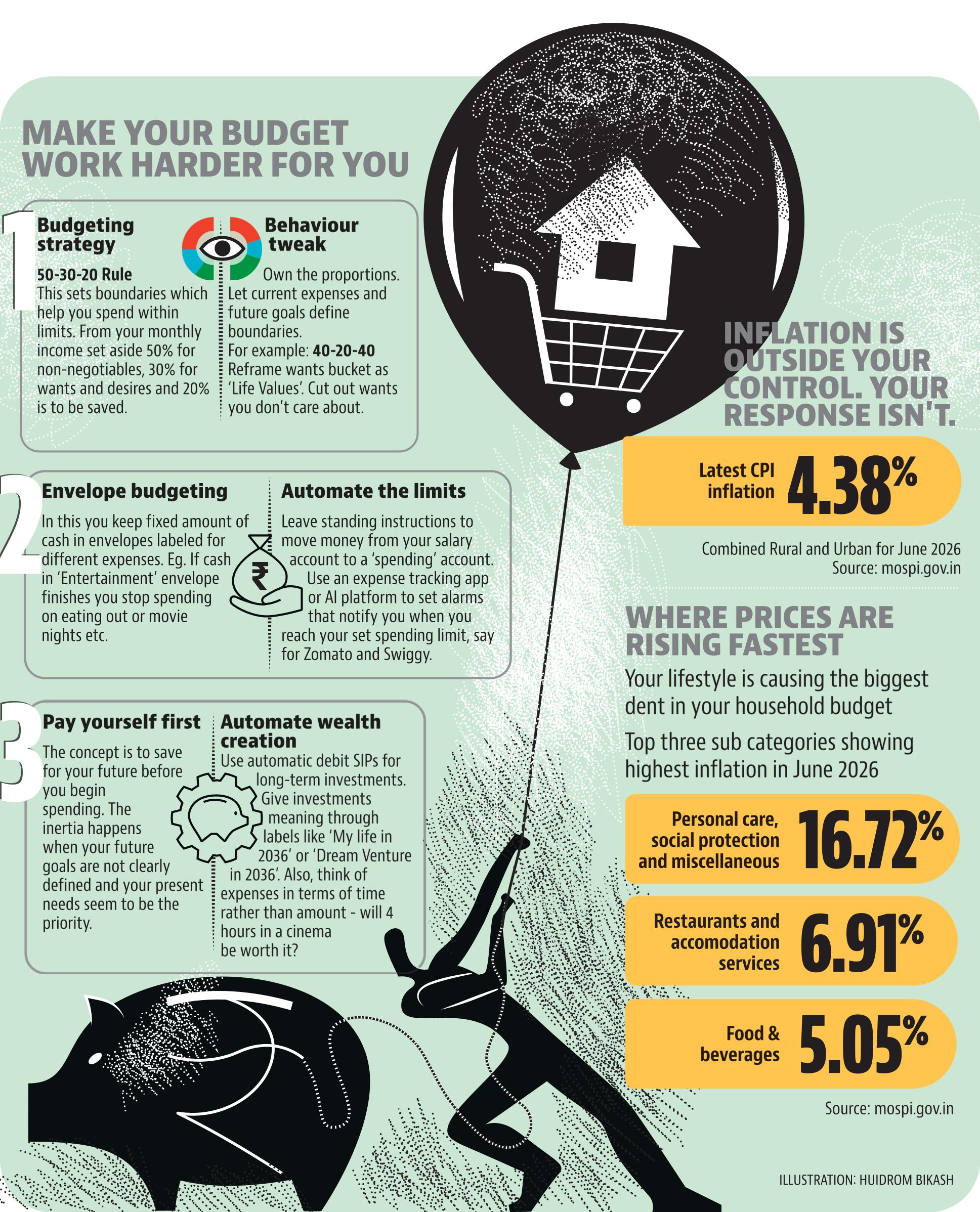
1. Make your budget easy
When you are asked to follow a budget, does it feel like you need permission to spend your own money?
If budgeting feels emotionally draining, stop relying on rigid thumb rules. Instead, begin with how you already spend. Pull out the last six months
of your bank and credit card statements and let them define your budget.
Categorise spending into needs,
wants, future security and social obligations.
Use AI tools to pick an expense tracking app which can synchronise information from bank SMSes, track aggregate spending, identify major expense categories and set limits. If privacy is a concern, Excel works just as well, although entries will need to be manual.
Now optimise your spending pattern so that at least 20-30% of your monthly income goes towards savings. Which categories you trim is a personal choice rather than a formula. Move your savings into investments within the first two days of receiving your salary and transfer money meant for essential expenses into a separate account. What remains is available for discretionary spending and social obligations.
A budget built around your own spending habits is much easier to sustain than one imposed through generic rules.
2. Automate as much as possible
Automate calculations, transfers and investments to remove emotional friction from budgeting. If you know expenses will rise in a particular month, plan for them in advance. A recurring deposit for predictable annual expenses such as school fees, festivals or holidays creates a dedicated savings pool while earning better returns than leaving the money in a savings account.
Long- and medium-term goals can be automated through mutual fund SIPs.
Also automate higher investments whenever your income rises. Commit a fixed proportion—say 60%—of every pay hike and bonus to long-term investments. Move surplus money out of
your salary account by the 10th of
every month so rising income automatically translates into rising investments.
Strategies can vary based on what works for you.“I recommend two separate bank accounts; one for income and expenses and the other for investments and passive income. I also recommend that a percentage of income earned should be transferred to the investment account before EMI payments and other expenses,” says Shah
Both Dhawan and Shah agree that denial about spending patterns is normal. That is emotion, not objectivity. Shah recommends that individuals can overcome this by working through an exercise, which helps them identify unique needs and wants in alignment with their life’s values, circumstances and goals.
Also Read | Planning a future together? Here are the financial issues women should never overlook before marriage
3. Don’t let the budget outcome be invisible
A successful budget must produce a visible reward. Check your investment balance every six months to see how your unspent money has grown.
“Often, people are unable to understand the tradeoff in spending today versus saving for the future. We prefer to work with a savings target rather than an expense target. This helps in reframing what may seem like a constraint into something liberating. The visualization is around what all can be done once a particular savings target has been achieved. This works well for small business owners too where income is not uniform across each month,” says Dhawan.
Be careful not to spend your entire surplus. That reinforces the value of delayed gratification.
If you follow this three-step process for a year, many invisible, discretionary expenses will disappear naturally. What remains are the expenses that genuinely add value to your life without compromising your future. Budgeting also works better when the whole family is involved.
Do the work once, automate wherever possible and acknowledge the results regularly. Those three steps are the key to aligning behaviour with your budget.


