
 E-Paper



Four out of 10 men addicted to drugs in Punjab
A steady supply from across Punjab’s borders is making it next to impossible to cure the state of its deadly addiction to illicit drugs, a Narcotics Control Bureau survey of eight cities including Amritsar and Patiala has shown. Addicts overcrowd Punjab drug rehab centres

 Prefer HTon Google


A steady supply from across Punjab’s borders is making it next to impossible to cure the state of its deadly addiction to illicit drugs, a Narcotics Control Bureau survey of eight cities including Amritsar and Patiala has shown.

But recent police seizures have pushed prices of drugs, originating in Afghanistan and routed through Pakistan, to sky-high levels and driven addicts who cannot afford their daily fix to de-addiction centres.
This is the latest twist in a sorry saga that has ruined the lives of many in the prosperous state. Another central study of the Punjab drug problem shows that four out of ten men in the state are addicted and up to half this number are youth and farmers.
The analysis shows that heroin is still largely a transit drug accounting for less than 7% of consumers. 15% of the addicts crave for “bhukki” (poppy husk) and 20% need other synthetic drugs, most of which come from pharmaceutical units in Himachal Pradesh, on the state’s eastern border.
Anti-narcotic agencies say the primary reasons for high levels of addiction in Punjab are traditional use of opium by farmers, the rising prices of alcohol, easy availability of narcotics from Himachal and a thriving smuggler-police-politician nexus which is hampering enforcement action.
But Punjab director general of police Sumedh Saini differs from the central assessment. He told HT that since May this year, the authorities had seized 149 kilogrammes of heroin. To date, his men have seized 1,462 kgs of raw material for making synthetic drugs like ICE, registered 9,935 cases under NDPS Act and made 11,490 arrests.
“We have smashed the cross-border drug transit lines by targeting international drug traffickers. The result is that today intoxicants are not available to the consumers, which has led to some 2,08,171 consumers being treated at the de-addiction centres up to July-end,” he said.
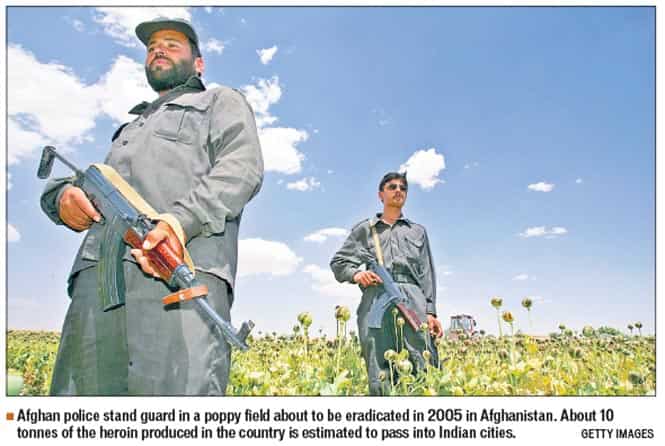
Heroin production in Afghanistan is expected to touch record levels of 550-600 tonne, of which around 10 tonne to pass through Indian cities.
According to Indian estimates, pure heroin costs Rs 1-2 lakh per kg in Pakistan. The cost doubles to Rs 3 lakh a kg after it crosses the border to pay for the risks involved. From Punjab to Delhi, the cost reaches Rs 8-10 lakh a kg and further doubles to Rs 16-20 lakh a kg in Mumbai.
The involvement of cross-border smugglers was evident from seizure of 27 kgs of heroin by Punjab police in the last week of June. The heroin has originated from Lahore-based smugglers identified as Kalu Chairman and Nasir, pushed into Indian territory across the Line of Control in Kashmir and was intercepted while on its way to Jaisalmer. The international cartel is also active on the synthetic drug front with key smugglers based in Chennai and agents active in Himachal Pradesh, Delhi and Haryana. Investigations have shown the cartel procuring drugs from HP and sent to Malaysia and other countries through Chennai.
According to NCB experts, a national anti- narcotic task force should be formed to tackle drugs for Punjab with a comprehensive statistical survey of addiction in the state.
“Strong enforcement action is needed against pharmaceutical units in HP with reduction in liquor costs and liberalised bhang and bhukki licenses so that Punjab youth do not move to hard drugs like heroin, cocaine, ephedrine, methamphetamine, ICE and LSD,” said a senior official.


