
 E-Paper



Kangana, that girl from our town
Kangana Ranaut has always been hot. Those unruly tresses lining her dew-kissed face and doe-like eyes are enough to melt your heart. But here, she is on fire.Unintentionally, she wields a knife. Slowly, she cuts your heart out, looks at it longingly, and burns it. Aarish Chhabra writes


Kangana Ranaut has always been hot. Those unruly tresses lining her dew-kissed face and doe-like eyes are enough to melt your heart. But here, she is on fire.
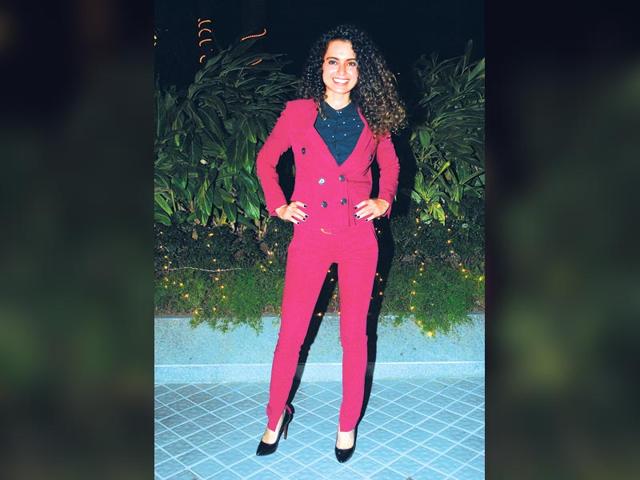
Unintentionally, she wields a knife. Slowly, she cuts your heart out, looks at it longingly, and burns it. With a smile, she walks away rather graciously as you collect the ashes from amid your sick societal dirt.
Also Read: National Awards: Kangana best actress, Queen best Hindi film, Court gets top honour
In Queen, her latest movie, this girl from Himachal — who came into her own while studying in Chandigarh, and then earned a name in film-land after some brutal stereotyping off and on the screen — has finally arrived.
Still carrying her cutely odd demeanour from the hills and that awkward manner of speaking, she starts off being the babe-in-the-woods whose little brother is her security guard.
By the end of it, she is a woman so sure of herself that she does not feel the need to get angry with her pitiably selfish fiancé who first cancels their wedding and then wants her back when she is finally ‘classy’ enough. Without spoiling the movie for you, that’s all I’d reveal.
Essentially, she is like the women in most Indian families, unless you are an oddity or from one of those families that tragicomically claim to have brought up their daughters “just like sons”.
Speaking from the limited proximity of having stayed in a PG in the lane behind her school — DAV, Sector 15 — I believe that Rani in Queen is unmistakably a version of Kangana, and of countless other small-town types who spend a lifetime trying to fly out and fit in.
She may have first felt that in Chandigarh, where the brutality of classiness is like a knife twisting in your gut. But she clearly sought to stand out, and shocked with aplomb in a bikini during one of those local beauty pageants.
I remember seeing the photo during my early days as a student in Chandigarh, and gawking less at her petite body, more at her then-unfashionable curls.
The body language did give it away, that she was somehow ill at ease — a lecher’s delight, a Bollywood wannabe, probably even a future victim of casting couch wolves. But she was, in the same frame, the perfect muse for an artist looking to paint a damaged, hungry soul.
She may have wanted to do Bollywood masala, or so I thought. I was wrong. It was a damaged soul on display when she portrayed those neurotic, affected women in her initial days of Gangster and Woh Lamhe, etc. She was so good at it that people started believing she needed care.
Many thought she would drink too much and actually jump in the sea some day, like she does in a brilliantly quiet scene in Gangster.
Then came some mindless stuff like Rascals, where her bosom had a longer role than hers. A lull followed, when you heard stories of how those famously exploitative male stars no longer liked her, and how she was becoming snooty, how she had got breast implants and a lip job, and how she was generally a wannabe.
The girl was trying to fit in, again.
After that, something clearly changed. It was evident in her movie choices. As Tanu weds Manu hit the screens, she had clearly made it to that rare space where small-town types stop feeling the need to fit in.
She was her own person, or so it seemed finally. Rajjo was an unabashed ode to that rare space, and Queen has proved how she’s finally fine playing herself.
Versatility may be the hallmark of good actors, but for Kangana and others like her — in Bollywood or any other profession — being at ease with their true selves is the real challenge.
Queen, the movie as such, is more about a girl’s struggle to have her own identity than about being a small-towner in a big city.
It is about the stuffiness of being a ‘ sayaani kudi’, ‘good girl’, from a ‘respectable’ family. Rani, or Kangana, breaks through that stuffiness.
After her fiancé betrays her, her family gifts her some freedom as a consolation. She travels alone, drinks and dances like there’s no tomorrow, befriends ‘loose’ girls and male strangers, and dares to live.
In the process, she liberates herself.
You know who she is? No longer awkward, no longer visibly damaged, she is the scary muse of Yo! Yo! Honey Singh and his cowardly cult.


