
 E-Paper



Kashmir ki kani: How a small village revived a dying craft
The spectacularly beautiful ‘kani’ shawls have been restored to life through the untiring efforts of a man named Ghulam Mohammad Kanihama

 Prefer HTon Google


Many art forms die and are forgotten, but in Kanihama, which is being given the special status of ‘handloom village,’ the spectacularly beautiful ‘kani’ shawls, now GI (geographical indication) tagged, have been restored to life through the untiring efforts of a man named Ghulam Mohammad Kanihama.
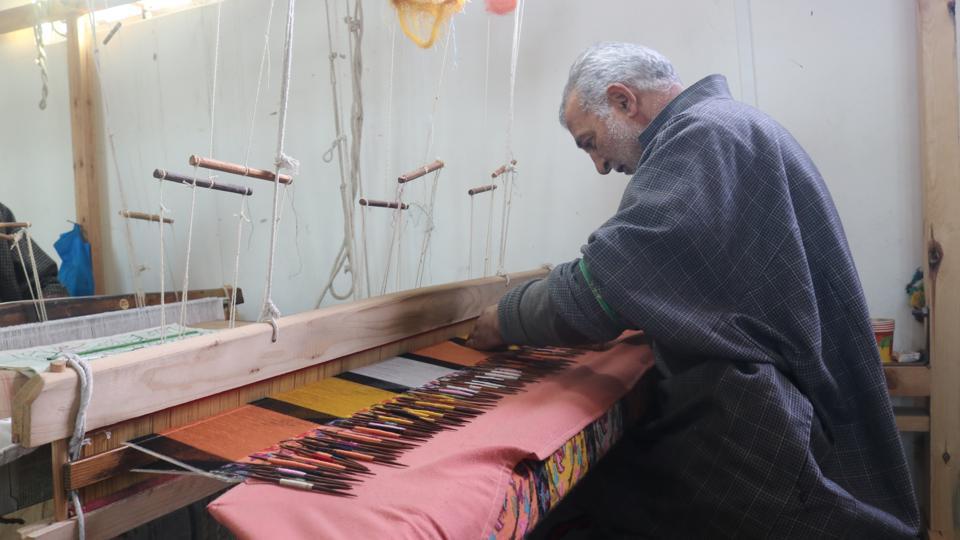
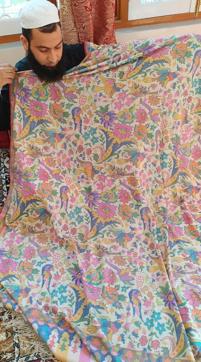
Once you enter the picturesque village with 400 households on the Srinagar Gulmarg highway you come across a group of artisans who have been busy for months weaving delicate pashmina yarn with hundreds of spools (or kani) that come together to form delightful patterns of flowers, leaves and birds on the finest of shawls. A GI tag is indicative of the specific geographical origin of a quality product.
More than 50 years ago, the quest to revive the kani shawl began from the Wani House here with 10 villagers getting special training in weaving.
“Our family has followed the tradition of weaving this style of shawl for generations. It is in our bloodline. Official estimates put the number of shawls produced in the village from 500 to 700 a year. The weaving is a meticulous process that takes about six months to two years to complete,” says Sajjad Wani, who has around 15 looms in the village.
Starting with a small loom
Ghulam Mohammad Kanihama, Wani’s father, was a member of the Jammu and Kashmir legislative assembly from Beerwah in Budgam district. “Almost all the weavers had stopped making these shawls in the 18th century after heavy taxes were imposed on this trade. Somehow it survived in our family. Being a weaver himself, my father set up a small loom in the house and hired an artisan to train young men from the village,” says Wani.
Luckily, Kanihama had preserved some old designs from his forefathers and a few graphics of the weaving process which helped with the training, says Wani.
“So great was his love for the kani shawl that my father sold a portion of his land to pay the weavers.Till his death in 2001, my father used to sit with weavers at the looms and discuss new designs,” says Wani, showing antique shawl designs preserved in his family for generations.
Calling love for the art form “a gift from our forefathers, which we are passing to future generations,” Wani says, “In our family every person knows how these shawls are made, their designs and the yarns to be used. My young daughters who are studying are also well versed with this craft.”
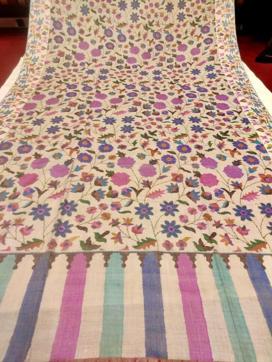
The villagers are proud of the fact that the tradition has not just been revived in their village, but that it has been adapted in other parts of Kashmir as well, especially in the neighbouring villages of Batapora, Mazhama and Roshanabad. “Two of our weavers were selected for national awards for producing the finest shawls on spools. Here you will find original products in the price range of Rs 50,000 to Rs 3 lakh and nobody can challenge the quality of the shawls,” says Farooq Ahmad, a weaver from Batapora.
The products have become a major source of income for villagers, says field officer, handloom development department, Syed Qadri. “Weavers, makers of spool and looms or dyers today have an income because of the shawls. The government initiative to declare Kaniwami as a handloom village has also given a boost to shawl making.”
Things are changing for the better. “Besides giving money for setting up of new looms, the government under the scheme will be establishing a trade facilitation centre here for the weavers to display and sell their products with live demonstrations of shawl making, especially for tourists,” says Qadri.
GI tagged village
Director handicrafts Kashmir, Massratul Islam, says a handloom village status is for promoting art and craft, heritage and culture. “Once a gate is created marking Kanihama as a handloom village, tourists and art lovers will stop here to find out how the shawl is woven. Kashmir is the only place in the world where these shawls are made, woven through spools where the design is embedded in the weaving process. It has great potential in the international market.”
Officials say that under a Centrally funded scheme Rs 5 crore will be given to the village where houses will be painted a uniform colour and weavers provided solar lights and work stations.
A modern cafeteria will also be set up here.
The villagers also feel the government should do more to help. “ I have taught my son this craft in spite of the fact that he is completing his postgraduate studies while weaving. For the last 47 years I have survived on the money I made from the shawls, but the government should do more to make our lives better. Other villages should get the handloom tag too,” says Ghulam Mohammad Reshi, an expert weaver and member of the Gul-e-Anar Cooperative Society established here years ago.


