Sign in

Prime Minister's Office pushes for Punjab land model

An amended Punjab law that allows long-term lease of farm land for projects may soon be replicated across India, with the Centre planning to use it as a model for alternative land management legislation after letting a controversial ordinance lapse.

Updated on: Sep 3, 2015, 21:33:38 IST
Hindustan Times | By , Chandigarh
Share
Share via
  • facebook
  • twitter
  • linkedin
  • whatsapp
Copy link
  • copy link

An amended Punjab law that allows long-term lease of farm land for projects may soon be replicated across India, with the Centre planning to use it as a model for alternative land management legislation after letting a controversial ordinance lapse.

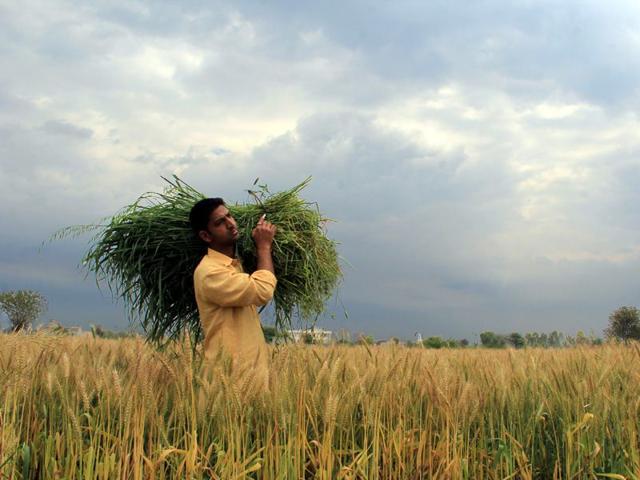
A farmer working on the field under the shadow of dark clouds at Bathinda. (Photo by Sanjeev Kumar/HT Photo)

Sources said the prime minister’s office had asked the Niti Aayog to draft a model land lease law in the next few months after consulting all states, indicating the government’s renewed bid to fast-track stalled industrial projects.

Once the model legislation is drafted by the department of land resources, it will have to clear the hurdle in Parliament, where a Congress-led Opposition forced a washout in the recently-ended monsoon session. The land acquisition ordinance has been dubbed as “anti-farmer” by opposition parties, who hold a majority in the Rajya Sabha.

The PMO asked the Niti Aayog to suggest a framework for the new law after Punjab chief minister Parkash Singh Badal briefed Prime Minister Narendra Modi about the state’s land lease policy recently. Modi on Sunday announced the government wouldn’t re-promulgate the ordinance and let it lapse on Monday.

Panel vice-chairman Arvind Panagariya has met the revenue secretaries of all states on the proposed model law and officials said the secretaries were in favour of a national law.

“As land is a state subject, the Centre can only enact a model law,” an official explained, adding that the states agreed that the law would be a win-win situation and expressed interest.

Punjab amended its tenancy law in 2013, allowing farmers to lease out land up to 100 years and empowered sub-divisional magistrates to get the lease vacated in case of a dispute. See page 10


Centre pushes for land model

The companies can pay the entire cost upfront or in installments. There is also a revenuesharing model.

“The company pays a signing amount and then minimum money to the land owner every year for the lease period. If the company’s revenue is beyond a certain threshold, it is required to share its profit with the land owner,” a Punjab government official told HT.

States such as Gujarat, Haryana and Andhra Pradesh have land tenancy laws enacted soon after Independence but they are considered outdated for the productive use of barren land.

“Most of these laws are prohibitive in nature and therefore, needs a revamp,” an official said, adding the government wanted a uniform national framework on leasing of land to attract investors.

(Inputs from Gurpreet Singh Nibber)

  • Chetan Chauhan
    ABOUT THE AUTHOR
    Chetan Chauhan

    Chetan Chauhan is the National Affairs Editor looking into all aspects of news and features from across India. A Chevening scholar with over three decades of experience in reporting and news management, Chetan has extensively covered all important aspects of the social sector, political economy, environment and climate change nationally and internationally. He did a journalism course at the Reuters Institute of Journalism in Oxford and Digital Media training at Nanyang Technological University in Singapore. He started as a reporter with The Statesman in 1996 and joined the Hindustan Times in 2000 in the metro bureau covering environment, crime and Delhi politics. He covered hot local news, from the Jessica Lal murder case to the rebellion of Delhi Congress MLAs against then Chief Minister Sheila Dikshit, to the replacement of toxic vehicle fuel with cleaner compressed natural gas (CNG) in the national capital. Some of his stories on air pollution became part of the Supreme Court’s landmark MC Mehta versus Government of India case in the National Capital Region (NCR), forcing the government to take corrective measures. As part of the national political bureau since 2004, he covered important central sectors such as environment, education, social justice, labour, rural development, water resources, renewable energy, agriculture, broadcasting and the Planning Commission for more than a decade producing several exclusive and investigative breaking stories. His specialisation is the environment, having covered at least a dozen United Nations global conferences on climate change, biodiversity and wildlife including climate summits in Paris, Copenhagen and Bali. He also covered India’s two five-year plans ---11th and 12th and reported on drafting and execution of right based laws such as Right to Education, Right to Information and rural job guarantee law, MG-NREGA, now being introduced in new format as VG-RAM-G Act. He has in-depth knowledge of social sector issues. He was one of the first to report on tigers vanishing from Sariska and Panna wildlife reserves in 2004 and 2008, respectively, leading to the setting up of the National Tiger Conservation Authority (NTCA) and the introduction of stringent penal provisions for poaching. He has written extensively on the rising human-animal conflict in India and the degradation of India’s biodiversity hotspots because of mining and other activities. Since 2004, Chetan has covered Parliament comprehensively and participated in training on the nuanced coverage of Parliament proceedings. He has travelled extensively across India to cover national and provincial elections since 1998, especially in the Hindi heartland states, considered India’s road to power. He writes a regular column for Hindustan Times, Ecostani, on important national politics, economy, Himalayan ecology and environmental issues. His other responsibilities include providing inputs for edits and edit page articles for the publication, apart from managing news flow from across India.Read More