
 E-Paper



One month after floods: 75% of Kolhapur’s sugarcane crop destroyed
Heavy rains in Kolhapur have the city on edge, with hundreds of displaced families shuffling between shelters and farm land and cattle. Panchnamas have been done on 80,000 hectares

 Prefer HTon Google


Kolhapur’s sugarcane fields are the worst affected by the floods, according to the district collector’s office.
One month since floods struck the region following incessant rainfall and the Panchganga river overflowing, Daulat Desai, district collector of Kolhapur, said: “We have completed panchnama (assessment) of 80,000 hectares of agricultural land. At least 75 per cent of the damaged agrcultural land is sugarcane, and the remaining is paddy, soyabean, groundnut and others.”
Villages along the flow of the Panchganga river came within the direct flood line and hence, farm land in these villages suffered the most.
“The fields near the river banks have suffered 100 per cent damage. You cannot harvest any of those sugarcane fields,” added Desai.
Among the worst-hit are farmers from Shingnapur village in Karveer region of Kolhapur district. The village is located on the banks of Panchganga river which, a month ago, had swallowed an entire colony of houses and a road connecting to neighbouring Chikhali village. The farm stretch in Shingnapur is located 100 metres from the river and was under water for a week.
“I have 1.25 acres of land, as do two of my brothers. The elder brother has a family of 10, while the two of us have a family of three each. These farms are our basic source of income. I have two buffaloes, but one of them is pregnant so the milk production is negligible,” said Hari Mahadev Mohite, 55, who had sown sugarcane in early 2018. He was expecting a good produce in March 2020 - 45-50 tonnes.
The farmers in this village were expecting each surviving tonne to fetched close to Rs 3,000 at the sugar factories. The jaggery mills, they are sure, will not accept this harvest.
“We will know how much crop has survived after it gets some sunlight. Until then, we have no other option, but to wait for the rains to stop,” added a distraught Mohite.
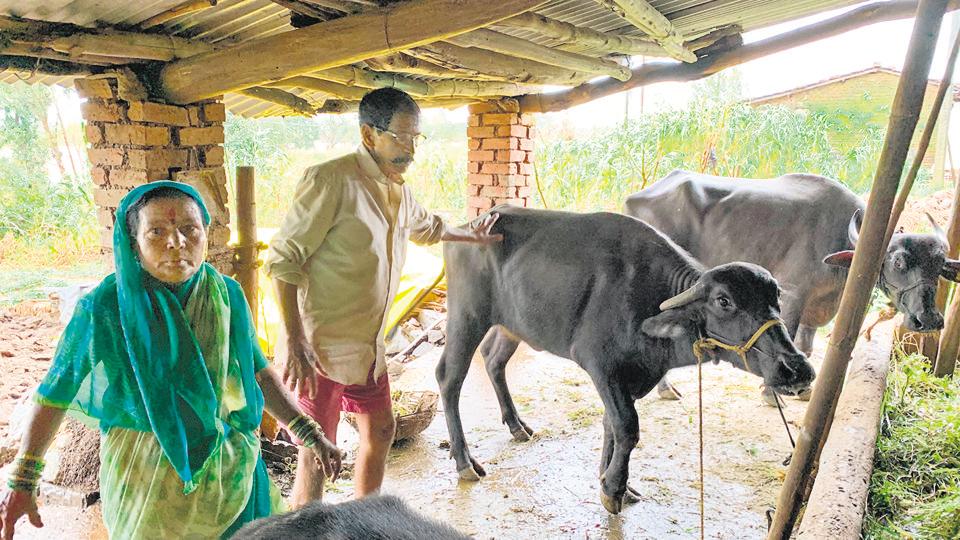
The other source of income for multiple families in the village is cattle and milk. The cattle that survived the floods is now housed in the dilapidated houses near the river banks.
“Disposal of animals of was a major problem. They were buried in fields as per guidelines. We did not burn any animals. We buried in fields so that after decomposition it will help improve the fertility of the soil,” collector Desai said.
“We come here twice a day to feed the cattle as we cannot take them to where we live now. It has started raining again. I’m afraid we might have to move the animals if it continues,” said Sarjerao Krishna Dalvi, 68, who is a resident of Shingnapur and supports a family of five.
The relief is yet to reach victims and a host of rehabilitation roadblocks are ahead of them. However, building the lost livelihood is going to be a bigger challenge, especially for the sugarcane farmers.


