
 E-Paper



AQI severe for third consecutive day, it may get worse, warns scientists
The average air quality index of Delhi was 427 on Saturday, marginally higher than Friday’s 406 but less than Thursday (450).


Delhi’s air quality remained in the severe zone for the third consecutive day on Saturday, with over 4,500 farm fires in Punjab and Haryana contributing to over 32% of ultrafine particulate matter (PM2.5) which could not be dispersed despite slightly better wind speed compared to Friday, scientists said, warning that a relief was unlikely at least till Tuesday.
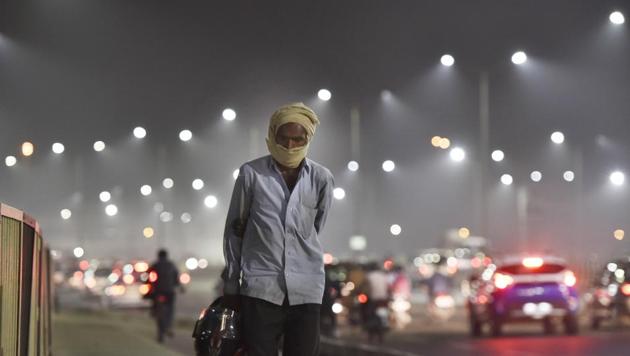
The average air quality index of Delhi was 427 on Saturday, marginally higher than Friday’s 406 but less than Thursday (450).
VK Soni, head of India Meteorological Department (IMD) environment monitoring research centre said that during the day the average wind speed was around 12kmph, which was higher than the wind speed recorded on Friday. Its impact, however, was not seen on the AQI because of the high stubble burning cases in Punjab and Haryana. He said that the north-westerly winds are bringing heavy load of pollutants from these fires to Delhi.
“For the last three days we have been observing that the number of fires spotted over Punjab alone is more than 4,000, and that it tends to increase on Sundays. Even though the wind speed picked up during the day, the improvement in air quality was not very significant only because of higher share of farm fires,” Soni said.
According to the union ministry of earth sciences’ air quality monitoring centre, System of Air Quality and Weather Forecasting and Research (Safar), 4,528 fires were spotted over Punjab and Haryana, on Saturday.
Kuldeep Srivastava, head of IMD’s regional weather forecasting centre, said that in parts of central Delhi the wind speed fluctuated between 6-8kmph, but around outer Delhi the wind speed picked up to 16kmph.
“In the Palam observatory, the wind speed was nearly 16kmph, but if you look at the winds recorded in the Safdarjung observatory, it was only around 6-8kmph. This could be the reason behind the high pollution in the heart of the city. The wind that we are receiving now is from the north-western direction, which is bringing a large share of smoke from Punjab and Haryana,” said Srivastava.
Srivastava said that there is a forecast of the wind direction changing to easterlies from Tuesday, but before that wind speed will reduce drastically, possibly pushing the city’s air quality further into the ‘severe’ zone.
“When the wind direction changes, in the transitional stage the wind speeds reduce drastically and from Sunday evening the wind may become calm. This will only spell more trouble for Delhi,” Srivastava warned.
Saturday was the third consecutive day when the AQI in the national capital crossed the severe mark. CPCB data shows that last year, there were 24 days when the air quality plunged into the ‘severe’ category. In 2018, there were 20 such days and in 2017, there were nine days when the AQI levels remained in the red zone.
Senior CPCB officials said that even though the city’s AQI levels has remained in the ‘severe’ zone for three days now, late Thursday night the PM 2.5 levels (ultrafine particulate matter with diameter less than 2.5 micrometres) had dipped below the 300ug/m3 mark. For the city to slip into the ‘severe plus’ category, PM 2.5 levels have to consistently remain above the 300ug/m3 mark and PM 10 levels (particulate matter with diameter less than 10 micrometers) have to be above the 500ug/m3 mark for 48 hours.
Under such a situation, the CPCB’s taskforce would declare an air emergency and direct all enforcement agencies in Delhi-NCR to bring about measures such as restriction of trucks into the city, stopping construction activities and directing the government to announce the odd-even vehicle rationing scheme under the Graded Response Action Plan (Grap).


Stay updated with all top Cities including, Bengaluru, Delhi, Mumbai and more across India. Stay informed on the latest happenings in World News along with Delhi Election 2025 and Delhi Election Result 2025 Live, New Delhi Election Result Live, Kalkaji Election Result Live at Hindustan Times.


