
 E-Paper



A missionary, a palace, and the Bhagavad Gita
Dasara is almost here in Bengaluru, Karnataka, with the annual Nadahabba. The city's historic connection to Mysuru and the Bengaluru Palace is explored.

 Prefer HTon Google


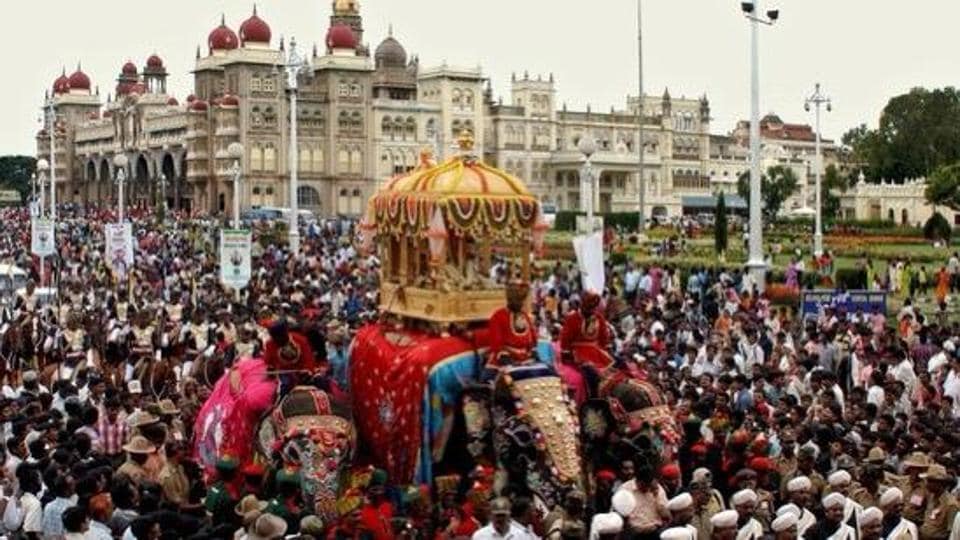
Dasara is almost here, and with it, the familiar frisson of excitement that accompanies the annual coming of the Nadahabba. Once again, old Bengalureans will promise themselves that they will get a ‘gold pass’ next year (always next year) to watch the Jumboo Savaari in Mysuru on Vijayadashami day. Once again, they will explain to the ignorant that in Karnataka, it has always been Dasara, not Dussehra, and no, it is NOT the same thing. Once again, the pomp and pageantry of the erstwhile capital of Karnataka will take centrestage as Yaduveer Wadiyar, the ceremonial Maharaja of Mysuru, holds a private darbar in the Mysore Palace.
It was the much-loved Sir Mark Cubbon, who served as Commissioner of Bangalore from 1834 to 1861, who first moved the capital from Mysuru to Bengaluru, thus creating two separate entities – a royal capital and an administrative capital. This was during the 50-year-period from 1831 to 1881 when Mysore was administered directly by the British. By the time of the Rendition in 1881, when Mysore went back to the Wadiyars and the 18-year-old Chamarajendra X was crowned king, Bangalore had established itself as a city that even the royals could not ignore.
In fact, once Queen Victoria approved Chamarajendra as the next king of Mysore in 1866, his British guardians immediately began to scout for a place in Bangalore that could function as a royal residence when the boy visited, for his lessons with British tutors. In 1873, they zeroed in on a 454-acre parcel of land that belonged to a Rev John Garrett. Construction began the next year, and by 1878, the somewhat incongruous (for these parts), but decidedly magnificent Bangalore Palace, built largely in the Georgian and Victorian style, was ready for occupation. And that was how Chamarajendra and his successors finally came to possess something that would be the envy of anyone, even in the 21st century – their ‘own house’ in Bengaluru.
Which brings us to the question – who was Rev John Garrett? When he sold his land to the Maharaja, Garrett was already an old Bangalorean, having lived here for 33 years. Having arrived in 1840 to serve as a Canarese missionary with the Wesleyan Mission, the former printer had a most important brief to fulfil – he was to set up the first Kannada printing press in Bangalore Pettah / Pete.
Garrett was blessed with such a fine ear for language that he had soon mastered not only Kannada, but also Sanskrit, Tamil and Persian. As early as 1849, he translated and published the very first Kannada version of the Bhagavad Gita, commissioned by Sir Mark Cubbon. It was based on the very first English translation of the text – ‘The Bhagavad Geeta, or Dialogues of Krishna and Arjoon’ (1785) – by the English orientalist and typographer, Charles Wilkins, a founding member of the Asiatic Society.
Perhaps even more than preaching, however, the good Reverend Garrett enjoyed teaching. In 1858, he started an Anglo-Kannada school, simply called the Bangalore High School, in a shed in the Pete, with him as its first Principal. That little school would grow up to become one of the city’s greatest educational institutions, Central College.
(PS: The second Principal of Bangalore High School was 23-year-old Benjamin Lewis (BL) Rice, who would woo and marry Garrett’s daughter, Mary Sophia. BL Rice himself would go on to research and translate thousands of ancient Kannada inscriptions and be hailed as the father of Kannada epigraphy and Mysore’s first archaeologist. Incidentally, BL Rice was the son of Rev Rice, who served a rival mission from Garrett’s, called the London Missionary Society. A proper Capulet-Montague story in the heart of Bengaluru Pete!)


