
 E-Paper



3rd sero survey: 76% population in Haryana has Covid antibodies
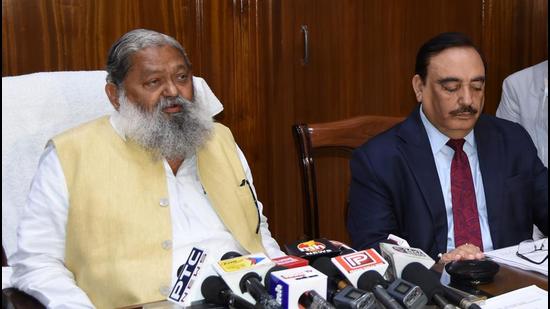
Haryana health minister Anil Vij, who released the report of third round of serological survey on Monday, said the sero positivity was 78.1% in urban areas and 75.1% in rural areas


Haryana’s 76.3% population has developed coronavirus antibodies, state the findings of the third round of serological survey conducted by the state health department in September.
The survey aimed to assess the presence of coronavirus antibodies developed in the population either by natural infection or as the result of Covid vaccination.
The third round’s seroprevalence is significantly higher as compared to the previous rounds of serological survey conducted in 2020.
About 14.8% population in the second round conducted last October and 8% in the first round in August 2020 was found to have developed Covid antibodies.
While the population sampled in the first and second rounds of survey was 18 years and above, the third round also included children aged between six and 17 years and adults aged 18 years and above.
‘Kurukshetra tops in seroprevalence’
Haryana health minister Anil Vij, who released the report of third round of serological survey on Monday, said the sero positivity was 78.1% in urban areas and 75.1% in rural areas.
“Kurukshetra district was found to have the highest sero positivity at 85% and Faridabad at 64.2% has the lowest seropositivity,” the health minister said.
Vij said that since Faridabad had the highest inconclusive samples at 13.2%, the district would be resampled. He added that 75% men and 77% women were found to have developed antibodies.
‘Close to achieving herd immunity’
Additional chief secretary (ACS), health, Rajeev Arora said that their aggressive vaccination programme also supplemented to higher seroprevalence in the community. About 2.48 crore individuals, including 1.75 crore with first dose, have been vaccinated in the state. “Although, the results of this round of sero survey are somewhat near to the level of achieving herd immunity, a large proportion of population is still vulnerable. Therefore, enforcing Covid-appropriate behaviour is still our utmost priority,” Arora said.
Sample size increased
The ACS said for the third round, the sample size was increased to 36,520 as compared to 18,700 samples (seroprevalence: 8%) in the first round and 15,840 samples (seroprevalence:14.8%) in the second round in 2020. He said that 21,912 individuals in 18 years and above category, 10,956 in 10 to 17-year age group and 3,652 individuals in the 6-9 age group were sampled during the third round.
Arora said that since the health minister wanted the third round of sero survey to be more inclusive, it was decided to expand the sample size to include the most-vulnerable population of children above six years. “This was done considering the possibility of third wave affecting the kids,” he said. It was decided that the efficacy of vaccination should also be determined by detection of anti-spike coronavirus antibodies.
69.8% kids aged between 6 and 9 years have antibodies
As per the third round, the sero-positivity rate in kids aged between six and nine years was 69.8%. It was 73.2% in adolescents (10-17 years) and ranged between 76.7% and 79.5% in individuals aged 18 years and above.
Health officials said that stratified simple random sampling technique was used in this study to maintain uniformity and comparability with the national-level sero survey. The health department selected 60% samples from rural areas and 40% samples from urban areas.
Nodal officer for Covid Dr Dhruva Chaudhary of Rohtak PGIMS said that serological surveys gave an accurate estimate of the population exposed to Covid infection, including asymptomatic individuals. “The sero-survey findings enable better understanding of population protection against epidemic peaks which is not possible in hospital-based surveillance,” he added.


