
 E-Paper



5 Bills cleared; Haryana assembly passes Bill to plug loopholes in urban area law
The statement of objects and reasons of the Bill said that loophole was noticed after property or land registration authorities found that exchange deeds were increasingly being used to bypass restrictions on sale of small land parcels in notified urban areas.

 Prefer HTon Google


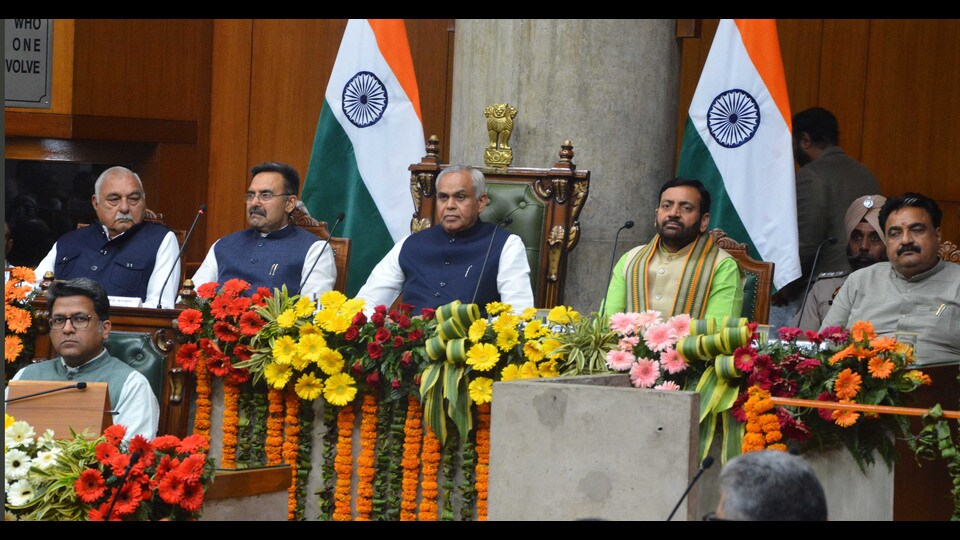
The Haryana assembly on Wednesday passed five Bills, including the Haryana Development and Regulation of Urban Areas amendment Bill, 2026, to plug a loophole in the Act of 1975. The statement of objects and reasons of the Bill said that loophole was noticed after property or land registration authorities found that exchange deeds were increasingly being used to bypass restrictions on sale of small land parcels in notified urban areas.
Section 7-A of the Act mandated that no document involving sale, lease or gift of vacant land measuring less than one acre in a notified urban area can be registered without obtaining a no objection certificate (NoC) from the director, Town and Country Planning. The purpose of ascertaining such NoC under section 7-A by the registration authorities was to prevent unauthorised colonisation in violation of section 7(i) and (ii) of the Act in the urban areas.
However, authorities found that parties were resorting to exchange deeds, often swapping small plots for larger or more valuable parcels as a means to indirectly execute sale transactions while avoiding the NoC requirement. These transactions, though formally structured as exchanges, defeated the intent of section 7-A and came to light only at the stage of mutation. Thus, the government proposed to amend Section 7-A to bring exchange deeds within its ambit.
The House also passed the Haryana Appropriation (No 2) Bill, 2026, for authorising the state government to spend money from the consolidated fund of the state. The enactment makes budget estimates presented in the House operational.
The Bill was introduced in pursuance of Article 204 (l) of the Constitution to provide for the appropriation out of the consolidated fund of the state of Haryana of all money required to meet the grants made by the legislative assembly and expenditure charged on the consolidated fund for 2026-27 financial year.
The assembly passed the Haryana Fiscal Responsibility and Budget Management (Amendment) Bill, 2026, to fix ceiling for providing state government guarantee as recommended by the working group of RBI and guidelines.
The Bill said the state government shall cap incremental guarantees on term loan to be given during a year at 5% of revenue receipts of the previous year or 0.5% of Gross State Domestic Product (GSDP) of the previous year, whichever is lower. As a measure to enforce compliance an amendment was made to ensure whenever incremental guarantees exceed these limits, no fresh guarantee will be given except for the purpose of replacing high cost debt with low cost debt in such a way that there is no net increase in outstanding guarantees after such debt swap.
The House passed the Haryana Police (amendment) Bill, 2026, to disallow the state and district police complaints authorities from enquiring any matter where a police report or charge-sheet has been filed by the law enforcement agency under section 193 of the Bhartiya Nagarik Suraksha Sanhita, 2023, in an appropriate court. The amendment also bars any enquiry into matters pending or already dealt with by the National Human Rights Commission, State Human Rights Commission, National Commission for Scheduled Castes, State Commission for Scheduled Castes, National Commission for Women, State Commission for Women, National Commission for Minorities, State Commission for Minorities or state Lokayukta. Also, any matter falling within jurisdiction after more than five years of its alleged occurrence and any matter arising out of use of force by the police authorities in dealing with any unlawful assembly, protest, dharna, blockage of any public passage or disruption of essential services will not be enquired by the police complaint authorities. The amendment Bill also fixed a period of six months for the State Police Complaints Authority to decide the complaint from the date of its receipt.
The assembly passed the Haryana Consolidation of Project Land (Special Provisions) amendment Bill, 2026. As per the statement of objects and reasons, the Haryana Consolidation of Project Land (Special Provisions) Act, 2017 was enacted to make special provisions for consolidating left-out pockets of land for the purpose of setting up projects. The law was subsequently amended through the Haryana Consolidation of Project Land (Special Provisions) Amendment Act, 2020.
However, disputes arose regarding the compensation payable under Section 7 of the Act, leading to the filing of several Civil Writ Petitions before the Punjab and Haryana high court. In particular, in CWP number 15676 of 2019 titled Mool Chand & others versus State of Haryana and other connected matters, the HC in its September 26, 2024 order declared section 7 of the Act ultra vires to the extent it related to the determination of compensation.
The HC directed that compensation, along with interest, solatium, and rehabilitation and resettlement benefits, must be determined in accordance with the provisions of Sections 26 to 32 of the Right to Fair Compensation and Transparency in Land Acquisition, Rehabilitation and Resettlement Act, 2013.
In view of the aforesaid judicial pronouncement, it has become necessary to amend Section 7 of the principal Act. Accordingly, the amendment Bill, 2026, seeks to substitute the existing provisions relating to compensation by replacing them with the concept of exchange of land, so as to align the law with the HC directions and to provide a legally sustainable framework.


