
 E-Paper



A bird or its dead body?
When Dr Rajiv Narwal, an anaesthetist at the Panchkula civil hospital came across a nightjar perched on his residence’s garden rockery in Sector 4 MDC, the find was certainly a rarity.


Birders may search the jungles in vain but can miss the charismatic species of the night, the large-tailed nightjar. So, when Dr Rajiv Narwal, an anaesthesiologist at the Panchkula civil hospital came across a nightjar perched on his residence’s garden rockery in Sector 4 MDC, the find was certainly a rarity. But did it constitute the first instance of a nightjar inhabiting a lawn in the tricity?

That may not be true because specimens of this cryptically-coloured bird, which roosts perfectly still during the day, may have managed to evade sighting in other gardens, as they are known to stealthily take up residence in lawns and urban green areas. Or, a specimen may have been spotted by a tricity householder, but the fellow either cared two hoots for birds or did not know what to make of the seemingly-strange avian. So, its presence at the epicentre of a tricity urban area may have gone largely unreported till now.
Fortunately, Narwal had taken to nature photography a couple of years ago. On being alerted by his wife that an unusual bird was sitting in their rockery on Tuesday morning, he rushed out and initially mistook the bird for dead, for it was so still. Perhaps, some eagle had killed it and dumped it in the rockery, he thought. But on closer approach, the nightjar opened its eyes and flew in low circles, banging into the compound wall before making its way out of the garden. The nightjar did not return, but left Narwal with splendid photographs. The good doctor had gifted ornithologists with an emphatic record of the species’ surreptitious presence in the tricity’s heart.
What could be the reason for the nightjar’s presence in an urban garden? “The Panchkula urban sprawl is a part of the nightjar’s range as it is known to inhabit the adjacent Ghaghar riverbed and the Shivalik foothills. The nightjar breeds from March to May. It is likely that this specimen was hawking insects at night in the vicinity and came to rest in the rockery. The nightjar seems a female and had very consciously selected the rockery to roost. There is a possibility that the female wanted to lay eggs within the rocks, as these match with the colour of nightjar eggs. The other possibility is that it was resting during transit to breeding grounds. These nightjars winter in the plains of much lower altitudes and migrate to the foothills and further north for breeding during spring,” Mohali-based birder Prof Gurpartap Singh told this writer.
Meanwhile, as the moon deepened this week, one crescent upon another, it briefly peeped through a window in the branches of a mango tree outside our house in Sector 19, Chandigarh. The moonbeams spread like a fragrant veil across the eyes. The scent of mango blossoms, as if sailing on the moonbeams like crescent-shaped boats, annexed the nostrils. The blossoms were an augury of summer and an impending golden harvest — a Baisakhi up in the trees — of mangoes.
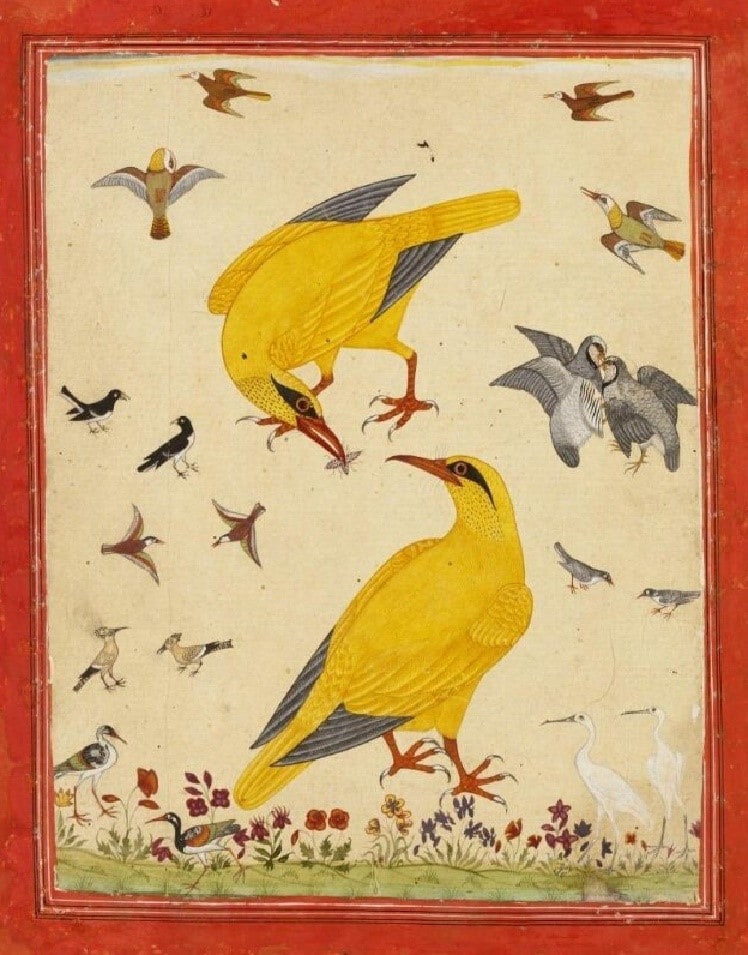
The hot weather will bring to our jungles exquisite birds, Mr and Mrs Mango Delight, or Indian golden orioles, which breed in the foothills. Among the symphony of bird songs emitted from greenery and floating on “garm hawa”, a clear, fluty whistle will go: “peelolo...peelolo”. It is the male oriole, whose Mozartean magic flute casts a Krishna spell. The blessed musician remains secretive in the high canopy… his gold for her bold eyes only.
To extend further the thought dots — across moon and human eye, bird and tree, time and space — let us turn to an artistic depiction of male orioles. The males’ eyes seem embellished with winged eyeliners of kohl (delicate black feathers actually) from a watercolour of the Mughal period, 1750 CE, attributed to an unknown artist from Murshidabad, Bengal. That artist, centuries ago, must have been deeply moved by the resplendent bird, as anyone would across time and cultures. The exquisite native art connects to a distant dot across the horizon of the seas. It lies glittering, in the possession of a foreign museum.


