
 E-Paper



AAP seeks to gain foothold in Himachal with 2022 elections
The Aam Aadmi Party opened its office in Shimla on Sunday and announced it would contest all 68 seats


With two years left for the Himachal Pradesh assembly elections, Aam Aadmi Party (AAP) is trying to gain a foothold in the hill state that is known for its bipolar politics.
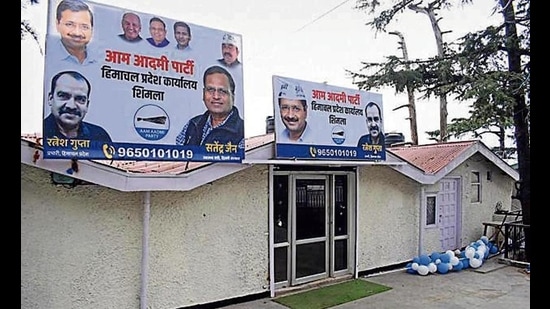
The AAP opened an office in the state capital Shimla on Sunday and announced its intention to contest from all 68 assembly constituencies in the 2022 polls. Spokesperson SS Zogta said AAP will also field its candidates in the upcoming municipal corporation (MC) elections in Dharamshala, Mandi, Solan, Palampur and Shimla .
“Time is ripe for AAP to enter the fray as the people of Himachal are fed up with both the parties: Congress and BJP. Electricity generated in Himachal is being sold to other states while we have to pay exorbitant bills. The BJP has failed to live up to people’s expectations. Meanwhile, the Congress in is facing a leadership crisis and is in doldrums,” said Zogta.
AAP has never contested assembly elections in the state before though it did try its luck in the 2014 Lok Sabha polls. Former BJP MP Rajan Sushant, who has now formed Hamari Party Himachal Party, had been the party’s convener in the state. However, all four candidates pitched by AAP, including Sushant and Kamal Kanta Batra, the mother of Kargil hero and Param Vir Chakra awardee Vikram Batra, lost the election. While Sushant polled around 20,000 votes, others had to forfeit their deposits.
Voters traditionally alternate between BJP, Cong
The two-party system has been ingrained in Himachal politics for so long that there has been almost no scope for a third alternative. Voters in the hill state have traditionally alternated between Congress and Bharatiya Janata Party, formerly known as Bharatiya Jan Sangh, for the last five decades.
Any third option emerging in the state’s political scene only served the purpose of demurring. Previously, attempts have been made to launch a third front but the parties, whether national or regional, failed.
“The largest community homogeneity and Congress and BJP’s penetration at grassroots level perpetuates bipolarity in Himachal’s politics. The rule of two clans has also re-enforced the bi-party system,” says Harisha Thakur, heads of the political science department at Himachal Pradesh University .
Regional parties in Himachal have not succeeded
Lok Raj Party (LRP), headed by former speaker Thakur Sen Negi, was the first regional party formed in the state in 1967. JBL Khachi was another tall leader of the LRP.
In the 1972 assembly election, LRP had pitched candidates in 16 constituencies. They won two seats, only to be disbanded by the time of the next elections. No third party succeeded for the next two decades as power changed hands between the Congress and BJP.
Come 1990, the Janata Dal (JD), made a mark on the political landscape. Vijai Singh Mankotia, who had left the Congress, led JD to a big victory, winning 11 seats in a pre-poll alliance with BJP, which got an absolute majority with 46 seats. Former chief minister Thakur Ram Lal’s outfit Jan Him Kranti Morcha had merged with the Janata Dal . However, the coalition government was dismissed in the aftermath of the Babri Masjid demolition in 1992. By the 1993 assembly elections, Mankotia was back with the Congress and JD had faded into oblivion.
Congress veteran Pandit Sukh Ram also tried to give HP residents a third alternative. After parting ways with the Congress, he founded the Himachal Vikas Congress (HVC) in 1997. HVC won five seats in 1998 and formed a post-poll alliance with the BJP. It helped the saffron party, which was one seat short of majority, to form a government. Mayawati’s Bahujan Samaj Party (BSP) made a foray into Himachal’s political landscape in 2008 but could only secure one seat. Its lone legislator Sanjay Chaudhary later joined the BJP.
The BJP witnessed a split in 2012. Maheshwar Singh, former president of the saffron party, with other disgruntled leaders formed Himachal Lokhit Party (HLP) before the 2012 elections but won only one seat. The party merged with the BJP before the 2017 assembly polls.


