
 E-Paper



Bathinda Fort: Life, glory to return to historic Rani Mahal before monsoon
Popularly known as Quila Mubarak, considered as the oldest surviving fort in the country, it is believed to be the place where Razia Sultana, the only woman emperor to rule Delhi, was imprisoned by Malik Altunia, the then governor and her husband


The maiden restoration work of the historic Rani Mahal, a principal area of the 1,500-year-old Bathinda or Govindgarh Fort, is expected to be completed before the onset of monsoon in July.
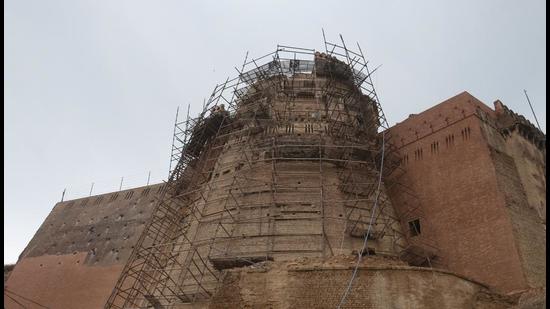
Popularly known as Quila Mubarak, considered as the oldest surviving fort in the country, it is believed to be the place where Razia Sultana, the only woman emperor to rule Delhi, was imprisoned by Malik Altunia, the then governor and her husband.
Archaeological Survey of India’s (ASI’s) conservation assistant at the fort Tarak Singh said on Sunday that ₹17 lakh has been spent to conserve Rani Mahal, located above the only entrance gate, in the last one-and-half-years.
“It is believed that Razia (who ruled Delhi from 1236 to 1240) had escaped from the same Rani Mahal. The roof of the Mahal, with its beautiful murals, collapsed after the rain a few years ago and outer walls have been eroding extensively during every monsoon. Work had to be suspended during the lockdown, but now restoration has been expedited,” said Singh.
The fort is located in the heart of the city and according to popular belief, a river used to flow in the modern-day Bathinda city that is now a semi-arid region. The fort was considered essentially a military outpost used by rulers at different times of history.
The ASI-protected heritage site was built by Raja Dab in the sixth century AD as a defence measure against the invading Hunas. The fort was visited by the 10th Sikh master Guru Gobind Singh in 1705. To mark this event, two gurdwaras were built inside the fort, including one built by Karam Singh, the erstwhile ruler of Patiala.
“It would not have possible to construct a massive structure without a huge water source in the vicinity of Bathinda. The monument is made of mud bricks and with rain, the exposed parts erode, thus posing threat to the monument,” said Singh, in-charge of the heritage building.
“Since the fort was located very strategically, rulers used and conserved the fort for their armies. However, alteration in the basic design of this mud fort was not possible and it has made the structure vulnerable to deteriorate with the passage of time,” he added.
There are 32 bastions and seven of them have crashed in the absence of restoration activities.
“A comprehensive conservation plan has been made and it will be executed in a phased manner. Availability of expert masons for conservation is a huge challenge in such projects but we are working to complete to protect the heritage,” said the ASI official.


