
 E-Paper



Canadian police probing Ripudaman Malik’s ‘targeted’ killing
Malik, 75, who was acquitted in the 1985 Air India Kanishka bombing, was shot dead outside his Surrey office in British Columbia province of Canada on Thursday morning


Homicide investigators in Canada are trying to figure out who killed the controversial Sikh community leader Ripudaman Singh Malik, a one-time terror suspect, wealthy businessman and founder of Khalsa Credit Union and Khalsa Schools.
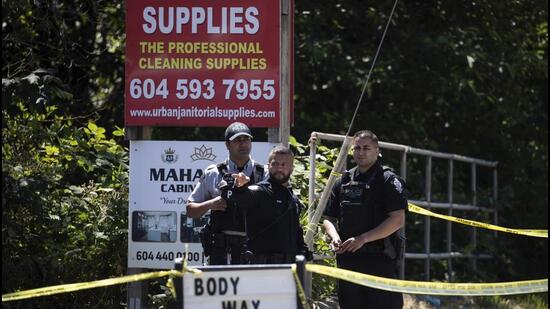
Malik, 75, who was acquitted in the 1985 Air India Kanishka bombing by the Canadian judiciary in 2005, was shot dead by a group of three unidentified assailants outside his Surrey office in the Metro Vancouver region of the British Columbia province on Thursday morning.
A spokesperson for the Surrey detachment of the Royal Canadian Mounted Police (RCMP) confirmed to the Hindustan Times on Friday that the killing “did appear to be targeted”.
Malik’s death comes weeks after he travelled to India in May-June this year, after having benefited from New Delhi’s whittling down of a blacklist related to pro-Khalistan figures in Canada and elsewhere. He also visited India in 2019.
In January this year, he wrote a letter praising Prime Minister Narendra Modi for reopening 1984 anti-Sikh riots cases, opening of Kartarpur Corridor, grant of FCRA licence for the Golden Temple among other initiatives, and also released an open letter to the community to renounce the demand for Khalistan.
The daylight attack has led to speculation it may have been connected to his past and, significantly, to his altered view in recent years. The outlet Vancouver Sun quoted Kash Heed, a retired British Columbia police officer and later solicitor general of the province, as saying, “My belief is that it (killing) is related to his (Malik’s) political advocacy.”
A senior Indian official felt that it could be connected to his return to India and concern that he may speak out about the Kanishka tragedy that had claimed 329 lives. The official also expressed apprehensions over the style of killing, potentially pointing towards a link between pro-Khalistan elements and organised crime, much of what is run by Indo-Canadian gangsters.
Malik’s change of heart had attracted the attention of separatist groups. In December 2019, Gurpatwant Pannun, legal adviser to the banned US-based Sikhs for Justice (SFJ), said in a release, “Instead of the stick, Prime Minister Modi and his agents are offering Sikh foreign nationals the carrot to once again visit family in India.” However, there is no reason to connect the killing to the SFJ, as the killers are yet to be identified and the organisation has repeatedly stressed that it abjures violence in pursuit of Khalistan.
“I just think there are so many potential motives,” retired RCMP deputy commissioner Gary Bass was quoted as saying by the Toronto Sun newspaper. Bass, who was in charge of the terrorism investigation into the 1985 Air India bombing, said, “I’m not privy to the ongoing investigations on Malik right now, but I can say that from years when I was that he was involved in a number of activities that might bring him into conflict with other people.”
Malik had also courted recent controversy for his links to printing the Sikh holy book outside of India in contravention of a religious edict. But several sources also said Malik has had a number of personal disputes with individuals over the years, the report said.
The probe has been handed over to the Integrated Homicide Investigation Team or IHIT, and in a release, a spokesperson said they “are aware of Mr Malik’s background, though at this time we are still working to determine the motive”.
He just worked for Sikh diaspora: Son
Malik had come to Canada in 1972 and was a successful businessman and also involved in charitable organisations. His killing came just three weeks after the 37th anniversary of the Kanishka bombing, the worst terror incident in Canadian history.
In a social media post, his son Jaspreet Singh Malik said: “My father’s goal was to see immigrant Sikh community thrive through education and financial security... The media will always refer to him (Malik) as someone charged with the Air India bombing. He was wrongly charged and the court concluded there was no evidence against him. The media and RCMP never seemed to accept the court’s decision and I pray today’s tragedy is not related.”
In March 2005, Malik and his alleged Babbar Khalsa associate Ajaib Singh Bagri, were acquitted by a British Columbia Supreme Court judge of murder and conspiracy charges in Kanishka bombing. Air India — then the country’s national airline — was bombed to retaliate against the Indian government for its attack on Amritsar’s Golden Temple a year earlier.
Malik and Bagri were alleged to be part of a conspiracy of a small group of British Columbia militants who placed suitcase bombs on two connecting flights leaving Vancouver airport. The deadly bags were tagged for Air India flights heading in opposite directions. One blew up aboard Air India Flight 182, a Boeing 747 wide-bodied jumbo jet christened Emperor Kanishka, off the coast of Ireland on June 23, 1985, killing all 329 people aboard, most of them Canadian citizens.
The other exploded in Tokyo’s Narita Airport as it was being transferred. Two baggage handlers were killed. Only one person, Inderjit Singh Reyat, served time in relation to both incidents, being convicted of manslaughter, and was released in 2017.
After Malik’s acquittal, he resumed his leadership roles at the Khalsa Credit Union and Satnam Education Society which operates several Khalsa schools. And he moved from Vancouver to South Surrey. He continued to run a number of businesses including Papillon Eastern Imports — the clothing company based in the building where Malik was killed Thursday.
What Kanishka co-pilot’s widow says
Reacting to the killing, Amarjit Kaur, widow of the Air India Flight 182’s co-pilot Captain Satwinder Singh Bhinder, said: “It has been 37 years since the Kanishka bombing, and since then Ripudaman Singh Malik was living a good and wealthy life. Since he was acquitted, I do not blame him entirely for the incident, but people say that he was part of the conspiracy.”
The 73-year-old Chandigarh resident said that though her family was sad about his acquittal in 2005, “I am not celebrating his death”. “His death will not lessen my pain of losing a husband or will never lessen the pain of my children who lost their father at a very young age of 7 and 10.”
Meanwhile, Delhi Sikh Gurdwara Management Committee (DSGMC) on Friday called the “assassination” a “highly shameful” incident. “It’s a very painful and unfortunate news. Malik always talked of serving the humanity and for many years he was helping immigrants in Canada,” DSGMC president Harmeet Singh Kalka said, adding that his death was a “big loss for the Sikh community”.
(with HTC and agency inputs)


