
 E-Paper



Chandigarh: Health problems common in every house in vicinity of Dadumajra landfill
In almost every house located in the vicinity of the Dadumajra landfill in Chandigarh, people are suffering from health hazards including allergies, asthma, skin ailments, tuberculosis (TB), cancer, paralysis and other chronic diseases

 Prefer HTon Google


For the past 12 years, 42-year-old Vinod Kumar, a resident of Dadumajra Colony, has been suffering from skin allergy and fungal infection. With even medical treatment not helping his condition, medical experts have recommended that he shift his residence from next to the City Beautiful’s biggest garbage dumping ground.
“The skin fungal infection is so severe that doctors have asked me to leave this area. Flies and mosquitoes are rampant here, a major cause behind my skin problem. Due to my condition, I am even unable to wear warm clothes in winter. Worse, even my teenage sons are facing the same ailment,” said Kumar, a government employee.
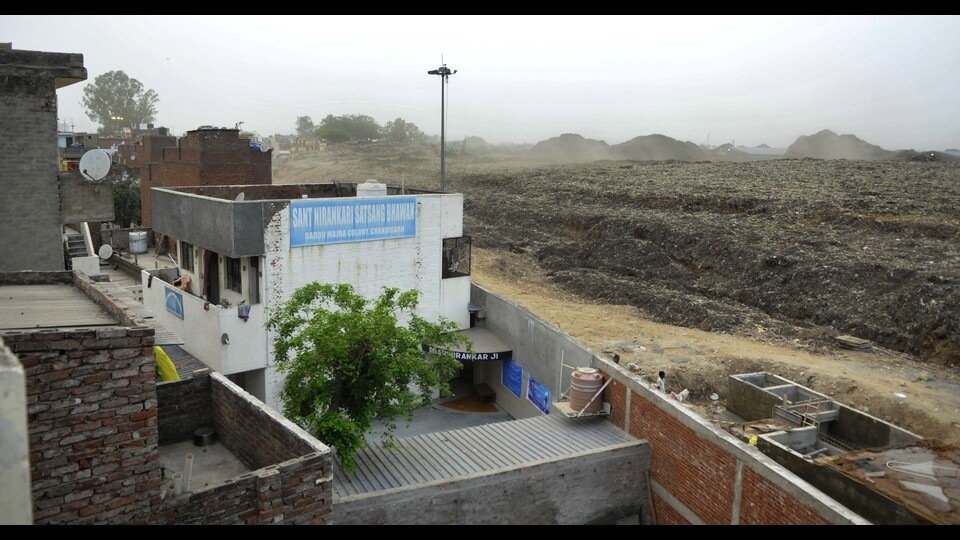
Kumar and his sons are not the only ones suffering in the colony. In almost every house located in the vicinity of the Dadumajra landfill, people are suffering from various health issues, including allergies, asthma, skin ailments, tuberculosis (TB), cancer, paralysis and other chronic diseases. Five cancer patients have died in Dadumajra Colony in past two years.
Spread across 45.11 acres, the landfill is located right in the middle of the residential area, exposing people of Dadumajra, Sector 38 (West), Sector 25 and Dhanas Colony, to various health hazards and foul smell.
Last week, it took more than two days to put out a fire at the dumping ground that left many people complaining of breathing problems. The dumping ground witnessed, on an average, 30 fires every year between 2005 and 2021. As per information accessed under the Right to Information (RTI) Act, 486 minor and major fires were reported at the site since 2005.
Mohinder Singh, 68, has been living in Dadumajra Colony since 1980 and has been suffering from asthma for the last 25 years.
“We always keep asthalin pumps, oxygen concentrators and nebulisers at home. I can’t talk much and face difficulty in breathing. During fires at the dumping site, I feel choked and have to use a nebuliser,” he said. Even Deepanshu, 19, always has medicines in his bags as the air pollution causes irritation in his eyes.
“My skin issues started with a small boil and now, these have spread all over my body. I can’t help but scratch my skin to soothe it, but it leads to bleeding,” said 63-year-old Chanderpal, another colony resident.
‘No health facility for people’
Dadumajra councillor Kuldeep Dhalor said, “Last year, my father died after getting a sudden asthma attack and this is not just the story of one family. Even though people complain regularly, there is only one government dispensary in the ward. There is also just one dermatologist and a limited number of general physicians. People are forced to rush to GMSH-16 or PGIMER even for small ailments. We request authorities to relocate the dump so that people can live here safely because the garbage treatment plant is of no use.”
Dr JS Thakur from the Post Graduate Institute of Medical Education and Research (PGIMER)’s department of community medicine and school of public health said, “The dumping ground is leading to major air and water pollution in the area, due to which people are suffering from chronic diseases. Even the young population is affected. There should be a proper waste management plan in the city and garbage should be processed using advanced technology.”


