
 E-Paper



Chandigarh traffic police collected ₹22.69 crore from violators this year
A total of 9.68 lakh challans were issued this year out of which, 1,40,286 were generated by on-the-spot enforcement devices while the majority—8,28,672 challans—were issued using ITMS (Integrated Traffic Management System) cameras.


The Chandigarh traffic police collected a whopping ₹22.69 crore in fines from traffic violators this year till December 24.
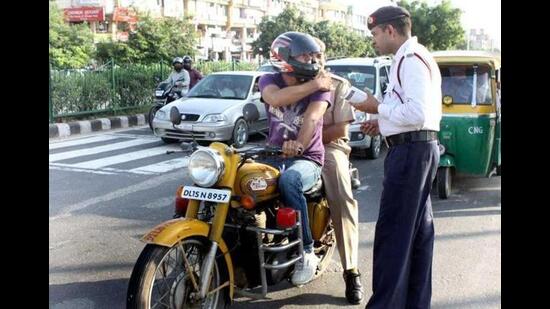
The figure was almost half, at ₹10.35 crore, last year.
A total of 9.68 lakh challans were issued this year out of which, 1,40,286 were generated by on-the-spot enforcement devices while the majority—8,28,672 challans—were issued using ITMS (Integrated Traffic Management System) cameras.
Senior superintendent of police (SSP) Sumer Pratap Singh, said, “A significant number of challans are now being issued through CCTV cameras, which highlights the increasing role of technology in our traffic enforcement efforts. Violators have an option to pay challans online through links directly sent to them on their system. This shift allows us to monitor violations more efficiently and ensures that offenders are held accountable.”
Under the Integrated Command and Control Centre (ICCC), more than 2,000 CCTV cameras have been installed in the city at 47 odd traffic junctions to keep a check on traffic violators. A dedicated fibre network (250km) has been laid with CCTVs being installed at 267 locations.
Deputy superintendent of police (DSP) Ram Gopal, who is also heading the PCCC, said, “Our teams at PCCC monitor traffic violations round-the-clock in three shifts: morning, afternoon, and night. Each shift is staffed by 30 to 32 operators who are dedicated to tracking and addressing traffic violations.”
Rudesh Kumar, project manager at ICCC, explained, “Under this project, there are 2,100 CCTV cameras installed across Chandigarh. What sets this system apart from other cities is that it is AI-driven. This means that the cameras are capable of automatically detecting and recording traffic violations, even when an operator is not actively monitoring the system. The system is programmed to recognise specific traffic offences as defined in the system’s database. Once a violation is detected in the camera, it automatically captures it. The operator later reviews the footage, confirms the violation, and then issues the challan. In contrast, in other cities, the operator manually observes the footage in real time and issues a challan based on their assessment.”
Red-light jumping most frequent offence
An analysis of the data reveals red light jumping as the most frequent offence, accounting for 4,89,382 challans, nearly 50% of the total violations. Speeding followed with 1,45,307 challans. Violations of helmet rules were also a significant concern, with 84,616 challans issued to riders without helmets.
“The highest number of challans are issued for red-light jumping, as 40 major junctions in the city are equipped with cameras that detect this violation. As a result, violators who jump red lights are captured more frequently. In contrast, there are currently 10 cameras monitoring for speeding violations. However, there are plans to expand the network by adding more cameras in the future,” added Kumar.


