
 E-Paper



Chandigarh tricity area’s weekly Covid tally sees dip but experts advise caution
At the peak of the second wave in May, the tricity had recorded 46,245 cases and 790 deaths in just one month. With restrictions on public movement being put in place, the curve started flattening thereon. The weekly cases have been fluctuating ever since, but had never crossed the 100-mark, until the week ending November 28

 Prefer HTon Google


Tricity’s cumulative Covid-19 cases saw a 15% dip last week (November 29-December 5) as compared to the week before (November 22-November 28) though health experts say the figures are significantly higher than what was recorded in October and early November, indicating that people are showing complacency with regards to virus safety protocols.
Of the 93 new cases between November 29 and December 5, 40 infections surfaced in Chandigarh while 39 were in Mohali and 14 in Panchkula. The tricity’s single-day infection tally remained in double digits on five days in the week. Mohali even logged a Covid death during this week.
At the peak of the second wave in May, the tricity had recorded 46,245 cases and 790 deaths in just one month. With restrictions on public movement being put in place, the curve started flattening thereon. The weekly cases have been fluctuating ever since, but had never crossed the 100-mark, until the week ending November 28.
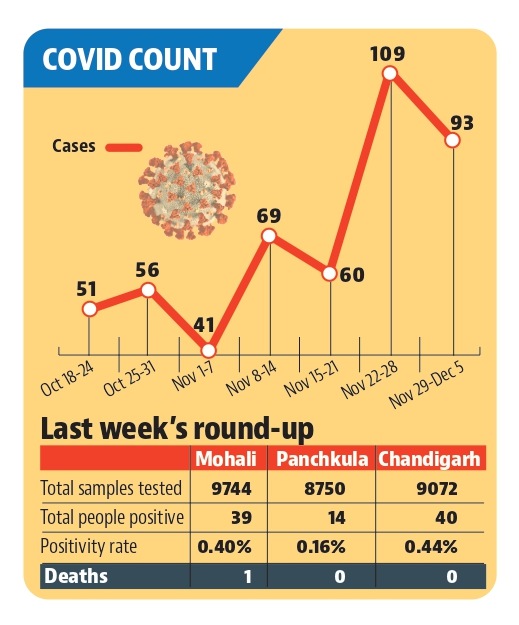
Though the infection tally started showing an upward trend after mid-November, the positivity rate in all three jurisdictions continues to remain below 1%. In the week ending on December 5, Chandigarh had tested as many as 9,072 people for Covid-19, of which only 40 turned out to be infected, keeping the weekly positivity rate at 0.44%. In Mohali, 9,744 people were tested and 39 were found infected. The weekly positivity rate in Mohali stands at 0.40%.
At 0.16%, the positivity rate in Panchkula was even lower with only 14 people testing positive out of the 8,750 tested.
Mohali district immunisation officer Dr Girish Dogra said people from all age-groups are testing positive in Mohali and most of them are fully vaccinated. “The maximum cases are coming from Dera Bassi and Kharar. We have increased sampling,” he said. Dr Suman Singh, director health services, Chandigarh, said, “In UT, there are no clusters or hotspots of infection. Only family members of infected persons are testing positive. The infected people include children, youth, working class, elderly.”
“Since 100% of the eligible population in Chandigarh have got the first dose of vaccine and 78% are fully vaccinated against Covid-19, all infected people are either fully vaccinated or have got one dose. The vaccination is definitely helping in controlling the severity of the infection and fatality rate as only one in 40 patients requires hospitalisation these days,” said Dr Suman, adding that complacency among people, especially in times of a new variant, can invite another surge.
Senior officers from Panchkula said, “We are increasing the daily testing and requesting people to get vaccinated at the earliest. People must follow Covid guidelines to stay safe and help us control transmission.”
Meanwhile, 20 new cases of Covid-19 were reported in the tricity in the last 24 hours, of which 12 came from Chandigarh and eight from Mohali. Panchkula didn’t report any new case. The last time Chandigarh recorded 12 cases was on July 2, after which the single-day count remained in single digits. Also, no new fatality was reported in the tricity on Monday.
The genome sequencing report of the South African returnee, who tested positive for Covid-19 in Chandigarh on November 29, is likely to be out in a day or two. The genome sequencing reports will confirm if the man is positive for the Omicron variant of Covid-19.
The man, along with his wife and maid who had also tested positive later, are isolated at Government Medical College and Hospital, Sector 32, and their health conditio


