
 E-Paper



Delayed winter sees dip in avian guests’ count at Harike wetland
Harike wetland, located at the confluence of the Sutlej and Beas rivers, is the largest bird sanctuary in Northern India. Spread over an area of about 86 square km, it spans three districts: Ferozepur, Kapurthala, and Tarn Taran.

 Prefer HTon Google


The delayed start of the winter season in the region has resulted in a decline in the number of migratory birds arriving at Harike wetland compared to 2023.
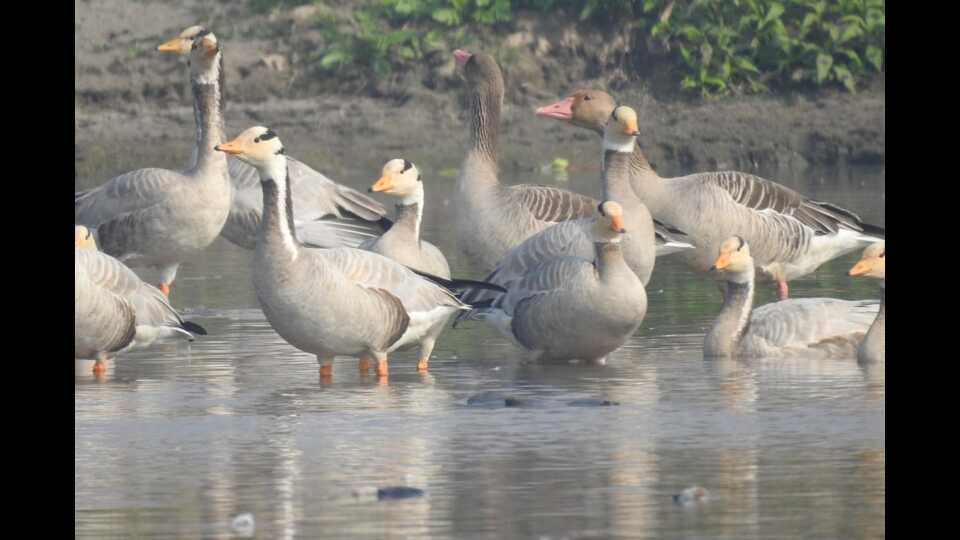
“The birds’ count is lower so far this year due to the delayed winter,” said an official of the wildlife wing of the forest department.
“Around 40,000 foreign birds from 70 species have arrived at Harike, also known as Hari-ke-Pattan, the country’s second-largest wetland. With a further drop in temperature, their numbers are expected to rise in the coming days, as approximately 15,000 migratory birds have reached the wetland in the past three days following the colder weather,” said Lakhwinder Singh, divisional forest officer (wildlife), Ferozepur.
When food becomes scarce for birds when snow freezes in the mountainous regions of European countries, Central Asia, Russia, Mongolia, Siberia, and China. Consequently, thousands of these birds migrate to Harike wetland, which has witnessed varying counts of migratory birds.
In 2013, 72,488 birds from 75 species were recorded, while 2014 saw 62,065 birds from 78 species. The numbers grew to 82,100 birds from 81 species in 2015 and peaked at 1,05,890 birds from 83 species in 2016. The trend continued with 93,488 birds from 83 species in 2017, 94,177 birds from 82 species in 2018, and 1,23,128 birds from 87 species in 2019. However, the numbers fluctuated in recent years: 91,025 birds from 82 species in 2020, 74,869 birds from 40 species in 2021, 96,000 birds from 245 species in 2022, and 84,000 birds from 40 species in 2023.
“Till now, we have spotted various species of migratory birds, including tufted ducks, knob-billed ducks, common pochards, red-crested pochards, northern shovelers, northern pintails, gadwalls, bar-headed geese, greylag geese, gulls, Eurasian spoonbills, green-winged teals, greater flamingos, river terns, whiskered terns, little/great cormorants, glossy ibises, black-headed ibises, red-naped ibises, common kingfishers, crested kingfishers, white-throated kingfishers, pond herons, black-capped night herons, purple herons, grey herons, buntings, common rosefinches, marsh harriers, greater spotted eagles, Bonelli’s eagles, short-toed snake eagles, Indian eagle owls, scops owls, barn owls, and short-eared owls,” said Kamaljit Singh, range officer, Harike wetland.
“Even though the arrival of migratory birds has been lower so far this year, the number of birds entering Harike wetland is likely to exceed last year’s count as the winter is expected to be more intense,” Kamaljit added.
“Binoculars are being provided to tourists for birdwatching, and pendulum boats are available for enjoying the Harike Lake. These efforts aim to increase the number of visitors,” said Kamaljit.
“In the last week of January, we will commence the bird census here,” added the range officer.
Harike wetland, located at the confluence of the Sutlej and Beas rivers, is the largest bird sanctuary in Northern India. Spread over an area of about 86 square km, it spans three districts: Ferozepur, Kapurthala, and Tarn Taran. The wetland and the lake were formed in 1953 by constructing the headworks at the confluence of the Beas and Sutlej rivers. Since then, the 86 square km wetland has become home to rare species of birds.
Caption: Migratory birds arrived at Harike wetland in Ferozepur.


