
 E-Paper



Four months on, Punjab’s AAP government is in trouble
The Bhagwant Mann government scores on anti-corruption front but falters on ensuring law and order and struggles to contain flow of drugs and organised crime, while it battles impression of being controlled by Delhi leaders


Chandigarh: Four months since leading the Aam Aadmi Party (AAP) to a decisive victory in Punjab, the Bhagwant Mann-led government’s anti-corruption campaign has been its biggest strength, while it puts up a sustained fight against gangsters and drugs, but its record on law and order in the border state, its flip-flops on policy issues, and the perception of being driven by Delhi has led to a serious political challenge.
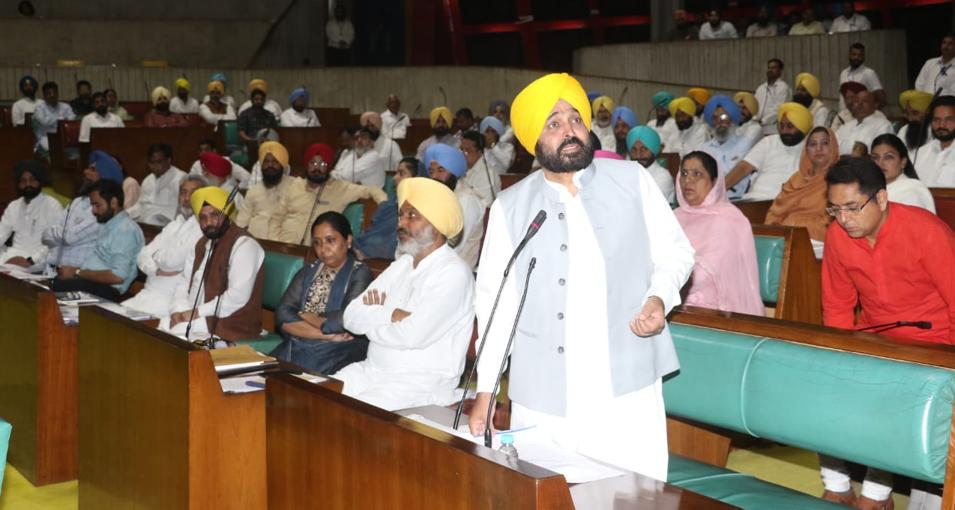
Listing out the Mann government’s achievements on completing 120 days in office on Friday, AAP spokesperson Malwinder Singh Kang said, “Our stand against corruption, assured benefits for the last man in the queue and the chief minister’s honest approach and clear intention must be appreciated.”
The issue of Punjabi pride
AAP, which won with a thumping mandate with an all-time high score of 92 seats in the 117-member assembly, however, finds itself on shaky ground over its stand on vexed issues such as Punjab’s claim on Chandigarh and the impression that it is being remote-controlled by AAP’s Delhi leadership.
The party landed faced criticism following the appointment of Rajya Sabha AAP MP Raghav Chadha, 33, as chairman of a Punjab ad hoc advisory panel. The move invited sharp criticism from Punjab’s opposition parties, which accused the Mann-led dispensation of being run by Delhi-based AAP national convener Arvind Kejriwal and his aides by remote control.
Opposition leaders allege such extra-constitutional appointments give outsiders an “over-arching control on the government” and “circumvent powers vested with a democratically elected chief minister, who is constitutionally under oath of secrecy”. Chadha’s appointment is the latest in a string of decisions that project Mann as a weak chief minister, lacking authority.
“(Bhagwant) Mann has not understood that his party high command in Delhi, with Chadha’s appointment, has made Punjab the first of its kind colonial outpost in independent India and curbed the state government’s independence as the Chadha-led advisory body is construed as giving a final word on all key decisions of the state government,” says Congress leader and leader of opposition Partap Singh Bajwa.
AAP leader Kang countered, “Why does the opposition react sharply to every development of our government?”
He said Raghav Chadha is a professional and has been appointed on the recommendation of the chief minister. The governments in past have been taking advice paying hefty sums, but Chadha will work without a salary or perks, Kang added.
The battle for Chandigarh
Mann’s recent reaction on Twitter after Union home minister Amit Shah announced land for the construction of an additional Haryana legislative assembly by raising a similar demand has not gone down well with a section of citizens, who claim he is diluting Punjab’s claim on Chandigarh. Despite condemnation and pressure from politicians of other parties, Mann has not retracted his statement.
“The CM lacks experience and has no vision. He should have acted responsibly on the matter and have announced that Haryana should build its additional Vidhan Sabha and high court in adjoining Panchkula or any part in its state but not in Chandigarh,” political scientist Jagrup Singh Sekhon, who has headed the political science department of Guru Nanak Dev University, Amritsar.
Kang differed saying that his party is clear that Chandigarh belongs to Punjab and it has been making efforts to restore its claim, which was diluted by successive Akali and Congress governments. “The CM has written to the Centre to appoint officers and staff in UT Chandigarh from Punjab and Haryana in 60:40 ratio,” he adds. Further, according to him, much blood had been shed in the past over the issue and the Centre should resolve it amicably.
On a recent visit to Harmandar Sahib in Amritsar, Mann tried to push the onus on his predecessors, particularly Akalis now in the opposition, of having shifted state government offices to Mohali when they were in power.
“This shows Mann’s lack of political acumen and understanding when the state has been fighting for a separate capital,” said Sekhon.
The fiscal challenge, the corruption success
The AAP government’s flip-flop on key issues have also to doubts about Mann’s decision-making abilities, particularly when Punjab is at the crossroads, struggling to come out of a financial turmoil as debts pile up.
Revenue is set to dip as the goods and services tax (GST) compensation from the Centre has stopped, leading to a shortfall of ₹14,000 crore annually. The government needs an enormously huge amount of funds to fulfil the AAP’s populist poll promises.
But there is no denying the fact that corruption has been curbed to large extent and the delivery system has improved, which largely concerns the population at the cutting edge, said Sekhon.
The government has sent out a clear message of a zero-tolerance against corruption at all levels in the dispensation from politicians to the bureaucracy, and it is clear that the cash-and-carry tactics of previous governments are a thing of the past. Setting an example with the arrest of its own cabinet minister, Vijay Singla, and that of the previous Congress regime, Sadhu Singh Dharamsot, and IAS officer Sanjay Popli for corruption, the intent is clear and it has earned the government much-needed brownie points.
The personnel problem, law and order challenge
Frequent transfers of bureaucrats and police officers point towards the government’s failure to choose its team and give them a direction for effective administrative control,” said Subash Sharma, the state BJP general secretary. Some of the officers have been transferred twice and even thrice in four months, showing the government’s volatile decision-making process.
Many in the government hint at AAP’s Delhi brass calling the shots on key positions in Punjab, bypassing the CM. “It is government of U-turns and denials,” Sharma added.
Law and order is a major problem, and they want to earn publicity out of everything even if it’s a sensitive matter like security,” says Sharma, referring to the AAP government’s blunder of sharing the list of 424 politicians and vulnerable targets from whom security had been withdrawn in May.
The brutal killing of Punjabi singer Shubhdeep Singh Moose Wala, popular as Sidhu Moose Wala, a day later in Mansa earned much criticism for the AAP government, with Mann facing the most flak. His government was cornered on how a confidential document was leaked into the public domain.
“It is total collapse of the rule of law in state. The positive agenda on which AAP had staged thumping victory in state polls, it seems have been forgotten by the party on assuming power,” said Shiromani Akali Dal (SAD) spokesperson Daljit Singh Cheema.
The AAP government accepts that law and order, flow of drugs and organised crime pose a stiff challenge for the state. “In the past, there has been a nexus which includes politicians. However, the DGP is upfront and since his first day in office, he is moving on the ground himself with a clear intention for no-nonsense on the three crucial matters,” said Kang.
The U-turns
The government’s flip-flop on a proposal for an industrial park for a textile unit over 1,000 acres near the Mattewara forest in Ludhiana district raised questions about tis decision-making process as earlier the public action committee (PAC) was assured that no tree would be cut but when public pressure built up, the government scrapped the project, blaming the Captain Amarinder Singh-led Congress government for allowing the project in the green zone.
In June, the rejection of the national achievement survey (NAS) of Punjab schools topping the chart in the country showed the AAP government in a poor light, but recently the results of board exams when government school students bagged top positions proved the state’s dispensation wrong.
“The government must own what is good here, not indulging in a game of political one-upmanship,” suggested Cheema. Kang also accepted that the good shall be appreciated, but he asked why was it that if schools are good, people preferred to send their kids to private institutions, students left for foreign countries and not many from the state were successful in competitive exams
The Mann government's honeymoon period is well and truly over with signs of trouble mounting by the day.
 ABOUT THE AUTHORGurpreet Singh Nibber
Gurpreet Singh Nibber is an Assistant Editor with the Punjab bureau. He covers politics, agriculture, power sector, environment, Sikh religious affairs and the Punjabi diaspora.


