
 E-Paper



Guest column: Stubble trouble: Why pin blame on farmers for policy failures?
It is claimed that the government agencies in Punjab have failed to effectively control the burning of paddy straw despite repeated directives from judicial authorities


Farmers are again being blamed for the poor air quality in the national capital region. Though various factors contribute to the smog in Delhi and its neighbouring areas, the burning of paddy residue in Punjab, Haryana, and parts of western Uttar Pradesh is considered the primary reason. It is claimed that the government agencies in Punjab have failed to effectively control the burning of paddy straw despite repeated directives from judicial authorities. The withdrawal of the minimum support price (MSP) is proposed as a solution by some to discourage paddy cultivation and address the straw management problem.
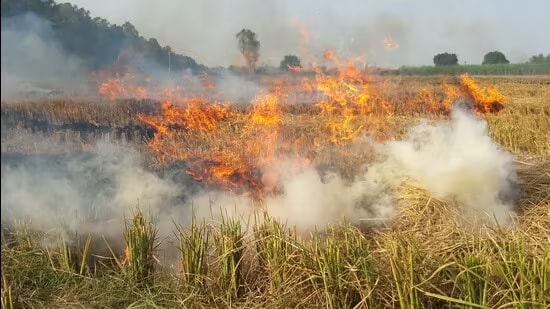
The area under paddy cultivation has increased to 3 million hectares in Punjab this year, with an estimated production of over 20 million tonnes of straw in the state. Such an amount of straw is produced year after year.
Storage blues
Managing such a vast amount of material in 3-4 weeks to ensure the timely sowing of rabi crops, especially wheat, poses a significant recurring challenge for farmers. The farmers understand the financial and environmental consequences of burning straws and put in their best efforts and resources for their timely disposal. They, however, are concerned about the storage of these substantial quantities and its costs. Only about 20-25% of the straw is used in various processes and as fuel by the industries, and the remaining increases the worries and anxieties of the farmers.
Due to its high silica content, paddy straw is not used as animal feed, and researchers have not yet developed paddy varieties with lower silica content. The absence of a solution to this crucial issue is a matter of concern. It is perhaps due to insufficient attention and funding for agricultural research. It is thus imperative to redirect research and development efforts to address this problem, benefiting the farmers and society.
Building policy synergy
The government has formulated policies to facilitate timely collection, baling, and disposal of residue by providing subsidies for machinery and equipment required to hasten these processes. Despite farmers’ enthusiastic adoption of these machines with substantial public investment, the problem persists. The farmers are still constrained to burn paddy residue to secure their livelihoods and prepare for the next crop.
The policy of offering financial assistance to farmers for equipment purchases does not address the issues of limited storage space and associated costs. It also does not guarantee the consumption of the collected and baled material. Currently, no policies or investment plans exist to promote industries that can utilise or consume paddy straw in a significant way, leaving farmers hopeless with a surplus of unwanted material.
Some experts and policymakers suggest diversification of agriculture as an alternative to reducing the area under paddy cultivation. It is surely a legitimate progressive option, as the present agriculture operations in Punjab are becoming increasingly unsustainable. However, notwithstanding the vociferous claims and suggestions by the government, much is yet to happen in agriculture diversification. There is a lack of synergy among different sectoral policies, and the agriculture policies have failed to make alternative crops attractive and remunerative for the farmers.
Marketing of alternative crops vital
The marketing of alternative crops is a major issue for which no viable solution has emerged to wean farmers away from paddy cultivation. Economists and policymakers often debate the continuation of MSP, but marketing-linked incentives are not discussed as forcefully as these should be to encourage farmers to shift to alternative crops. The MSP-based procurement of wheat and paddy should continue. The governments should, however, work out a package of incentives for the marketing of alternative crops, ensuring pragmatic and realistic solutions to the issues emerging from paddy cultivation.
Farmers resort to burning paddy straw out of helplessness and despair, a predicament that often goes unrecognised and unappreciated by the policymakers. The judicial authorities have also not yet fully appreciated the gravity of this situation. The existing policies are inadequate and fail to integrate effectively with other sectoral policies necessary for a comprehensive response to this problem.
Needed: A more inclusive, cohesive solution
The government should follow a holistic approach, considering the imperatives of agriculture, food, industry, environment, economic, and fiscal policies.
The relevant government agencies should devise a more inclusive, cohesive, and practical solution rather than relying on ad hoc measures and handouts, which are unlikely to yield long-term results.
Furthermore, it is crucial to understand that paddy cultivation is here to stay for the foreseeable future, given the imperatives of national food security and increasing global food demand. More substantial efforts should focus on research and development of low-water-consumption varieties of paddy with reduced silica content in the straw. The research could offer a more sustainable solution than merely providing temporary assistance to farmers for a problem that runs deeper than surface-level discussions. Insinuating or penalising farmers would only exacerbate social unrest in a state grappling with many other challenges. In the interim, the provision of paddy straw management costs along with the MSP should be compensated as an incentive to those farmers who do not burn it.
The writer is a retired Punjab-cadre IAS officer. Views expressed are personal.


