
 E-Paper



Guest Column | We must not let students stranded in Ukraine down
There is no organised agency that can help 76,548 international students from around 155 nations, including India, Morocco, Turkmenistan, Azerbaijan Nigeria, China, and Turkey, who are stranded in Ukraine reach the borders safely


Among the disturbing reports pouring in from besieged Ukraine are heart-wrenching videos, photographs and testimonies of students trying to escape the war-torn east European country. Sadly, not all of them have been successful.
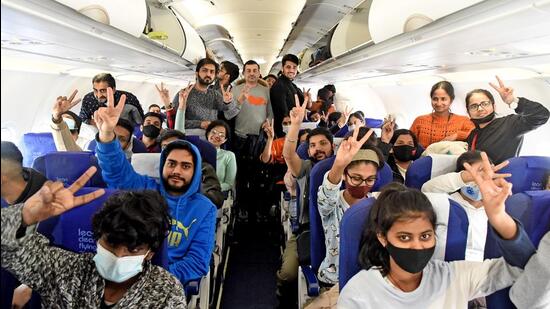
There is no organised agency that can help 76,548 international students from around 155 nations, including India, Morocco, Turkmenistan, Azerbaijan Nigeria, China, and Turkey, reach the borders safely. Indians, who fortunately made it to Poland and Romania, said they had to stand in sub-zero temperatures for 48 hours without water, food, or shelter.
Made to stand outside in minus 5°C temperature as snow blanketed the burning country, several students fainted, and on top of it guards were seen kicking, thrashing and beating the students with their rifles! Many of these students had walked 8 to 12 kilometres in the biting cold and snow to reach the border. Students from African countries such as Kenya, and Nigeria also went through similar ordeals.
A harrowing ordeal
The forces at the border are prioritising Ukrainian citizens, particularly children and women. Of course, there is nothing wrong in that, but foreign students marooned in Ukraine also deserve safe passage. Holed up in bunkers, the students have been posting heart-rending messages seeking immediate evacuation. With no help forthcoming, an Indian medical student, was tragically killed in shelling in Kharkiv.
A foreign student spends USD 7,000 per annum, as per the Ukrainian ministry of education. This aggregates to USD 542 million in revenue for the east European country. Even if ceasefire is announced, few students will want to return, causing losses to the war-torn country, and also to families who spent their hard-earned money so that their wards could have a foreign education. The students have already spent a great deal on air tickets, fee, accommodation and study material and have also expended a lot of time and effort on learning a new language, adapting to the food , culture and customs. Now, all of it seems to have gone in vain.
With the queues near at the borders at least 20-30km long, the logistics involved in receiving and managing refugees need improvement. More officials are needed at the border so that refugees can cross expeditiously. The number of entry points and the registration centres have to be quadrupled. This is emphasised by visuals of Ukrainian refugees spending nights in small tents in temporary camps in Przemysl on the Polish side.
Run sorties to rescue students
Governments of countries like India, Morocco, Turkmenistan, Azerbaijan, Kenya, and Nigeria should establish communication with the governments of Russia and Ukraine to let their embassies or special forces establish reception centres for their citizens and support them with water, food and some shelter. Special armed forces should be permitted to run sorties within Ukraine, to collect students from their hostels and ferry them across the borders. After all, the war has not yet fanned out to all towns where foreign students are studying. The Russian and Ukraine governments and armies are unlikely to object to this humanitarian mission. The United Nations and the Red Cross, can also assist in this mission. Our goodwill with Russia and Ukraine has to be encashed. If not now, then when?
In 2002, I was in Abidjan, when a civil war was raging in Cote d’Ivoire. Special French armed forces and US marines visited Abidjan, with the limited goal of rescuing stranded children from foreign schools and some French citizens. The entire operation was carried out seamlessly. A similar operation is required in Ukraine as well.
Even during the horrendous partition of India and Pakistan, Indian forces made many sorties to Pakistan to rescue refugees who could not cross to the Indian side early enough. My own parents were rescued by the Indian Army in September 1947. We cannot let down our traumatised students. As all religions teach us, “He who saves one life, saves the world entire.”
rkaneja@anejamanagement.com
(The writer is a Mumbai-based management consultant)


