
 E-Paper



Himachal’s Sundernagar, Nalagarh towns get award for clean air
Himachal Pradesh’s Sundernagar and Nalagarh towns were on Saturday presented with ‘Swachh Vayu Survekshan 2022’ award under the National Clean Air Programme at an event in Bhubaneswar


Himachal Pradesh’s Sundernagar and Nalagarh towns were on Saturday presented with ‘Swachh Vayu Survekshan 2022’ award under the National Clean Air Programme (NCAP) at an event in Bhubaneswar.
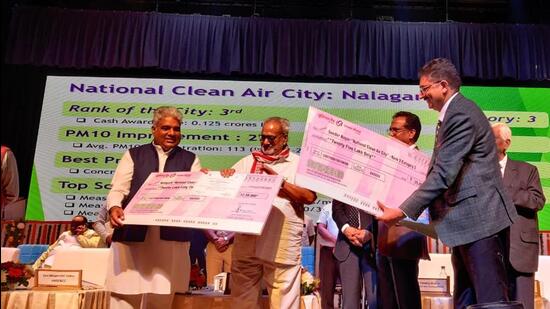
Union minister of environment, forest and climate change Bhupender Yadav and Odisha governor Ganeshi Lal gave the award during the international conference Vayu.
Himachal Pradesh State Pollution Control Board chief scientific officer Manoj Chauhan received the cash award of ₹25 lakh for Sundernagar and ₹12.5 lakh for Nalagarh on behalf of the state, a press release issued here said.
Member secretary, state pollution control board, Apoorv Devgan said Himachal has adopted a multipronged strategy by involving all stakeholders and prepared an action plan for mitigation of air pollution in all non-attainment cities and towns.
A non-attainment city is one whose air did not meet the national ambient air quality standards of 2011 to 2015. The NCAP was launched for such cities and towns.
The state board has upgraded the air-monitoring capability in all such cities, he said. Effective periodic review of implementation of the action plan by the air quality monitoring committee and efforts of the pollution control board as well as city-level implementation panels have helped in the more than 40% reduction in concentration of PM10 in the ambient environment. PM10 is the term used for a mixture of solid particles and liquid droplets found in the air.
Improvement of air quality in the state is not limited to non-attainment cities and towns, but overall air quality index (AQI) of Himachal has also improved from 81 during the base year 2017 to 61 during 2021-22, he added.
Various components of the action plan were containment of vehicular emissions, suppression of road dust and other fugitive emissions, control of air pollution from biomass burning, construction and demolition activities, and industrial air pollution, the official said.


