
 E-Paper



HP bypolls: Mandi and its tryst with the blue blood
While the Congress is seeking votes in the name of Virbhadra Singh, who passed away in July, and hopes to cash in on the sympathy wave; the election would be a litmus test for HP chief minister Jai Ram Thakur


Mandi parliamentary constituency, the second largest in the country in geographical terms, truly has been described as a ‘Battlefield of Royals’.
Mandi’s tryst with the blue blood began right from the first election post-Independence when Rajkumari Amrit Kaur, daughter of King Harnam Singh and scion of the princely state of Kapurthala, was elected from Mandi in 1952 general polls.
In 1957, it was a high-stake battle when the eighth ruler of Mandi and Congress candidate Joginder Sen Bahadur defeated another royal and Independent candidate Anand Chand, the scion of the erstwhile Bilaspur state.
It was represented by Congress leader and erstwhile ruler of Suket princely state Lalit Sen for two consecutive terms in 1962 and 1967.
In 1971, Virbhadra Singh, the scion of Bushahr princely state, was elected from Mandi, who later went on to become the chief minister of Himachal and tallest political figure in the state politics.
The first commoner to win the election from Mandi was Janata Party’s Ganga Singh, who defeated Virbhadra Singh in 1977 amid anti-Congress sentiments. However, Virbhadra returned in 1980 after the fall of the Janata Party’s government.
The first-ever election with no royal in fray from Mandi was held in 1984 when Congress veteran Sukh Ram defeated BJP’s Madhukar.
However, in 1989, a royal again stepped into the poll arena, this time from the BJP. Maheshwar Singh, a scion of the Kullu royal family, won the election.
In the next election in 1991, Sukh Ram defeated Maheshwar while in 1996 it was again a contest between two non-royals and Sukh Ram retained the seat.
Two royals, Maheshwar Singh and Pratibha Singh, wife of former chief minister Virbhadra Singh, locked horns in another high-stake battle in 1998 in which the former emerged victorious. In 1999, Maheshwar Singh defeated Congress’ Kaul Singh.
Five years later, Maheshwar was defeated by Pratibha while in 2009, Virbhadra returned to represent the constituency.
Pratibha returned as Mandi MP in the 2013 byelection after her husband vacated the seat to become the chief minister of Himachal.
Riding on the Narendra Modi wave, Ramswaroop Sharma defeated Pratibha in the 2014 elections. Sharma retained the seat in 2019 defeating Sukh Ram’s grandson Aashray Sharma.
War veteran slugs it out against a royal
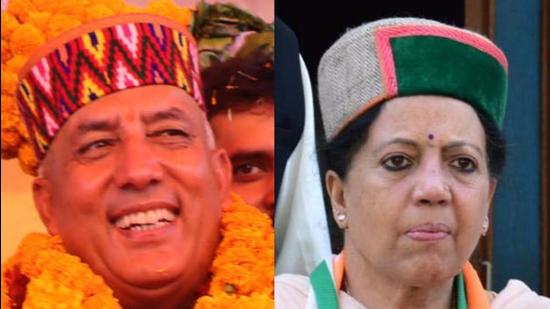
However, Mandi’s association with the royals is yet not over as Pratibha is back in the poll fray.
BJP candidate and a Kargil war veteran, Khushal Singh Thakur, would slug it out against her in an election wherein emotions are likely to eclipse the political issue.
The Congress is seeking votes in the name of Virbhadra, who passed away in July, and hopes to cash in on the sympathy wave.
All odds are stacked against the BJP. The election would be a litmus test for chief minister Jai Ram Thakur for Mandi being his home turf. It would also be a reality check of his popularity.
Farmers of Balh, the most fertile valley in Himachal, are already angry with the state government over the issue of a proposed international airport.
There also prevail anti-BJP sentiments among the people affected by the Chandigarh-Manali four-lane project.
Interestingly, BJP nominee Khushal led their movement for compensation, but he abandoned the cause once the BJP came to power and chose to become chairperson of ex-servicemen corporation.
Lack of development is one issues where both the parties have failed. Mandi comprises remote and tribal areas of Kinnaur, Lahaul-Spiti, Bharmour and Pangi which are still underdeveloped with poor connectivity.
The villages along the China border, particularly in tribal Lahaul and Spiti and Kinnaur districts, still lack proper roads, water supply and schools. The majority of the population in the border villages have migrated to the semi-urban and urban areas for better future prospects. Himachal shares a 260km porous border with China. Of the total border length, 140km lies along tribal Kinnaur district, while 80km of the border is along Lahaul and Spiti district.
Though the state’s border with China remains peaceful, the fast pace of development in neighbouring country has been a matter of concern for the government. China is continuously strengthening its infrastructure and constructing new roads along the border, particularly in the sensitive Kaurik sector in the Kinnaur district.
Himachal will strengthen its basic infrastructure in different phases under the border area development programme.
The government would spend more funds on the development in 76 villages that lie within a close range from the international border.
Tattered health and educational services compound the problems for the people.
While the electors in the last election voted in favour of the BJP, which had promised to eliminate all their troubles, that promise has not been fulfilled. Anti-incumbency against the state government may also hurt the saffron party dearly.


