
 E-Paper



Ludhiana: Faulty speed bump construction plagues GLADA colony residents
Residents of Dugri Phase 3 Greater Ludhiana Area Development Authority (GLADA) colony, under Ward number 50, have sounded the alarm over what they call “death traps” in their area constructed in the name of road safety


Despite tough stance by the Punjab and Haryana high court (HC) and clear guidelines by the Indian Roads Congress (IRC) over faulty speed breakers, in Ludhiana, unplanned, unmarked and hazardous speed breakers continue to mushroom across the city unabated.
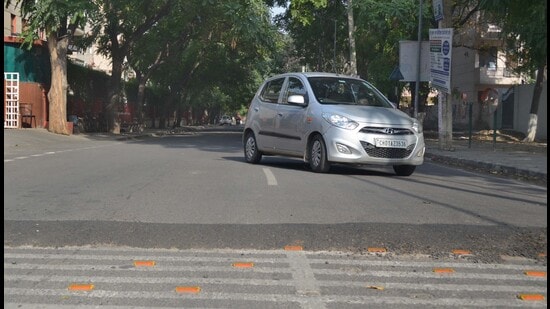
Residents of Dugri Phase 3 Greater Ludhiana Area Development Authority (GLADA) colony, under Ward number 50, have sounded the alarm over what they call “death traps” in their area constructed in the name of road safety.
Voicing his concerns, Sanjeev Gupta, a Dugri resident asserted, “The speed breakers in the area have been laid without proper planning, mapping, or adherence to safety norms. Many are either too steep, irregular in shape, or lack visible markings, posing a serious threat to commuters.”
Gupta said that the speed humps should only be constructed in lanes where the risk of road crashes remains high. “Tragically, in our area, such measures are missing, turning our roads into death traps for motorists,” he added.
The issue took a grave turn recently when Rupa Gupta, a schoolteacher and resident of the colony, sustained severe injuries after a high-speed vehicle rammed into the back of her scooter. The accident occurred near an intersection just outside a private school in Dugri Phase 3. “I was commuting through the lane outside my colony when a high-speed vehicle collided into my scooter from behind. The accident was severe, and I suffered four stitches in the mishap,” Gupta recounted.
In Ludhiana, several areas like Civil lines, Rani Jhansi Road Model Town extension, Dugri and road near Rakh bagh are grappled with such speed breakers.
Shedding light on the technical norms, Kamaljeet Soi, a member of the National Road Safety Council (NRSC), said that according to the IRC, a standard speed breaker must be 0.1m high and 3.7m wide. These specifications are designed to reduce the speed of an approaching vehicle to a maximum of 25 kmph.
The IRC further mandates that speed breakers must be painted with black and white stripes to enhance visibility, and cautionary signboards should be installed on both sides of the hump. “A set of six yellow transverse bars should be placed 50m before the speed breaker as a first warning, with another set 10 to 20m before as a second warning,” Soi added.
Notably, in April 2021, the HC issued a notice to the top brass of the Ludhiana administration, acting on a petition filed by RTI activist Rohit Sabharwal to remove faulty speed breakers that violated IRC guidelines. Despite this directive, such speed breakers continue to mushroom across the city.
Soi pointed out that the unchecked proliferation of unscientific humps is “prominently due to the intervention of uniformed political figures who, instead of consulting traffic experts, continue to order their construction at whim.”
When contacted, Jasdev Singh Sekhon, zonal commissioner (MC Zone D), pass the buck by stating, “The responsibility regarding the construction of such speed breakers lies with the B&R wing of the municipal corporation, which is obligated to ensure these norms.”
Despite repeated attempts, MC commissioner Aaditya Dachalwal remained unavailable for comment.


