
 E-Paper



Guest column | Mahatma Gandhi: A leader for the ages
Mahatma Gandhi’s teachings have influenced numerous global leaders; however his message of non-violence has been largely ignored and the world is overflowing with armed struggles as seen in Afghanistan, Palestine, Syria, and Lebanon


As an Indian on foreign soil, I would inevitably be asked, “Have you heard of Gandhi? Do you know of him?” It didn’t matter where I was - Brazil, Colombia or Ecuador - everybody was in awe of him.
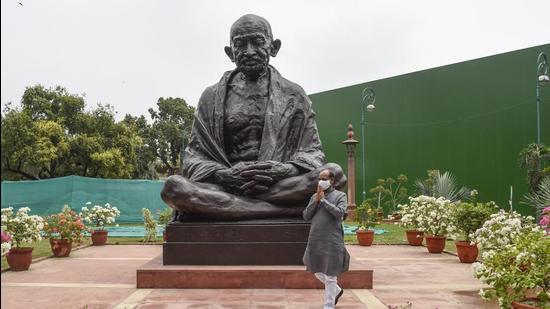
Sure, as an Indian, I was well-versed with Mahatma Gandhi’s role in India’s freedom struggle. However, I was amazed to see his fan following in distant countries, especially after Richard Attenborough’s Academy Award-winning film Gandhi. The film, which won eight Oscars took Gandhi to the far corners of the world. However, I was tickled by the fact that a Britisher had made a film on the man who had dedicated his life to fighting his countrymen.
Gandhi is revered all over the world as the messiah of non-violence. His message of non-violence is as relevant today, as it was in the 1930s and 1940s, when he led India’s fight against colonial rule. To Gandhi, the means were as important as the ends, to Gandhi. While advocating for swaraj (self-rule), Gandhi had requested all freedom fighters to peacefully resist the colonial forces, and never resort to violence against the police. In fact, he would call off large-scale satyagraha (civil disobedience) movements, in case violence was perpetrated by the protesters.
An appeal to the conscience
Every human life was precious for the Mahatma, even the lives of those who opposed India’s quest for freedom. Those who respect human life, never indulge in violence. By following a policy of non-violence, Gandhi appealed to the conscience of his opponents.
As the great physicist Albert Einstein succinctly put it, “Generations to come will scarce believe that such a one as this ever in flesh and blood walked upon this earth.”
Gandhi’s teachings have influenced numerous global leaders. Martin Luther King and Nelson Mandela were both followers of the Mahatma’s non-violence philosophy and imbibed his teachings in their own struggles.
Gandhi’s vision for India was that of a country where people of all religions lived harmoniously. He would often proclaim that he was not just a Hindu. He was a Hindu, Muslim, Christian and Jew, all rolled into one.
Gandhi practiced, what he preached. In his ashrams, all residents were responsible for cleaning the toilets, a role traditionally consigned to a group of people who were considered “untouchables.”
He was against all discrimination and respected all forms of work. So, at his ashrams people cleaned toilets by rotation as Gandhi believed that one must be the change they wanted to see in the world.
He also prescribed being truthful in both relationships and politics, proclaiming, “Truth is as old as the hills.”
Role model for the youth
Gandhi’s autobiography My Experiments With Truth, has been written with candour and in elementary English, which can be understood by everybody. It should be made mandatory reading for the youth. It is important to expose youngsters to leaders, who ushered significant changes in our world, without any violence or firing a single shot.
Younger generations would also benefit by reading American author Louis Fischer’s The Life of Mahatma Gandhi. The book was my Bible in my younger days. Fischer spent seven days with Gandhi at the Sevagram Ashram in Wardha. The author was surprised to see that the Mahatma only kept a black and white photograph of Jesus Christ, in his bare room.
While the world has paid homage to Mahatma Gandhi through statues and postage stamps, his message of non-violence has been largely ignored. The world is overflowing with armed struggles as seen in Afghanistan, Palestine, Syria, and Lebanon. Armed militancy movements such as the Al Qaeda, and ISIS in the Middle East and rebel groups in Colombia and Peru have caused the death of thousands of people in the name of ideological struggles. Many of the embattled people may not even have heard the name of Mahatma Gandhi. Should they choose to struggle nonviolently, perhaps it would draw more global attention to their cause.
The world needs to subordinate religion to economics. We need to provide more money, food and medicines to about 36% of the global population, which lives below the poverty line. We need to rediscover Mahatma Gandhi. Feeding, clothing and housing the destitute of the world, is the highest religious duty, we can perform.
As Martin Luther King wrote, Mahatma Gandhi “belonged to the ages.”
rkaneja@anejamanagement.com
(The author is a Mumbai-based management consultant)


