
 E-Paper



Panchkula bets on stop-gap measures, cleaning drive to improving Swachh Survekshan ranking
Panchkula is facing concerns over the absence of a garbage processing facility as it aims to improve its ranking in the Swachh Survekshan 2023. The city has made progress in waste collection and cleanliness, but needs to address issues such as garbage processing, grievance redressal, and cleanliness of roads and public toilets. The municipal corporation has temporarily transported garbage to Ambala for processing and is working on setting up a waste processing plant. The city aims to break into the top-50 in the upcoming survey.

 Prefer HTon Google


While Panchkula began transporting garbage to Patvi, Ambala, earlier this year, the absence of the garbage processing facility remains a cause of concern for the municipal corporation as it hopes for a good performance in the Swachh Survekshan 2023.
Panchkula bagged the 86th spot from among 382 cities in 2022, showing a slight improvement from the 99th finish in 2021. Panchkula graph has been up-and-down with the city being ranked 56 in 2020, 71 in 2019, 142 in 2018 and 211 in 2017.
The slight jump can be attributed to the success of door-to-door collection of segregated waste, cleanliness of market and residential areas, drains, water bodies and daily sweeping in residential areas.
Hoping to break into the top-50, municipal commissioner Sachin Gupta said, “We have taken initiatives to improve in areas in which we were found wanting.”
Standing out from among the areas that can do with improvement are the need for a garbage processing facility, a grievance redressal and cleanliness of roads and public toilets.
Garbage transported to Patvi, hunt on to set plant
Panchkula generates 200 tonnes of waste on a daily basis from about 70,000 households, of which 60% is dry while the rest is wet waste.
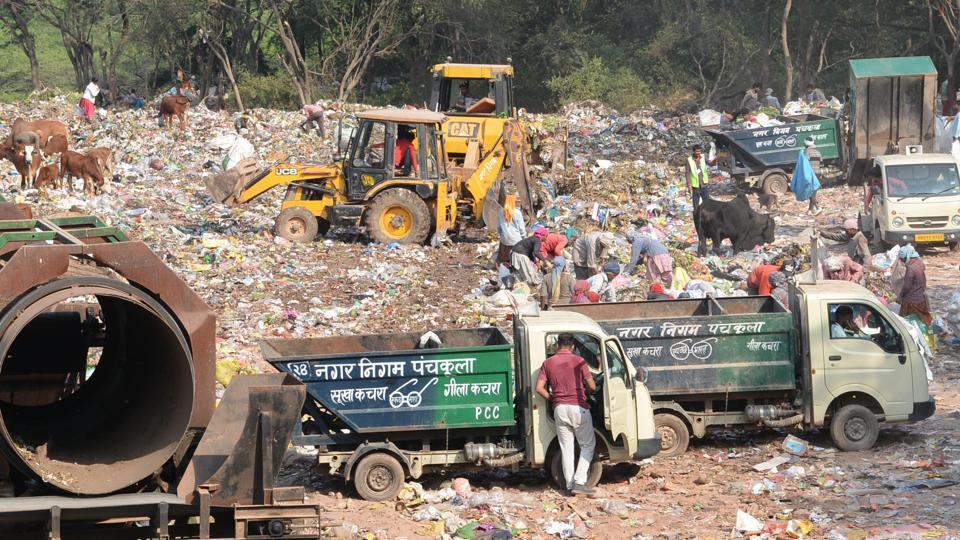
The MC came up with a stop-gap arrangement to transport garbage all the way to Ambala’s Patvi for processing. The decision was taken as residents of the nine sectors in the trans-ghaggar area, Moginand, Bana and Madanpur villages had been protesting and seeking removal of the waste from Jhuriwala dumping ground.
The commissioner had also set a December 31 deadline to eliminate the 2.5 lakh tonnes of legacy waste from Sector 23, which had the dumping site until July 2021 and Jhuriwala.
Two machines are currently being set up for bio-mining of legacy waste in Sector 23, with the project set to be completed by March 2024. The initiative aims to dispose of 3 lakh metric tons (MT) of waste at a rate of 60,000 MT each month.
A biomining machine has already been installed at Jhuriwala and the treatment of waste is expected to conclude by December. The site will manage the disposal of approximately 90,000 MT of waste.
The civic body has also set the ball rolling for a plant that would cover processed wet waste into compressed natural gas (CNG).
Segregation, grievance
redressal a work in progress
Door-to-door collection of segregated waste was a big step in improving management, but the segregation remains a herculean task. After the staff highlighted residents’ failure to segregate the waste, a ward-wise committee was announced to check disposal.
To streamline door-to-door garbage collection, the municipal corporation has also uploaded the contact information for sector supervisors and drivers on its website. The move is to ensure timely collection of garbage from each sector.
Speaking of the same, Gupta said, “We have put out numbers to facilitate residents to call if garbage is not picked up.”
The residents can also get the garbage picked up by lodging a complaint on the corporation’s number: 9696120120.


