
 E-Paper



PGI to shift emergency patients to wards in 96 hours
The new rule will be applicable at emergency medical OPD (Triage area, Halls A, B, C and Hall L area of corridor), emergency surgery OPD, Advanced Trauma Centre and Advanced Paediatric Centre (APC) emergency at PGI.


To decongest the rush of emergency patients, the Post Graduate Institute of Medical Education and Research (PGIMER) has decided to shift patients from emergency wards to general wards/units within 96 hours of admission.
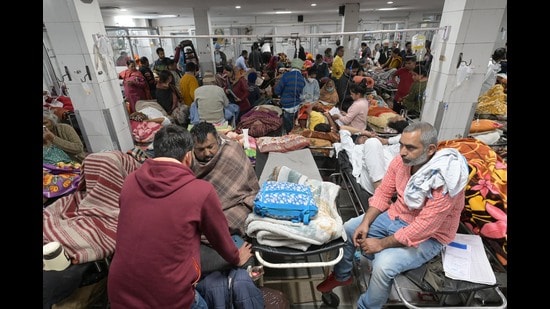
The new rule will be applicable at emergency medical OPD (Triage area, Halls A, B, C and Hall L area of corridor), emergency surgery OPD, Advanced Trauma Centre and Advanced Paediatric Centre (APC) emergency.
“All the stakeholder departments of the PGIMER shall ensure that no patient shall be kept in these emergency areas beyond 96 hours at the maximum and are shifted to the respective units/wards/areas for continuation of treatment,” the official orders by PGIMER’s medical superintendent read.
Further, the faculty in-charge posted in the emergency wards must prepare the admission files of the patients under the departments/units concerned and will hold the sole prerogative to subsequently transfer the patient to the units concerned within 96 hours.
Though the emergency medical ward has only 109 beds, more than 350 patients are being treated at any given point of time, with the help of trolleys and stretchers that are lined up in corridors and anywhere space is available.
In the Advanced Trauma Centre (ATC), which was set up to admit 100 patients requiring treatment from multiple surgical specialties, there are 200-225 patients, including on trolleys, be it day or night.
‘Refer back patients whenever possible’
Over 90% patients in the emergency and ATC are referred cases, mostly from Punjab, where government hospitals are either short of specialists, equipment or saddled with non-operational technology. Due to this, the region’s premier research institute’s trauma and emergency services are running at double the capacity, that too with limited healthcare staff.
Besides shifting the patients to wards, PGIMER has directed departments to make best possible efforts to refer back patients to the referring institute. “The departments shall make possible efforts to refer back the patients after providing the required tertiary level care at PGIMER,” the notice further read.
‘Move will reduce overstay in PGIMER’
PGIMER director Dr Vivek Lal said, “At present, patients are kept in emergency wards, even when they can get the same treatment in wards. But now, the faculty members will ensure that they are admitted in wards timely. With this, more beds will become available for new patients. This will not only reduce overstay of patients in the emergency, but also decongest the emergency wards and reduce the risk of infection spread.”
Dr Lal further said the doctors had been told to refer back patients whenever possible, as patients, even when they could get treatment in district hospitals, preferred tertiary care hospitals, which often led to serious patients not getting the required care.


