
 E-Paper



Problem of plenty:Flooded with relief, Punjab looks for long-term rehabilitation
Battling its worst floods in four decades that have claimed 53 lives and destroyed crops in 1.91 lakh hectares, Punjab is now faced with a deluge of relief material. With the outpouring of aid from states across the country, Punjabi diaspora the world over, philanthropists and Sikh organisations, the state is flooded with an oversupply of perishable items, such as cooked food and dry ration, while it needs help with long-term rehabilitation as the floodwater recedes and the extent of damage to crops, livestock and property surfaces

 Prefer HTon Google


Battling its worst floods in four decades that have claimed 53 lives and destroyed crops in 1.91 lakh hectares, Punjab is now faced with a deluge of relief material. With the outpouring of aid from states across the country, Punjabi diaspora the world over, philanthropists and Sikh organisations, the state is flooded with an oversupply of perishable items, such as cooked food and dry ration, while it needs help with long-term rehabilitation as the floodwater recedes and the extent of damage to crops, livestock and property surfaces.
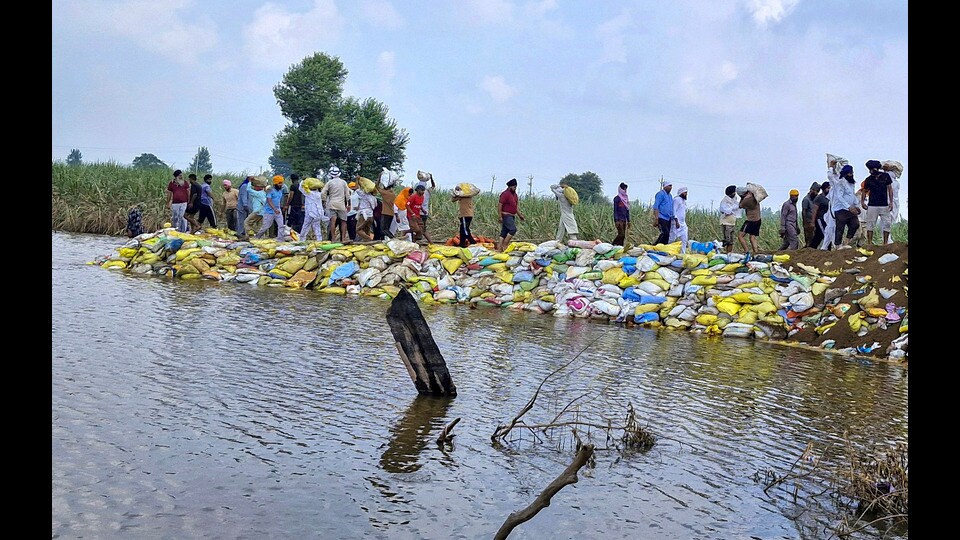
Admitting to the problem of plenty along with poor coordination in relief disbursement thus far, a senior Punjab revenue department official said in Chandigarh on Wednesday that the state government’s role in making arrangements for the distribution of relief has been overtaken by volunteers and non-governmental organisations (NGOs). “The relief efforts of individuals, NGOs, religious bodies, and other Good Samaritans is welcome, but they need to look at what people actually require at this stage. There is no dearth of food items, medicines or tarpaulin. Cooked meals are available at langars (community kitchens) in the flood-hit areas. Tractor-trolleys laden with relief material are lined up waiting to be received by residents of flood-affected villages,” the official said, requesting anonymity.
“In our opinion, people need seeds (for the coming rabi sowing season), fodder for livestock, diesel to pump out water from low-lying areas to save people from the spread of epidemics,” he said.
Instead, he urged volunteers to look at long-term rehabilitation efforts to support those in distress so that they could repair their damaged houses, remove silt from the fields and provide seed for rabi sowing by October.
Speaking on the support from the government, the top official in the department said that the procedure to assess the damage has begun. “Instructions have been issued to staff in the flood affected districts from deputy commissioners to patwaris. The girdawari (survey to ascertain damage) will begin next week and the report will be compiled within a fortnight after that,” he said.
“After that, funds will be sanctioned by the government and distributed to the victims, so until then the volunteers have a crucial role to play. Plans are being made for providing relief material, but things move at a slower pace in the government,” the official added.
Ferozepur, Fazilka grapple
with uncoordinated efforts
Problem arises when groups bypass district administrations and distribute aid directly, says Ferozepur DC, while villagers seek urgent road repair and long-term flood protection.
Gaurav Sagar Bhaskar
Most consignments are of perishable food items and packaged drinking water, yet critical supplies like medicines, hygiene kits and cattle fodder remain in short supply in the border districts.
Independent contributions by NGOs, religious bodies, and volunteer groups have triggered chaos in villages, with crowds rushing toward vehicles and, at times, turning violent.
Tension flared up at Bhadru village last weekend when sarpanch Sukhdev Singh was attacked after trailers carrying straw for cattle of flood victims were stranded due to damaged roads. Police have booked nine people in connection with the assault.
“The most urgent need today is fodder and feed for livestock, but with roads washed away and boats limited, delivery has been stalled,” said Shalinder Kumar of NGO Firozpur Foundation. Another volunteer, Simar Singh Sandhu, noted that a truckload of eatables had to be diverted to a religious place as there was no demand from the flood victims.
District officials admitted that the lack of coordination is worsening the crisis. “Volunteers who approach us are being regulated and sent to needy areas. The problem arises when groups bypass the administration and distribute aid directly,” said Ferozepur deputy commissioner Deepshikha Sharma.
Another senior officer in Fazilka, requesting anonymity, urged philanthropists to wait until water fully recedes, saying only then will the real requirements emerge.
Demand to bolster infrastructure
The floods have also underlined the vulnerability of Punjab’s border infrastructure. Villagers said that damaged roads take years to rebuild, cutting them off during every flood. Demands are mounting for elevated, durable roads and permanent embankments along the Sutlej.
To streamline relief, district administrations have set up control rooms and issued lists of urgent needs such as medicines, sanitary kits, animal feed, and clean drinking water. Officials stress that coordination is vital to prevent duplication, wastage, and clashes.
Meanwhile, the Sutlej’s level is slowly receding. On Tuesday evening, 2.25 lakh cusecs were released from Harike headworks and 2.36 lakh cusecs from Hussainiwala towards Pakistan — 28,000 cusecs less in 24 hours. Still, nearly 14,000 hectares of paddy remain destroyed, with villages like Tendi Wala, Jalloke, and Hamed Chak under three to four feet of water.
Some families have begun returning home and cleaning up, but frustration is growing.
Residents are pressing for urgent road repairs and long-term flood protection before the next monsoon.
Kapurthala calls for sand bags
to reinforce bundhs, not ration
District administration sets up warehouse to ensure fair distribution of relief material at doorsteps of affected villagers.
Navrajdeep Singh
Villagers have appealed relief providers to stop the supply of ration and sought help to transport sand and sand bags, diesel, Poclain and JCB machines to strengthen embankments now that the water level is receding.
Sarwan Singh of Baupur village said: “We are overwhelmed with the aid we are getting from people not only in Punjab but also other states. They have stood shoulder to shoulder with us. We now appeal to them to stop bringing dry ration as the stock has reached affected areas in abundance. Instead, we need sand to strengthen the river’s embankments.”
With social organisations, NGOs and philanthropists spearheading the relief work, ration has reached the flood-hit mand area of Sultanpur Lodhi in abundance but its fair distribution to the affected population is still a matter of concern.
The affected people, whose house is surrounded by gushing waters of the Beas, have been provided with relief material from mattresses to sanitary pads, ration to vegetables, medicines, dry fodder, corn silage and livestock feed.
Yet, tractor-trolleys and trucks carrying relief material are queued up on the main connecting overbridge to nearly 15 villages in the mand area, awaiting for distribution via boats. Such has been the outpouring that those involved in the relief and rescue operation have appealed to people to stop sending material for now as it is available in surplus.
Kapurthala deputy commissioner Amit Kumar Panchal said: “We have ample stock of all sorts of relief material.” Nodal officers have been appointed to streamline the distribution and a warehouse has been set up in Sultanpur Lodhi for the storage of relief material.
“A large number of donors, social service organisations, religious groups, and common citizens are bringing relief material to Kapurthala. However, due to lack of information about the geographical conditions of the area and about the genuinely needy, they often face difficulties due to which the nodal officers have been appointed now,” he said.
He said that the administration had got calls from village heads about their requirement related to relief material. “We have provided boats to donors for fair distribution of the material,” he added.
Meanwhile, Maulana Mohammad Mohsin from Mandpuri village in Haryana’s Mewat said: “Punjabis have always stood by us and are in need today. We have been sending trucks of relief material after making decent financial collections from our villages.”
Another volunteer, Rajendra Singh, who was among a group of 10 people from Chandigarh’s Nayagaon, said he had brought corn silage for livestock.
Akal Takht wades in to
streamline distribution
Surjit Singh
Yet, activists on the ground say material is often ending up in unaffected villages, while several flood-hit families remain cut off.
Dal Khalsa leader Paramjit Singh Mand, who has been leading relief efforts in the region, recently called a meeting of NGOs in a bid to establish coordination to ensure that the aid can be delivered to the needy without wastage. “Most of the NGOs are not ready to rely on the administration and they want a coordination committee to be set up under the leadership of the Akal Takht jathedar to prevent any chaos. The final decision will be taken with a consensus.”
Akal Takht acting jathedar Giani Kuldeep Singh Gargaj has convened a meeting of Sikh organisations and NGOs serving flood victims at the Shiromani Gurdwara Parbandhak Committee (SGPC) head office in Amritsar on September 13.
Commending Punjabis and well-wishers for rendering service during the relief operations, he said there is now a pressing need for all to work in an organised manner. “Relief material must be distributed in a planned way, and long-term service must continue so that the donations and contributions (dasvandh) of supporters are not wasted or misused. Since the floods have caused large-scale damage to houses, lives, property, livestock, crops, and land across Punjab, it is essential that policy-based long-term relief services are provided, especially for the resettlement of affected people, as well as for the revival of education, healthcare, agriculture, and animal husbandry,” he said.
He added that an investigation into the causes of these recurring floods in Punjab is also crucial so that the people of the state can remain aware and prepared.


