
 E-Paper



Punjab faces kharif crop diversification challenge
According to the Punjab agriculture director Jaswant Singh, the department has set a target to cover 2 lakh hectares under cotton in the 2024-25 kharif cycle. Punjab is struggling with diversification plans by turning farmers towards the cultivation of the traditional crop of cotton.

 Prefer HTon Google


Days before the commencement of kharif sowing season, Punjab is struggling with diversification plans by turning farmers towards the cultivation of the traditional crop of cotton.
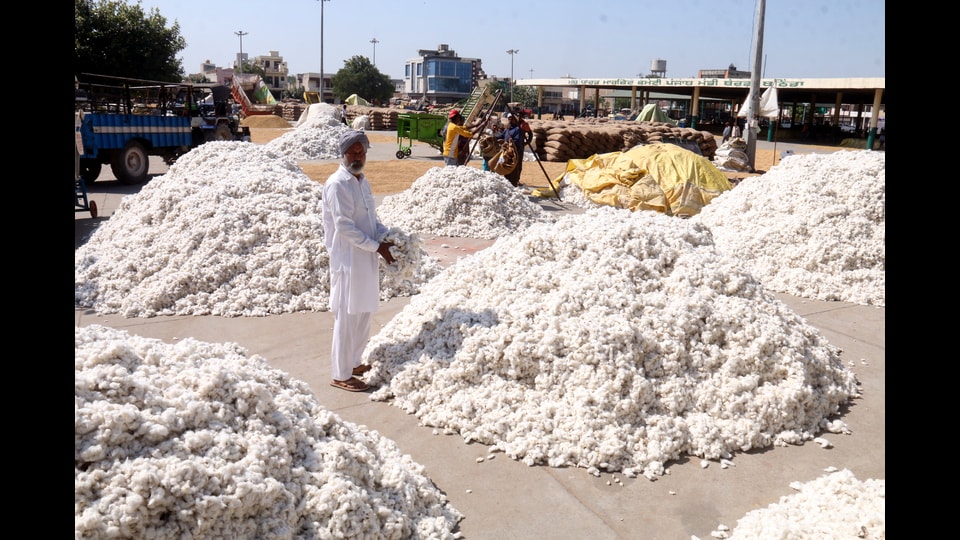
According to the state agriculture director Jaswant Singh, the department has set a target to cover 2 lakh hectares under cotton in the 2024-25 kharif cycle. Acreage of the ‘white gold’ saw a downward trend from 2021-22 and experts attribute it to deadly pest attacks of whitefly and pink bollworm, lack of irrigation facilities in the canal-fed areas and inclement climatic conditions.
Cotton sowing would start soon after harvesting of the key rabi crops of wheat and mustard and experts at Punjab Agricultural University have advised complete sowing by May 15.
A data said Punjab’s area under cotton is going down every year — in 2021, it was 2.52 lakh hectares, in 2022 it was 2.48 lakh hectares and in 2023, it was 1.73 lakh hectares, the lowest ever.
In 2020, the state had recorded a bumper production of about 50 lakh quintals but owing to multiple factors in the next three years, farmers started shying away from the cash crop sown traditionally in the semi-arid region of the south Malwa belt.
Officials in the agriculture department said initially the authorities had planned to raise the cotton area to 4 lakh hectares this kharif season to stop farmers from switching over to water-guzzling paddy but after going through the ground reality, the target area was brought down to half.
“It would be a challenge to meet even the target of 2 lakh hectares,” added an official.
Admitting the challenge, director Jaswant Singh said the agriculture authorities are working to motivate farmers to sow maize if not cotton.
“Due to subsequent crop failures in the last three years, farmers faced an economic setback. The state government has taken several measures to support farmers by introducing a subsidy on seeds to ensure only approved varieties are used and banning cultivation of summer moong in the cotton-growing areas to curtail the scope of whitefly attack,” he added.
Subsidy proposal on bio-safe tech shelved
In 2023, the agriculture department mooted a plan to give a subsidy on Specialised Pheromone and Lure Application Technology (SPLAT), a wax-based formulation to combat pink bollworm infestation in cotton crop, in the 2024-25 kharif season.
However, it was shelved due to high-cost involvement.
“The initiative was aimed at rebuilding confidence among the loss-making cotton growers to stop switching to rice cultivation. There was a plan to get financial support from the Centre for the project but it has been dropped for this season. But we will encourage farmers to use SPLAT and PBKnot and hope for its ample availability in the market,” confirmed the director.
SPLAT is an advanced mating disruption technology (MDT) containing chemicals secreted by insects to lure male moths. Expert says MDT targets only pink bollworm’s population cycle and other insects remain completely unharmed.
In SPLAT, the application of a pea size of pheromone paste is applied to cotton plants. Whereas, in PBKnot, the pipe is needed to put on the top twigs. In both cases, MDT products are used after 40-45 days of sowing, and it must be applied before the flowering stage.


