
 E-Paper



Legal experts divided over Punjab's new anti-sacrilege bill
The bill, tabled by CM Bhagwant Mann, aims to provide a stringent legal deterrent against acts of sacrilege, proposes stricter penalties, including life term.

 Prefer HTon Google


The legal experts are divided over the Jaagat Jot Sri Guru Granth Sahib Satkar (Amendment) Bill- 2026 that was passed by voice vote during the one-day special session of the assembly.

The bill tabled by chief minister Bhagwant Mann, with an aim to provide a stringent legal deterrent against acts of sacrilege, proposes stricter penalties, including life term, along with fines up to ₹25 lakh.
This is not the first legislative attempt by successive governments in Punjab to address the sensitive issue of beadbi (sacrilege).
Sacrilege has remained a highly emotive issue in the state, particularly after the 2015 incidents in Faridkot involving the Guru Granth Sahib and the subsequent death of two protesters in police firing, which triggered widespread unrest.
Punjab’s former advocate general APS Deol cautioned that the law could be prone to misuse.
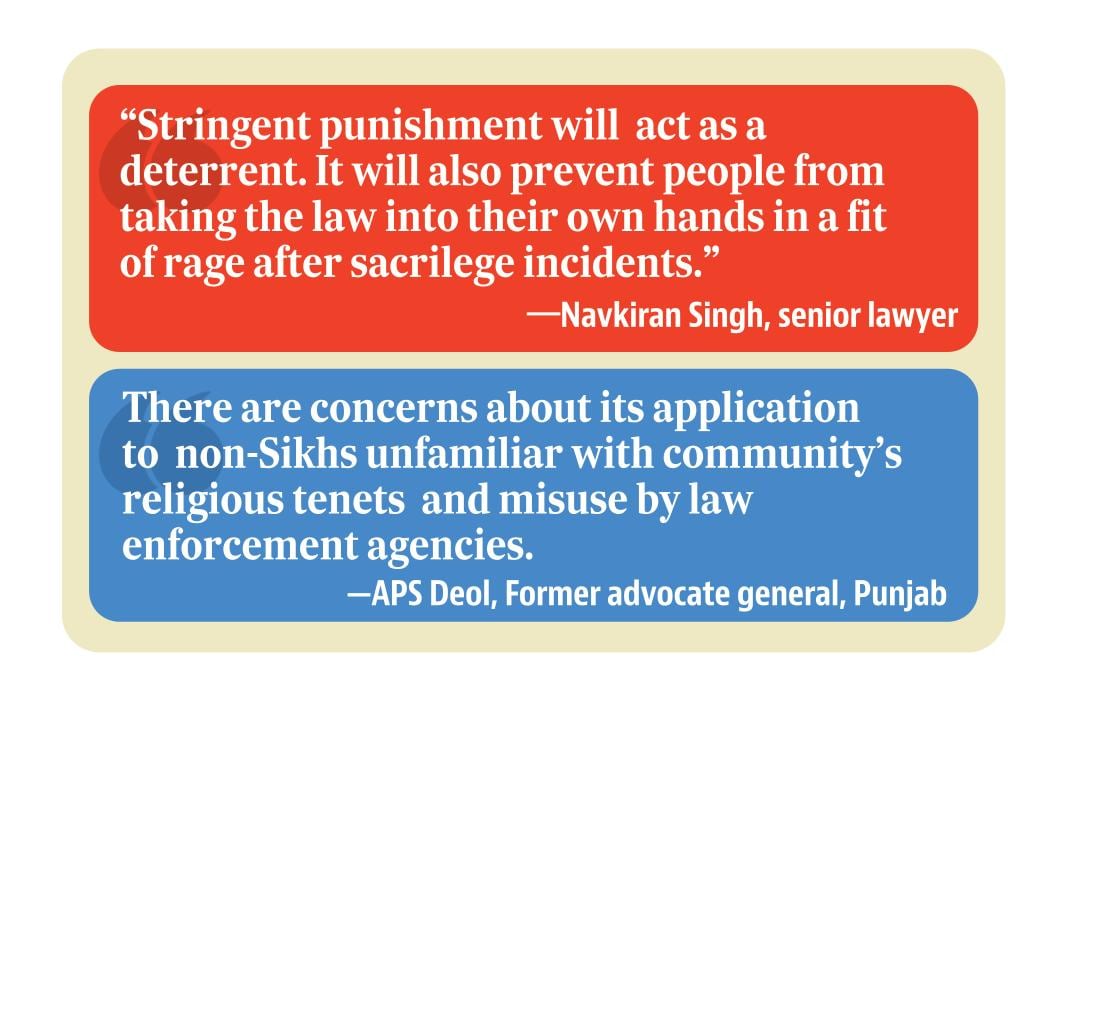
He questioned the absence of distinctions in cases involving minors, women, or persons of unsound mind. “There are also concerns about its application to non-Sikhs unfamiliar with Sikh religious tenets,” Deol said, while warning of potential misuse by law enforcement agencies.
Senior advocate RS Bains expressed doubts over whether the freshly passed legislation will secure the governor’s or the President’s assent if referred.
He also flagged concerns about possible misuse, alleging that fabricated evidence could be used by police to falsely implicate individuals.
In contrast, senior lawyer Navkiran Singh said that stringent punishment could act as a deterrent. “It will help prevent people from taking the law into their own hands in the aftermath of sacrilege incidents,” he said.
Human rights activist and lawyer Jaspal Singh Manjhpur said that while the government has proceeded with the Bill, it may not fully satisfy sections of the Sikh community.
“In Sikh tradition, the Guru Granth Sahib holds a sovereign spiritual status and cannot be regulated under a statutory framework,” Manjhpur said, while pointing out that the law’s jurisdiction would remain limited to Punjab.
Past attempts
It is not the first time that a law has been brought for stricter punishment for perpetrators of sacrilege acts. In 2016, the then SAD-BJP government brought in the IPC (Punjab Amendment) Bill, 2016, and the CrPC (Punjab Amendment) Bill, 2016, recommending a life sentence for sacrilege acts against Guru Granth Sahib. The Centre later returned the Bill, saying all religions should be treated equally, given the secular nature of the Constitution.
In 2018, the then Congress government led by Capt Amarinder Singh had passed two Bills -- the Indian Penal Code (Punjab Amendment) Bill, 2018, and the Code of Criminal Procedure (Punjab Amendment) Bill 2018, which stipulated a punishment of up to life imprisonment for injury, damage or sacrilege to Guru Granth Sahib, the Bhagavad Gita, Quran and the Bible. However, those two Bills did not get the President’s assent and were returned.


