
 E-Paper



Punjab’s maiden honey processing unit brings sweet rewards
Besides imparting training and sensitising farmers about beekeeping, the honey processing unit in Punjab has done a business of ₹ 1.50 crore by providing bees to process and sell the end product of apiculturists

 Prefer HTon Google


Within a year of its functioning, Punjab’s first honey-processing cooperative society has started contributing successfully to the Union government’s ‘Sweet Revolution.’
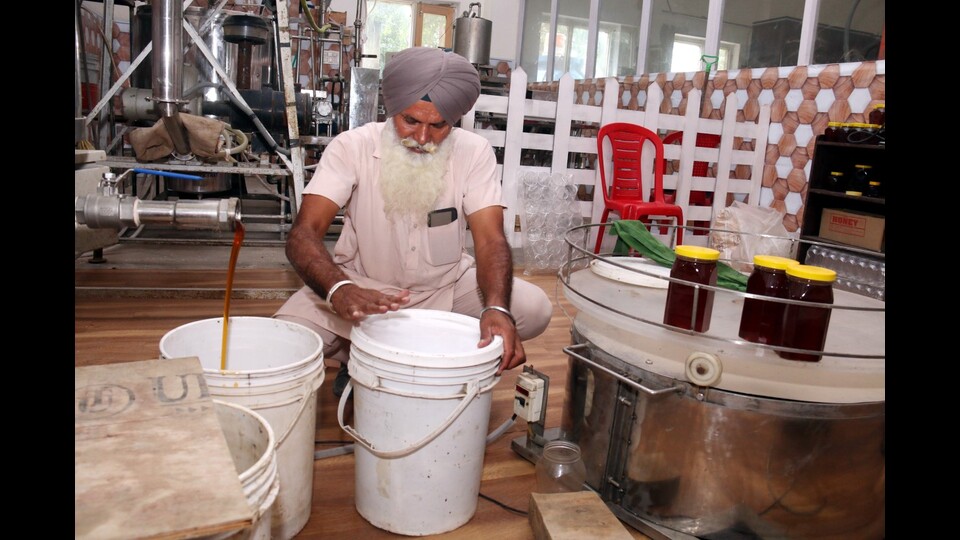
Located at Tungwali, about 25 kms from the district headquarters, the centre-funded Tungwali Beekeepers Cooperative Society, a special purpose vehicle (SPV) or a subsidiary institute, commenced operations in September 2021 to boost the income of rural entrepreneurs by providing sustained employment for traditional industry.
Besides imparting training and sensitising farmers about beekeeping, the cooperative has done a business of ₹ 1.50 crore by providing bees to process and sell the end product of apiculturists.
Backed by an experience in apiculture of over two decades, Gurcharan Singh Mann took the initiative to convert his farm into the state’s maiden honey processing unit in the cooperative sector under the Scheme of Fund for Regeneration of Traditional Industries’ (SFURTI).
“Our daily honey processing capacity is more than four tonnes and the facility is equipped to manufacture all infrastructure including, bee boxes, wax, bottling, labelling and packaging the refined honey under one roof,” said Mann, the chairperson of the society.
Of the ₹ 2.72 crore project, Mann’s investment was ₹ 68 lakh and the rest was the subsidy by the centre.
Experts said the demand for honey has been increasing in the domestic and international markets and farmers can earn handsomely with low investment.
“Honey has a large potential market and the natural product can be used easily in manufacturing more than 100 products, including soap, cream and salty snacks,” said Mann.
According to Sarabjit Kaur, a resident of Mehraj who has been a beekeeper since 2003, rates of honey have improved since the Covid-19 outbreak due to enhanced awareness of the benefits of the natural sweetener.
“Being part of a woman’s self-help group in the village, I am working in collaboration with Mann. He also arranges transportation of bee boxes to different parts of Punjab, Rajasthan and Himachal Pradesh on the basis of the flowering season. Even conventional farmers earn extra with low investment in apiculture,” she added.
General manager of Bathinda district industry centre (DIC), the implementing agency, Preet Mohinder Brar said the annual average honey production in the district is 800 tonnes.
“This first-of-its-kind project has immense scope to support the enterprising community. In spite of challenges posed by Covid-19 induced restrictions, Tungwali centre has provided training to over 100 aspiring beekeepers,” said Brar.
A progressive farmer from Muktsar, Lakhwinder Singh is planning to invest about ₹ 10 lakh with his relatives in beekeeping for the first time.
“We were guided to contact Tungwali cooperative to secure all basic requirements and training to start the venture. Honey production is remunerative and one can earn without investing in farmland,” he added.


