
 E-Paper



Right to life meaningless without right to education: Justice Gavai
The Supreme Court judge was speaking during a two-day international webinar organised by Chandigarh University


Justice Bhushan Ramkrishna Gavai, a judge of the Supreme Court of India, on Saturday said that the right to life was meaningless without the Right to Education.
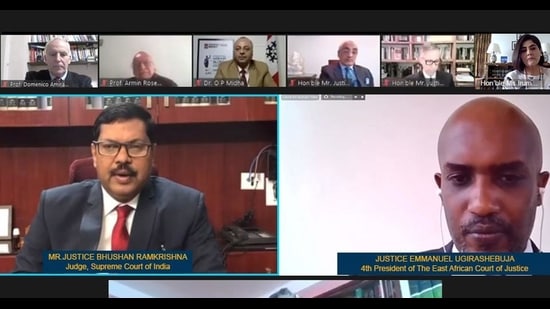
Justice Gavai was speaking during the two-day international webinar on “Global challenges in modern times” organised by Chandigarh University.
“Right to life provided to us under Article 21 of the Constitution of India is meaningless without the incorporation of the Right to Education as Dr BR Ambedkar said that there was no use of rights if a person does not possess the knowledge to use them,” the judge said.
“With the implementation of the New Education Policy, more deprived sections of the society of our country will come under the ambit of education and will improve their social and economic status,” said justice Gavai.
Supreme Court judges from ten countries including India, USA, UK, Nepal, Brazil and others are taking part in the international webinar to dwell upon issues like Right to Education, nuclear energy and environment protection, laws for migrant population and human rights.
Justice Surya Kant said, “With the enactment and implementation of the Right to Education, the social and economic status of citizens, especially the vulnerable sections of society, drastically improved.”
Justice Kant further added that women today had dismantled the social barriers and inequality that the world had enforced upon them: “This has been made possible in countries like India only because of the recognition of the Right to Education.”
Justice Brian Preston, chief judge of land and environment, Court of New South Wales, said, “Countries like India have committed to reduce carbon emissions by 35% by generating 9% of the total electricity from nuclear energy, which is currently at 4.2%.”
Speaking on the contribution of migrant workers, Ananda Mohan, a justice of the Supreme Court of Nepal, said, “Migrant workers are the most unprotected sections of humanity, especially those working in unorganised sectors and those self-employed in urban centres away from their native places.”


