
 E-Paper



Roundabout: Alchemy of war - national interest or pride, prejudice
City-based writer Mandeep Rai, with a passion for the historical novel genre, delves deep into the Great War to lay bare the deep disasters of war and brings forth humane sagas of resistance


War has always intrigued writers as has peace. Stalwart American writer Ernest Hemingway, who was witness to both world wars — first as a volunteer ambulance driver, then as a reporter — in his classic A Farewell To Arms (1929), says World War I was “the most colossal, murderous, mismanaged butchery that has ever taken place on earth. Any writer who said otherwise lied, so the writers either wrote propaganda, shut up, or fought.”

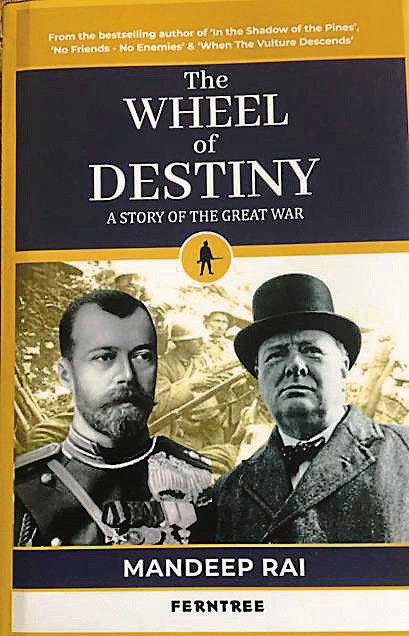
Recounting the Great War, as it is called, Chandigarh-based writer Mandeep Rai, in his action-packed novel The Wheel of Destiny highlights the utter futility of war. “Apart from the feeling of dread and horror, what stands out in the end is the piercing realisation that there are no victors, friends lose and so do enemies,” says Rai. A fictional character in the book sums it up: “Entire mankind is the victim, but ultimately God is the victim.”
The Great War novel, published by Ferntree Publishing, follows Rai’s In The Shadow Of The Pines, No Friends, No Enemies and When The Vulture Descends. Rai says, “World War I has continued to inspire and intrigue me as in it lies the genesis of World War II and the state of affairs in the present world. I have delved deep into the mysteries and causes of the war with its share of misguided patriotism and chauvinistic fervour. The 19th century philosopher Friedrich Nietzsche aptly said, ‘war is the destiny of man’ and sadly the Great War proved him right!”
Khushwant’s wonder
Born in 1949 in Sherwani Kot near Malerkotla, Rai’s father Colonel Amar Singh was a commissioned officer in the British Indian Army serving in the Army Service Core. It was the princely Yadavindra Public School, Patiala, a prestigious institution for the children of the Jat elite that his skill with words as well as the English language was honed. Years on, glancing through his book ‘In The Shade Of The Pines’ celebrated writer Khushwant Singh, a child of the Raj, looked up in admiration and asked, “Angrezi kithon sikhi ?”(Where did you learn English from?), “YPS Patiala ton!” (From YPS), came the pat response.
The idea of the book first came to Rai when he was posted in Shimla. “It was inspired by Lord Dalhousie who changed the face of colonial India by bringing many reforms and introducing railways, the electric telegraph and laying the foundations of the modern education system. As a visionary governor-general, he consolidated the East India Company’s rule by strengthening the administrative system. India owes a lot to him, and it was ironic indeed that many in Britain denounced him for not seeing the seeds of Indian rebellion of 1857, which we remember in Independent India as the first war of independence.”
“In The Shade Of The Pines’ did exceedingly well in circulation as well as reviews, including a generous one by Khushwant himself, whose one regret was that it should have been brought out internationally.
From words to numbers
One wonders how a young man with a love for writing and a great interest in literature found himself in the Indian Revenue Service, he smiles and replies: “The problem was that I was good at too many things. I was known in school for my soulful essays, debates and declamation. Interestingly, when I passed out, the boys of a junior class snatched the notebook, in which I wrote my essays. As boys pulled at it, the notebook was torn into three. Word reached the faculty and the principal. He announced that if any boys were found copying my essays, they would be given a big zero.”
Rai was equally good at numbers, a topper and an all-rounder. Dismissing the idea of humanities, his father wanted him to go for engineering in an IIT. So, off he went to IIT Bombay to study chemical engineering, which he left after doing well for two years to pursue a bachelor’s course in English in Government College, Chandigarh. But his persuasive father made him take the competitive examinations and there he landed in the revenue service, which is the destiny of many a bright student, boy or girl.
A columnist once wrote about him, saying: “How important are figures to a writer of historical fiction? For Mandeep Rai, the six-feet-tall sardar in a red turban, here are the ones that spring to mind: 50 years, four books and 111 rejections the first time round; eight, six and five years poured into the second, third and latest novel respectively; 3,000 copies of his first book sold; and, oh yes, this little note of encouragement from his father, now 80, “If you want to be a writer, it’ll take you 20 years to get published.” It took Rai 30.”
Well Rai was never afraid of numbers or words and with the novel on The Great War in the hands of the readers, he is already contemplating his next novel. Bravo!


