
 E-Paper



Roundabout | The play is the thing and Mumbai the protagonist
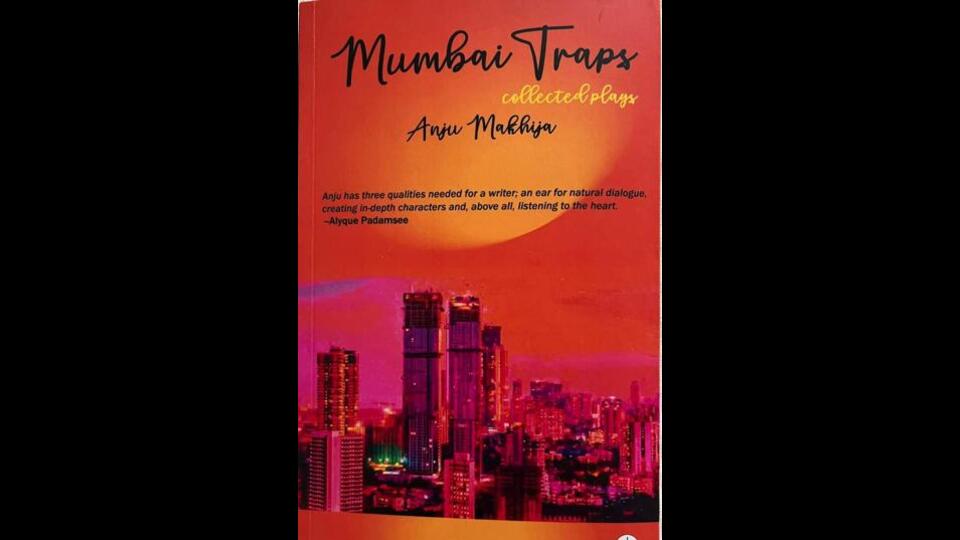
It’s pickling season in poet-playwright Anju Makhija’s Amchi Mumbai ; her anthology of six plays titled ‘Mumbai Traps’ is a literary testimony to the life and times of its people over several decades

 Prefer HTon Google


“Anju Makhija has three qualities needed for a writer: an ear for natural dialogue, creating in-depth characters, and above all listening to the heart.” This is how theatre veteran, the late Alyque Padamsee had described the poet- playwright’s writing prowess.
One of the trailblazing writers of English, Makhija put her talents to optimum use as a poet, playwright and translator. She won the Sahitya Akademi Award for her translation of 16th century Sufi poet Shah Abdul Latif’s ‘Seeking the Beloved’, and has received many other honours for her poetry and plays.
While the stress is on her Mumbai plays, one cannot help but dwell on her signature poem because poets do make the best of playwrights across languages and poetry is the highest mark of creativity. ‘Pickling Season’ is one of her best loved poems, in which she starts with appreciating nature’s bounty and “then onto peeling, chopping, salting, boiling, spicing, bottling….” The residents of Chandigarh, which was largely built on mango groves, will relate to the process. However, it takes a poet with Makhija’s talent and insight to relate it to human relationships in the larger sense.
She asks: ‘Will the sorcery work?/By year’s end, we hope, when/ the pungent brine matures to its prime./ The zing depends on turmeric balancing the tamarind,/ the chili complementing the amchur,/ and if the assafetida poured in candle light/ late one night works for pickles/as if seldom does for couples, apart since the first pickling season./ The alchemy has rarely bewitched,/ Jaggery sours, vinegar sears the tongue./ To change the recipe we’ve tried/ with old ladies’ advice,/ but nature moves inexorably,/and life proceeds predictably/ beneath the mango tree.
Looking anew at Indian theatre
In Mumbai Traps, a volume of six plays penned over the past three decades and published by Dhauli Books, Mumbai is a central character cast in manifold shades – sometimes, as a reflection of the city’s obsessions; other times, as a confidante to its secrets. The titles included in this volume are telling: If Wishes Were Horses, The Last Train, Cold Gold, Now She Says She’s God, Meeting With Lord Yama and Off the Hook.
Of her interest in playwriting, Makhija says: “ My obsession for drama began in my days as a student at the State University of New York. Being on a very limited budget, my options were few. To my delight, I found many readings and performances to be free-of-charge, especially the Off-Broadway variety. From renowned playwrights, like Arthur Miller, to contemporary ones, like John Guare, I was exposed to an exhilarating array of plays. In later years, when I continued my studies in Montreal, Canada’s multicultural mosaic widened my outlook – from French satire to Chinese folklore, I took it all in”.
However, Makhija, who was rooted in the Indian soil and made Mumbai her home, decided to make up for her lack of exposure to regional Indian theatre by exploring the works of well-known Indian playwrights across languages such as Vijay Tendulkar, Girish Karnad, Mohan Rakesh, Badal Sircar, Mahasweta Devi and others of the generation. Understanding the complexity of their work she began to evolve her own form from both the worlds. This was something different as most of Indian writers of English looked only at the West , dismissing the ‘bhasha’ writers. But here was a writer who knew that she wanted to write of the world around her and seclusion of any kind would not help because the regional drama had forged ahead of the western fare.
City in search of a playwright
The first play that Makhija wrote was ‘If Wishes Were Horses’ and was quite ready for lack of enthusiasm when she read it at the National Centre for the Performing Arts (NCPA), Mumbai. But what happened was quite contrary as two directors expressed interest in it, and even eminent theatre director, Pearl Padamsee, discussed it avidly with her saying that class discrimination was at the heart of the play. Makhija recalls, “It was finally directed by Anahita Uberoi in a rather unique way. I was not in favour of Hinglish, which was creeping into the theatre scene at the time, and had suggested the play be performed bilingually. Anahita respected this and presented it in English with a generous dose of Hindi and Marathi.”
The play was hailed as the first bilingual play in India. Jiten Merchant’s review in a leading newspaper said: “In If Wishes Were Horses, much is touched upon – the rights of women, dreams of the underprivileged and the difficulty in reconciling idealism with practicality. Anju Makhija’s symmetrically constructed script strikes a chord or three... It varies from extreme naturalism to surreal fantasy with patches of slightly stagy dialogue and moments of high, almost farcical comedy.”
The playwright evolved her own medium and she was to chisel it further from play to play, tackling several issues along the way. Uma Narain, a well-known scholar of theatre and founder of The School of Liberal Arts, Mumbai, calls the plays a ‘lifetime’s work’.
“The volume is called Mumbai Traps and its most striking feature is the omnipresence of the omniscient city; Mumbai materialises into different forms and shapes. At times, it is the other way around and Mumbai becomes the all-powerful behrupiya in search of a playwright, demanding to be cast in myriad shades of characters and situations. Either way, the city is a palpable presence in all the work as a character, a trap, an elusive ambition or simply a backdrop contextualising and influencing the narrative, but never inert or docile”.
An inspirational journey
It is indeed an inspirational journey, remarkable by the sheer sincerity of its search not just for words but also the people behind the words, people of different folds, wearing different clothes and speaking different languages. Makhija’s plays have been staged in India and abroad. Her other awards include: the Charles Wallace Trust Scholarship and the BBC World Poetry Prize. She was on the English Advisory Board of the Sahitya Akademi for five years and is the co-founder of the Auroville Poetry Festival.


