
 E-Paper



Sonam Wangchuk’s climate fast ends; survived on water, solar gadgets
On the fifth and last day of his climate fast, Sonam Wangchuk reiterated his demand of the sixth schedule to protect fragile environment of Ladakh, its mountains, glaciers, land, people and culture

 Prefer HTon Google


Education reformist Sonam Wangchuk’s five-day ‘climate fast’ in sub-zero temperature of Ladakh ended on Monday after Buddhist spiritual leader Thupstan Chhewang offered him some food at the Himalayan Institute of Alternatives Ladakh (HIAL).
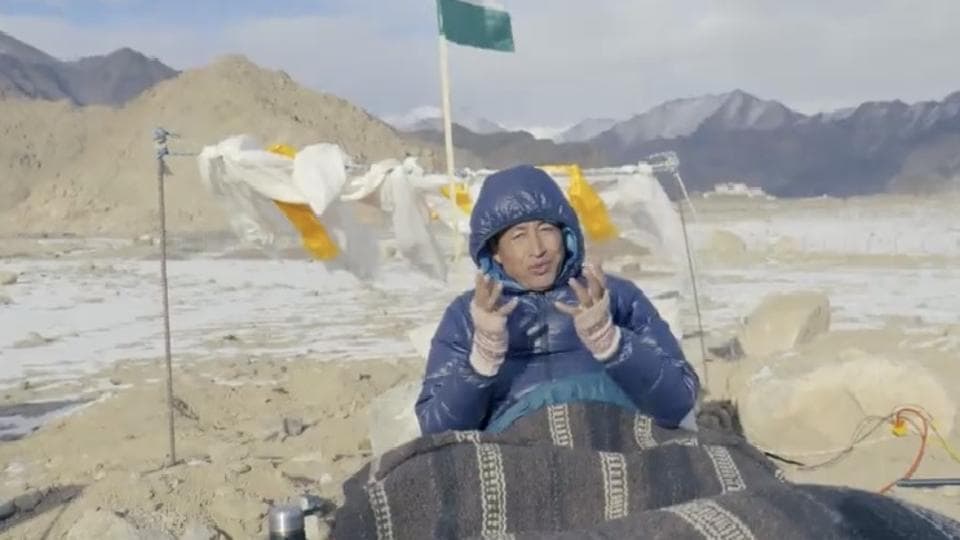
Wangchuk, 56, known for his environment-friendly innovations, has been demanding safeguards under the sixth schedule of the Constitution to Ladakh.
Despite “arm-twisting” tactics by the Ladakh UT administration, an undeterred Sonam Wangchuk went ahead with his fast on Republic Day that culminated on Monday.
On the fifth and last day of his fast during which Wangchuk survived on water reiterated his demand of the sixth schedule to protect fragile environment of Ladakh, its mountains, glaciers, land, people and culture.
“People from all religions and areas of Ladakh joined me on the last day of my climate fast. The fast was for our region, Himalaya’s glaciers, which finds a mention under the sixth schedule, our land and people,” he said. Wangchuk said that 200 crore people depend on glaciers and half of the glaciers were in the Indian sub-continent.
“The entire population in northern India directly or indirectly depended on Himalayan glaciers and if they are not conserved and if keep melting them in the name of industrialisation then we will all face severe water crisis. So, we have to preserve them,” he said.
He expressed regrets that in democracy the leaders saw things from the prism of five years tenure and the nature becomes a casualty for them.
He also took a swipe at the Ladakh UT administration for preventing him from going to Khardung La for observing the fast.
“The administration in the last three years has failed in providing jobs. They had promised 12,000 jobs but only 250 to 300 were given away that too in police department. Similarly, powers of hill councils are being diluted. Out of ₹6,000 crore budget to the region, 70% of it lapses and only 8% is given to hill councils while lion’s share goes to the L-G, who doesn’t understand the pain and sufferings of the locals,” he said.
He claimed that in the absence of elected representatives, democracy died long ago and only one man (LG), an outsider, doesn’t understand the region and its people.
“Now, the people of Ladakh are demanding full statehood,” he said and reminded that and Ladakh had to be a UT with legislature, which remained elusive.
“Ladakh is now permanently under governor’s rule but people are now demanding full statehood,” he said.
Disheartened by “dilly-dallying” tactics of the BJP government to provide safeguards under sixth schedule, Wangchuk had decided to go on a five-day fast.
On Monday, Chhewang and several religious leaders from Leh and Kargil joined Wangchuk in his climate fast.
In the evening, Chhewang offered some food to Wangchuk to end his five-day fast.
During the fast at HIAL, Wangchuk survived the sub-zero temperature with his innovative gadgets.
To draw the attention of the people around India and world to lead carbon neutral lives, he had put up a solar exhibition that included a solar concentrator dish, a solar power system and a solar bed.
Solar concentrator dish supplied hot water to him by concentrating sun rays to a black metal pot containing water at the centre.
Solar power system comprised a solar foothold type panel that generated electricity from the sun and supplied it to a solar box that contained batteries because they go cold and would freeze in minus 20 and minus 40 degree Celsius.
Solar bed during the day could be folded and used as a bed. It absorbed sun rays during the day. Inside it had a black water mattress with a heat storage capacity.
At night, with the help of four panels a little tent was raised over the bed to protect the body from icy winds and beneath the black water mattress kept the bed warm.


