
 E-Paper



Spiti valley’s young eco-warriors wage war on plastic waste
With heaps of plastic waste blemishing the once pristine Spiti valley, a battalion of young eco-warriors is transforming these non-biodegradable eyesores into avant-garde poly bricks

 Prefer HTon Google


Tenzin Choedon is only 10, but each day the precocious eco-warrior gathers polythene bags, beer bottles, wrappers, cups and straws carelessly strewn along roadsides and forest trails in the picturesque Spiti valley, and stuffs these non-biodegradable pollutants into empty plastic bottles, which are reused as poly bricks.
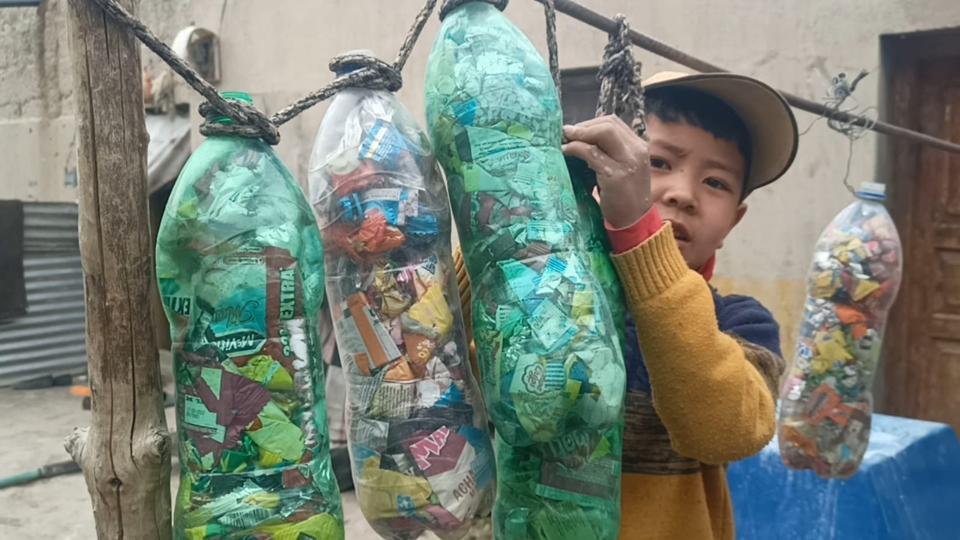
He is among the motley group of young environmental crusaders – which includes his younger sisters Thinley Palmo, 8, and Palmo Cheering, 6, his classmates, neighbours and members of local youth clubs – who have undertaken the mission to restore the valley to its pristine splendour.
The green warriors deposit these bottles crammed with discarded plastic waste, which serve as an alternative to construction bricks, to the block office at Kaza, which is the subdivisional headquarters of Spiti. A two-litre poly brick weighs at least 500g.
No waste treatment facility
Spread over 7,119 square kilometres, the valley has around 231 villages that house 12,457 people, but no waste treatment facility, which makes the reuse of plastic waste in the form of poly bricks all the more essential to protect the region’s fragile ecosystem.
In the absence of a waste treatment plant, villagers either burn the waste or dump it in pits. The valley, which receives a heavy tourist influx, generates 40 tonnes of garbage annually. Kaza does have a material recovery facility, but the project is riddled with challenges, as waste is not being segregated.
Preserving the green heritage
Eco-activism has been passed down to the young crusaders who take pride in the unique ecology, culture and traditions of the valley. Choedon’s father, Tenzin Lhamo, 41, a resident of Lingti village and a farmer, says, “Mountains have a fragile ecology, but we do not have a system in place to dispose of the waste. Therefore, I learnt how to make poly bricks from the panchayat pradhan. When he grows up, my son will take up farming as well, but if the fields are littered with plastic how will we grow crops?”
Kaza block development officer Tashil Dolkar said, “We encourage school children, mahila mandals and nav yuvak mandals (youth clubs) to help manage plastic waste. These poly bricks are being used for low-cost construction of walls. Recently, we used them to make benches. Schools have been directed to restrict the use of plastic on the premises, and ensure that the area outside the school (up to at least 500m) remains litter-free.”
“The garbage disposal plant will also start functioning by May-end,” she added.
Pradeep Sangwan, the founder of Healing Himalayas, an organisation of volunteers working for the preservation of the ancient mountains, says, “In the absence of door-to-door waste collection, and scientific waste disposal, poly bricks can help manage non-biodegradable waste.”
The organisation has got the nod from the district administration to set up a material recovery facility in Tabo village, which is famous for ancient monasteries that were built in 996 AD. “We are hoping to finish construction by June-end and operations will start by the first week of July,” he said.
Buy-back waste initiative
In 2019, Himachal Pradesh launched an initiative to buy back non-recyclable plastic waste. Under the policy, the government is procuring plastic waste at a minimum support price of ₹75 per kg. Under the scheme, 227 tonnes of plastic have been procured to date.
The Public Works Department is using at least 10% of the plastic waste collected for surfacing roads, while the rest is being procured in kilns.
Mixing 15% plastic waste will help save an equivalent quantity of asphalt, thereby reducing the overall road construction cost.
In 2009, Himachal Pradesh imposed a ban on the production, storage, use, sale and distribution of all types of polythene bags made of non-biodegradable material. The government later included all plastic materials like disposable plates, cups and glasses within the ambit of the ban.


