
 E-Paper



Tiger caught on camera for first time in Himachal’s Simbalbara National Park
Officials suspect that the tiger may have crossed over from Rajaji National Park in neighbouring Uttarakhand owing to low water level in Yamuna


Wildlife officials in Himachal Pradesh are upbeat after a tiger was captured on the camera in Simbalbara National Park in Sirmaur district.
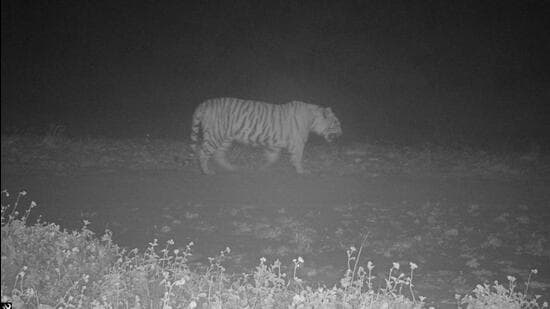
The Shimla wildlife division had shared the picture of the big cat on its Twitter handle on February 21.
Earlier in January, wildlife officials had reported pug marks in the park after which they started following the feline.
Officials suspect that the tiger may have crossed over from Rajaji National Park in neighbouring Uttarakhand owing to low water level in Yamuna.
“It appears that tigers are using the corridor between Rajaji, Simbalbara and Haryana’s Kalesar National Park. A tiger was caught on the camera trap set up by the wildlife department. Such sightings might increase in Simbalbara in the near future,” said divisional forest officer, wildlife (headquarters), Ravi Shankar.
Himachal Pradesh is home to big cats like leopards and snow leopards, but sightings of a tiger have never been reported in its territory.
Located in Sirmaur’s Paonta, Simbalbara National Park with its deep green valleys, mountains, water streams and jungles makes for a perfect jaunt for nature lovers.
In the past, it was a hunting ground of maharajas of Sirmaur.
From the periphery of the forest, tourists can catch glimpses of picturesque Puruwal valley. The park is also home to rhesus macaques, leopards, Indian muntjac, gorals, crested porcupines, Himalayan black bears, wild boars and common langurs. Spotted deers, chittals and Indian muntjac are also found in its dense Sal forests.
The park was set up in 1958 as a wildlife reserve and designated as a sanctuary in 1974.
The 27.88 square kilometre sanctuary was declared a national park in 2010.
It shares its boundary with Haryana’s Kalesar National Park.
The wildlife department has also planned to introduce a pair of tigers at Renukaji zoo which once offered a lion safari. The wildlife wing has contacted three zoos and biological parks to get a pair of tigers in the sanctuary that was earlier popular for propagating Asiatic lions. The decision to move tigers into the lion sanctuary came after the last Asiatic lion died six years ago.
The wildlife wing department has moved a proposal under the animal exchange programme seeking a pair of lions and a pair of tigers for the Renuka sanctuary.
“We have got the approval from the Central Zoo Authority of India (CZAI) to build enclosures for tigers in Renuka,” said Ravi Shankar.
The wildlife department had earlier proposed to get a pair of lions from the zoological park in Gandhinagar (Gujarat) while a pair of tigers has been proposed to be brought from Bannerghatta National Park in Karnataka.
Asiatic lions at Renukaji once grew fast and steady. However, in the later years, their population gradually declined because of inbreeding problems. Renuka Safari was considered as the first zoo in Himachal Pradesh and set up in 1957 by caging animals that strayed into human habitations.
Initially, the sanctuary came up as a mini-zoo and later on, many endangered species were introduced there.
Hog deers, barking deers, chinkaras, blackbucks and other species were added gradually. With time, their population grew and to accommodate increasing number of animals, an open park was set up in 1983.


