
 E-Paper



US court convicts man of killing first turbaned Sikh police officer
Robert Solis, 50, was convicted by the jury of the Harris County Criminal Court in Houston for the capital murder of 42-year-old Sandeep Dahliwal, a 10-year-veteran of the Harris County Sheriff’s Office. He had drawn widespread notice when he gained permission to wear a turban as part of his uniform in 2015, and was killed in an ambush-style shooting while on duty on September 27, 2019


Houston: A man, who was found guilty of capital murder for gunning down Deputy Sandeep Dahliwal, the first turbaned Indian-American Sikh police officer in the US state of Texas in 2019, has been convicted by a court.
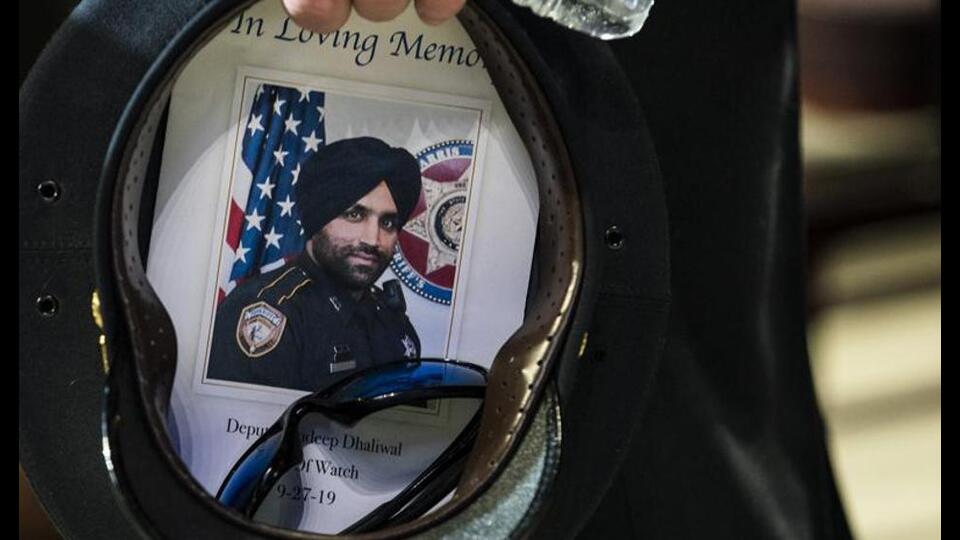
Robert Solis, 50, was convicted by the jury of the Harris County Criminal Court in Houston for the capital murder of 42-year-old Dahliwal, a 10-year-veteran of the Harris County Sheriff’s Office. He had drawn widespread notice when he gained permission to wear a turban as part of his uniform in 2015, and was killed in an ambush-style shooting while on duty on September 27, 2019.
With Dahliwal’s family in the courtroom on Monday, the jury took less than 30 minutes to announce the verdict.
Solis, who fired his attorneys, had decided to represent himself in court. He started his opening statement in the punishment phase by asking for the death penalty.
“Since you believe I’m guilty of capital murder, I believe you should give me the death penalty,” Solis told the jury.
Jurors deliberated for just 25 minutes before finding Solis guilty of capital murder. “A swift verdict does not tell anyone in this courtroom what they already know…Find him guilty of capital murder,” the Prosecutor said in his closing arguments in trial of Robert Solis accused of killing.
The verdict came after over three years after Solis was arrested and charged with capital murder, accused of shooting Dhaliwal to death during a routine traffic stop.
As Judge Chris Morton read the verdict, Solis nodded his head slightly and showed no emotion.
During his testimony and closing argument of the guilt phase, Solis claimed that the shooting was an accident, calling the state’s case against him insufficient.
“I stand before you an innocent man until you all go back there and deliberate and determine whether or not the state has met its burden and whether I intentionally and knowingly, a conscious objective, shot this deputy,” Solis told the jurors.
Prosecutors said that Solis, who had an active parole violation warrant for aggravated assault with a deadly weapon from 2017, was motivated to kill the deputy because he did not want to go back to jail.
To prove their case they showed the jury a video from slain Deputy Dhaliwal’s body cam, showing Solis jumping out of his car and running up to his patrol car in the middle of the traffic stop, ordering him to put his hands up and not to move.
He then shot the deputy in the head at point-blank range.
It was a piece of heartbreaking evidence that moved everyone, members of the jury and Dhaliwal’s family, in the courtroom into tears.As for Solis, just moments after the actual video of the murder was played, he asked the judge to render a summary judgment on the case, right then and there, and declare him acquitted of the crime, claiming the state had failed to make an adequate case against him for capital murder.
The killing of Deputy Dhaliwal, a father of three children, shocked the entire community in Houston, where he had been known as a “trailblazing deputy” for the Harris County Sheriff’s Office, who wore his traditional articles of faith, including a turban and a beard, while on patrol.
Dhaliwal worked with United Sikhs, a global humanitarian relief and advocacy nonprofit, to help organise the donation of truckloads of supplies for first responders after Hurricane Harvey. Dhaliwal was a source of pride for the Sikh community.
A post office in west Houston has been renamed in Dhaliwal’s honour. A year after his death, a portion of Beltway 8 near Highway 249 was renamed after him.


