
 E-Paper



Whitefly attack not widespread but be vigilant: Experts
Whitefly infestation in cotton-growing districts attributed to poor farm practices and humid conditions. Farmers urged to be vigilant.


With the whitefly infestation starting to surface in several areas of the cotton-growing districts, experts have attributed the emerging pest attack events to disadvantaged farm practices and ongoing humid climatic conditions. This year cotton has been sown in around 96,000 hectares, the lowest ever under this cash crop in the semi-arid south Malwa.
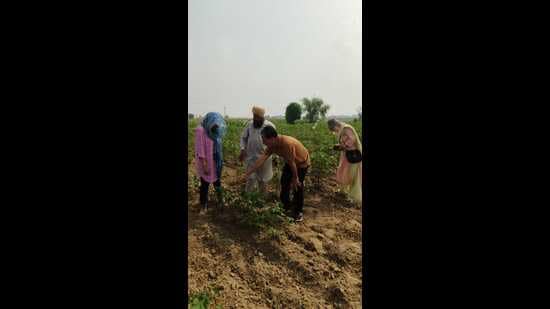
Besides the state agriculture officials, teams of entomologists from the Ludhiana-based Punjab Agricultural University (PAU) and its network of experts at Krishi Vigyan Kendra (KVKs) are holding field inspections in the southwest Punjab region to assess the situation.
They said field inputs suggest that whitefly’s impact on the cotton plant’s health is not visible at the moment but farmers have to remain vigilant for possible threat of the pest and pink bollworm attack in the next 15-20 days.
Information gathered from multiple sources on Tuesday confirmed that contrary to the advisory of the state government, this year farmers cultivated summer moong (green gram) on about 70,000 acres in the key cotton-growing districts of Fazilka, Bathinda, Mansa and Muktsar.
In 2023, the Punjab government restricted legume cultivation in all eight cotton-growing districts due to the established threat of the whitefly attack on the cotton crop referred to as white gold.
Officials familiar with the development said after the worst whitefly attack in 2015, an expert committee of PAU in 2016 had recommended against moong cultivation in south Malwa.
It was followed until the 2022-23 kharif period when chief minister Bhagwant Mann announced the assured purchase of the summer moong on the minimum support price (MSP) by the Punjab government as a part of the crop diversification plan.
Attracted by the lucrative promise, moong cultivation was adopted in a big way by the farmers.
A farmer said that given the high land contract rates, they have to adopt three crop patterns against the advisory.
“In several districts, farmers have started sowing summer maize while others are opting to sow zaid (third crop sown between rabi and kharif) moong to earn extra at the costs of groundwater depletion. This makes the cotton crop vulnerable to pest attacks. Since the 2021 failed cotton crop due to pest infestations, farmers are hesitant to sow it,” said the farmer.
A field agriculture official said that farmers have been apprised time and again against the cultivation of moong.
PAU principal entomologist Vijay Kumar, who visited several fields in Mansa and Abohar on Tuesday, said cultivation of summer moong or ‘rabi zaid’ in the semi-arid districts of Punjab on a big scale is a worrying trend.
“Moong plants are a natural host of the whitefly. After legume is harvested, pests shift to cotton fields. The occurrence of whitefly infestation is an annual feature during the ongoing hot and highly humid conditions prevalent in southwest Punjab this time around. The presence of the host plant enhances the scale of pest attack threat. Whitefly infestation could certainly have been scaled down significantly if farmers in the cotton belt, avoid cultivating moong,” Kumar added.
He clarified that inputs sent to him by the KVK networks across the districts of the region, the situation of whitely is not alarming.
Kumar said farmers should follow the experts’ advisories to protect crops as the use of insecticide would enhance the cost of cotton production.
“This time, PAU has advised to use insecticide “clasto” with a dose of 200 grams per acre. The farm chemical has been recommended for the first time, and it should be used if the pest count on a cotton plant crosses the economic thrash hold limit (ETL) of six or more adults per leaf. It was tested at an infested field in Mansa, and it gave satisfactory results,” the expert added.


