
 E-Paper



Wildbuzz: The timid kakar
Taking to its heels at the slightest sign of danger or a perceived threat, perhaps, accounts for its survival in a jungle where poachers particularly savour its flesh and natural predators such as leopards are forever on the prowl; the burglars included rifle-wielding poachers apprehensive about their nefarious nocturnal activities being caught on these stand-alone cameras


Jungle lore has it that the rarely seen barking deer or ‘kakar’ is an inordinately timid creature. Taking to its heels at the slightest sign of danger or a perceived threat, perhaps, accounts for its survival in a jungle where poachers particularly savour its flesh and natural predators such as leopards are forever on the prowl.

Fascinating evidence of the Kakar’s jittery nerves comes from a camera trap installed at an artificial waterhole atop a Shivaliks ridge at Karaundiawallah village, Mohali. The camera was placed by Chandigarh-based farmer and orchardist Narbir S Kahlon, a member of the state wildlife advisory boards of Chandigarh and Punjab.
The kakars, including a pregnant female, come regularly to Kahlon’s water hole. Night-time footage revealed that one of the kakars jumped back in fright when nearing the water. On closer examination of the footage, it transpired that the kakar had been rattled by a creature many, many times smaller in size: an Indian bullfrog! The pugnacious bullfrog, perhaps wary of the kakar drinking up the water in which the amphibian was dwelling, jumped to the edge of the water, squarely faced the approaching kakar and snorted loudly. The nervous kakar swallowed its pride and thirst and slunk away leaving the David-like bullfrog not only dominant over the precious pool but possibly also chuckling at having impelled the Goliath to beat an unceremonious retreat!
“Footage further revealed that the kakar would not dare drink water even when a peacock was quenching its thirst at the water point that the deer was habituated to. The kakar would retreat and return only after the peacock had departed,” Kahlon told this writer.
Apart from umpteen birds, insects, bees and moths, sambars, porcupines and an Asian palm civet regularly drink water from Kahlon’s benevolent provision. What has thrown a spanner in the works is that, on Friday night, thieves filched the US-made camera trap recording the valuable proceedings at the water hole. “I will not give up. I will either track down the thieves or buy a new camera trap and install safeguards against theft,” said Kahlon.
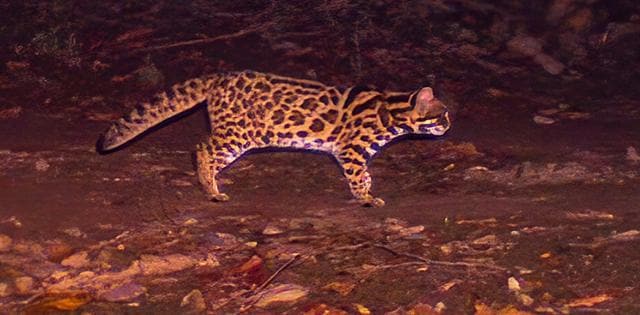
The mini-leopard
Narbir S Kahlon has suffered just the first of his expensive camera traps being burgled. Imagine the plight of eminent zoologist, Rajiv S Kalsi, who has lost 24 camera traps (priced at ₹28,000 each) to such thefts at the Kalesar National Park (KNP),Yamunanagar, Haryana.
The burglars included rifle-wielding poachers apprehensive about their nefarious nocturnal activities being caught on these stand-alone cameras. But the positive news is that Kalsi was not thwarted in his research effort by these thefts. The camera traps that escaped the burglars’ attention managed to record the hitherto unknown existence of the leopard cat at the KNP. A rare creature of north India, records of this species are scanty. Even at the iconic, sprawling Corbett National Park, this small but gorgeous cat is but rarely recorded.
“As for the KNP, there were no previous records of the species until my camera traps captured three specimens at night. The reason for KNP records drawing a blank is that firstly, no one had conducted a techno-savvy research on the lesser cats here; secondly, lesser cats are small and inconspicuous, secretive and get active deep into the night. So, their presence can easily be missed by the human eye. However, camera traps finally unearthed them. The leopard cat can be described as a mini-leopard as it is an ace hunter of jungle rodents and a crucial species in the predator hierarchy,” Kalsi told this writer.
The species was discovered during the course of a two-year research (2018-20) titled ‘Spatial ecology and prey base of lesser cats’, funded by the Government of India’s department of science and technology. Conducted by Kalsi — an author, associate professor and zoology head at MLN College, Yamunanagar — the research revealed the presence of four species at KNP — the leopard cat, rusty-spotted cat, jungle cat and Asiatic wildcat. The first two did not exist in the KNP records till Kalsi’s intrepid cameras nailed them.


