E-Paper



‘Take strict Covid-19 measures during Mahakumbh’: Centre tells Uttarakhand govt
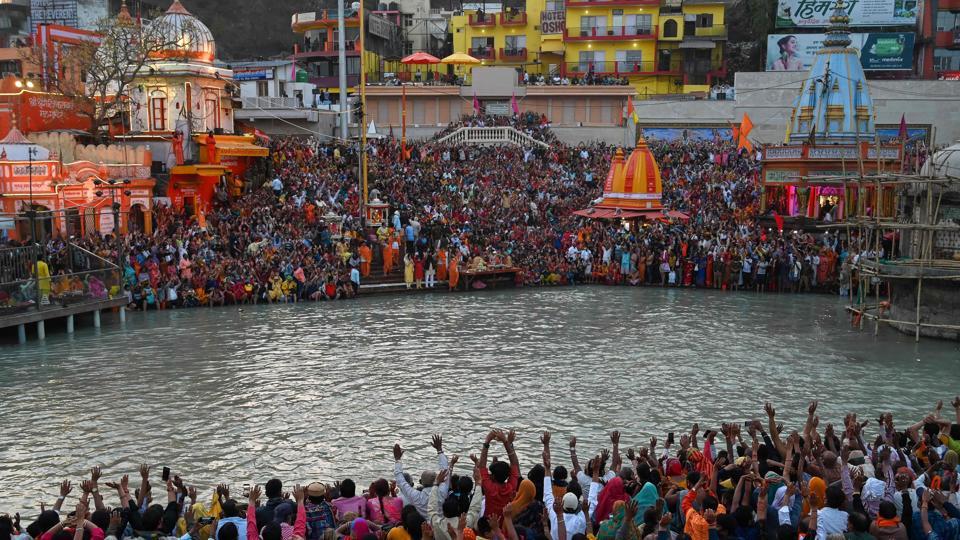
Images of the first shahi snan of Haridwar Mahakumbh showed visitors gathered in large groups, flouting Covid-19 preventive norms.

 Prefer HTon Google


The central government has written to the Uttarakhand government strongly highlighting the need for stringent measures to control the spread of Covid-19 during Mahakumbh, the world’s largest religious congregation. The development comes a day after chief minister Tirath Singh Rawat said that “nobody will be stopped in the name of Covid-19, as we are sure people’s faith will overcome the fear of the virus”.
According to the statement issued by the Centre, Rajesh Bhushan, Union secretary, ministry of health and family welfare, on Sunday wrote to chief secretary Uttarakhand Om Prakash and highlighted the concerns raised by the high-level central team in its visit to Haridwar on March 16 and 17 on the need of stringent measures to control the spread of Covid-19 during Kumbh Mela.
A high-level central team, led by the director National Centre for Disease Control (NCDC), visited Haridwar on March 16 and 17 to review the medical and public health preparedness measures undertaken by the state for the ongoing Kumbh mela in Haridwar.
The Union health secretary also observed that currently, more than 12 states in India have shown a surge in Covid-19 cases during the past few weeks, and pilgrims expected to visit Haridwar during the Kumbh mela could also be from these states. It has been noted that there is a potential for an upsurge in cases in the local population after the auspicious Shahi Snan (royal bath) during the Kumbh mela.
Also read: 10-20 Kumbh pilgrims testing Covid-19 positive daily - Centre
The secretary also noted that as per the report of the central team, 10-20 pilgrims and 10-20 locals are being reported positive for Covid-19 every day. This positivity rate has the potential to rapidly turning to an upsurge in cases, given the expected large footfall during Kumbh, the statement added.
The state has been informed that the daily testing numbers reported in Haridwar (50,000 Rapid Antigen Tests and 5,000 RTPCR tests) are not enough to effectively offset the huge pilgrim footfall. It has been advised that the current share of RTPCR tests be significantly increased as per the ICMR guidelines to ensure that the pilgrims and local population are appropriately tested.
JC Pandey, public relations officer, state health department, said they are yet to receive the letter but assured that the department will take all appropriate action recommended by the central government in the case of Mahakumbh.
The Mahakumbh event has the potential to become a super-spreader this time not just for Uttarakhand but for the whole of India. Covid-19 cases are witnessing a surge in many states and many people are coming to Haridwar in substantial numbers from these states. In the first Shahi Snan on March 11, over 3.3 million people visited Haridwar.
In January, the central government had issued an SOP for Mahakumbh with strict guidelines like mandatory negative Covid-19 test report, following which the state government also issues guidelines for the mega event.
Newly-appointed Uttarakhand CM Tirath Singh Rawat, who visited Haridwar thrice after taking charge, has been repeatedly saying there won’t be unnecessary restrictions on the pilgrims.
On March 13, Rawat had announced that negative Covid-19 reports are not necessary to participate in the upcoming ‘shahi snans’ during the mega event. On Saturday, the chief minister stated in Haridwar that all “unnecessary” restrictions imposed to contain the spread of the pandemic will be removed. He said that “faith is stronger than fear”.
Uttarakhand has reported 98,311 Covid-19 cases so far, of which 14,525 cases are from the Haridwar district. At present, Haridwar has the highest active cases of all 13 districts in the state with 266 active infections of the total 756.
Millions of pilgrims flock to Mahakumbh, especially on days of shahi snans (royal holy baths). The first one was on March 11 and the remaining three will fall on April 12, April 14 and April 27. Images of the first shahi snan showed visitors gathered in large groups. About 3.3 million attended the event without pilgrims following any Covid-19 norms.