E-Paper



India’s longest rail tunnel achieves breakthrough in Uttarakhand
Union railway minister Ashwini Vaishnaw said this success is not just the story of a tunnel, but the beginning of a new, strong and connected India

 Prefer HTon Google


Rail Vikas Nigam Limited (RVNL), a public sector undertaking under the Ministry of Railways, has achieved the first Tunnel Boring Machine (TBM) breakthrough of Tunnel-8, the longest transportation railway tunnel in India, as part of the ambitious 125-km Rishikesh–Karnaprayag Broad Gauge Rail Link Project in Uttarakhand.
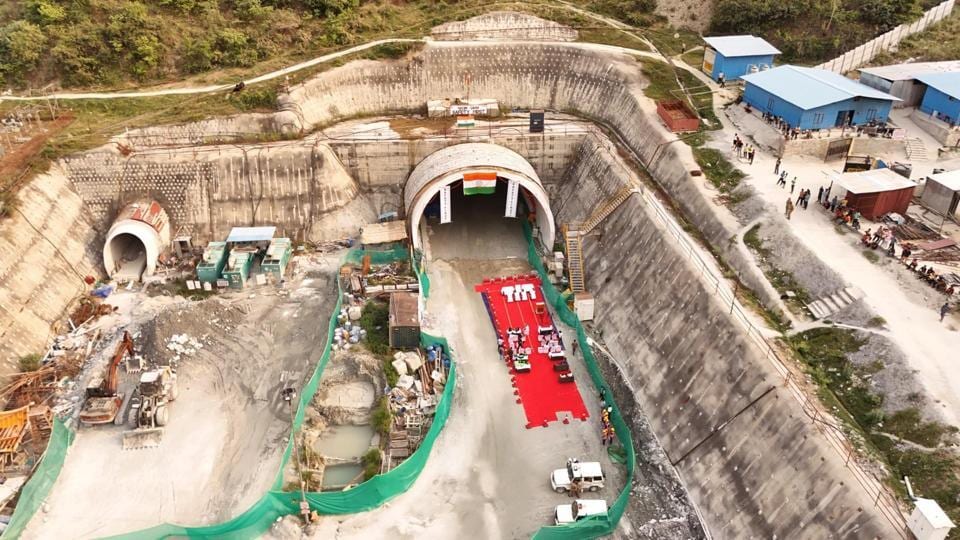
The breakthrough was achieved in the presence of Union railway minister Ashwini Vaishnaw and Uttarakhand chief minister Pushkar Singh Dhami here on Wednesday
According to RVNL officials, the 14.57-km tunnel from Devprayag Saud to Janasu was bored using a state-of-the-art Tunnel Boring Machine (TBM) named Shakti, marking a historic moment in Indian tunneling history. This is the first time TBM technology has been deployed for rail tunneling in mountainous regions of the country, and the progress sets a new global benchmark with a 9.11-metre diameter single-shield rock TBM.
Railway minister Ashwini Vaishnav, expressing happiness over the successful breakthrough of the tunnel, said, “This is an important step towards the development of Uttarakhand. It has paved the way for the future. This project will prove to be a milestone in connecting the mountainous areas of the state with the rail network. This 14.57-km-long railway tunnel is the longest tunnel not only in Uttarakhand but in the whole of India. With this project, the journey from Rishikesh to Karnaprayag will be reduced from seven hours to just two hours. This success is not just the story of a tunnel, but the beginning of a new, strong and connected India”.
Dhami said that this tunnel is a historic achievement towards the development of Uttarakhand. “It will not only make transportation easier for the local people, but will also give a new impetus to tourism, trade and economic activities in the region. Under the leadership of PM Modi, infrastructure development in the state has got new direction and momentum”
Pradeep Gaur, chairman and managing director, RVNL said, “This breakthrough marks a significant step in the Government’s mission to enhance connectivity across India’s hill states. More than just a technical milestone, it showcases RVNL’s technical prowess, determination and risk averseness to execute complex infrastructure projects in some of the most challenging terrains. With this achievement, Shakti hasn’t just cut through rock, it has paved the way for a more connected and resilient Uttarakhand.”
The Rishikesh–Karnaprayag project, executed from concept to commissioning by RVNL, aims to transform regional connectivity by linking key towns such as Devprayag, Srinagar, Rudraprayag, Gauchar, and Karnaprayag across five Himalayan districts. More than 83% of the 125 -km alignment passes through tunnels, involving over 213 km of tunneling across main and escape routes.
Tunnel-8, twin tunnels located between Devprayag and Janasu stations, are being excavated with two TBMs Shakti and Shiva, each with a boring diameter of 9.11 meters and equipped with advanced support systems. The second TBM, Shiva, is expected to achieve breakthrough by July 2025, said RVNL officials.
RVNL officials said the TBM has faced extraordinary logistical and geological challenges, including transporting 165 Metric Tonnes components from Mundra port to the site across narrow Himalayan roads and old bridges. The tunnel also lies in tectonically active Seismic Zone IV, requiring sophisticated design and continuous advance geological probing.
Once complete, the project will reduce travel time, improve all-weather access to remote regions, and boost tourism and economic development across Uttarakhand. It is also a critical step in realising the Char Dham rail connectivity initiative, said RNVL officials.