E-Paper



Stop tiger safari project until fixing Corbett tree felling violations: NGT
NGT has ordered that Pakhro Tiger Safari project in Corbett Tiger Reserve may not be allowed to proceed until a three-member committee constituted by the green panel identifies the violators and recommends steps for the restoration of the environment there

 Prefer HTon Google


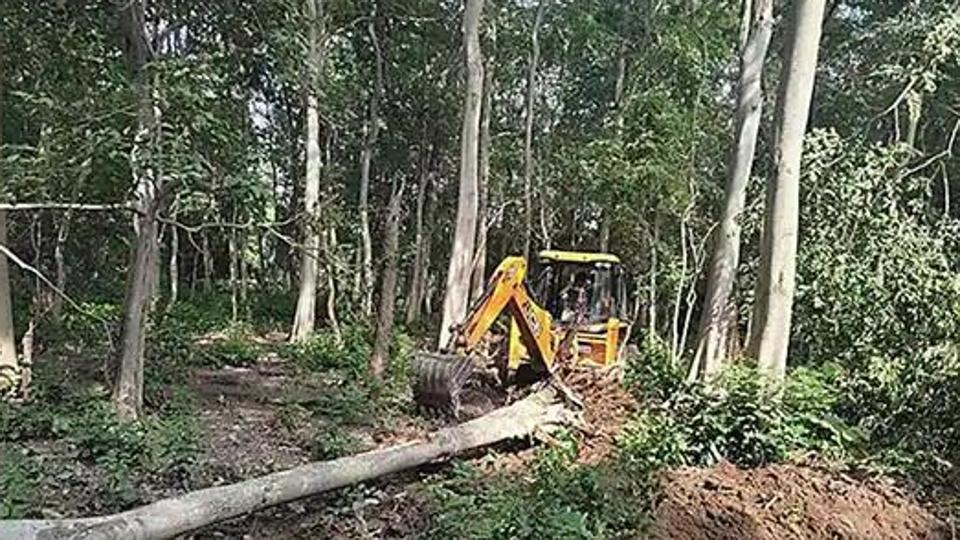
Taking suo motu cognisance of a media report on the illegal felling of over 6,000 trees in Corbett Tiger Reserve, the principal bench of the National Green Tribunal (NGT) has ordered that Pakhro Tiger Safari project may not be allowed to proceed until a three-member committee constituted by the green panel identifies the violators and recommends steps for the restoration of the environment there.
The directions were issued by NGT principal bench, New Delhi, while hearing the matter on Friday.
Earlier this month, HT reported that over 6,000 trees were felled for the proposed Pakhro Tiger Safari project in Corbett Tiger Reserve over an area of 16.21 hectares, citing a report of the Forest Survey of India (FSI), based on an analysis of old and new satellite images and field visit by FSI team to the area concerned.
NGT while referring to the FSI report, stated in its order, “..it is seen that illegality in cutting of trees is clearly acknowledged. Thus, accountability needs to be fixed for such violations and damage to environment restored, following due process of law.”
“Accordingly, we constitute a three-member Committee comprising DG, Forest Department, DG Wildlife Department and DG, Project Tiger to identify the violators and the steps required for restoration of environment. Its report with specific recommendations may be furnished to the secretary, Ministry of Environment and Forests (MoEF) within one month and steps for further course of action in the matter be finalised within next one month. Till then the Project may not be allowed to proceed,” the order said.
NGT also ordered that the action taken report be filed by MoEF on or before January 31, 2023.
The FSI report which has also been submitted to NGT said that a total of 6,093 trees have been estimated to be felled for the Pakhro Tiger Safari in Corbett Tiger Reserve. Forest Survey of India (FSI), is a premier national organisation under the Union Ministry of Environment and Forests, responsible for assessing and monitoring of the forest resources of the country regularly.
The 81-page report in its conclusion said, “The area cleared is estimated as 16.21 hectares. The trees estimated on this cleared area are 6,093 in number with lower bound of 5,765 and upper bound of 6,421.”
The matter relates to a petition originally filed by Gaurav Bansal, a Supreme Court lawyer and a wildlife activist. On a petition filed by him regarding illegal constructions, felling of trees and the construction of approach roads in Corbett Tiger Reserve (CTR), the Delhi high court on August 23 last year directed the National Tiger Conservation Authority to look into the issues raised by him. Following the court directions, NTCA constituted a committee on September 5, which inspected CTR between September 26 to September 30 and submitted its report on October 22 last year.
Bansal said the NTCA committee not only recommended vigilance inquiry against Uttarakhand Forest officers responsible for all this but also urged the Union forest and environment ministry to take strong action against the erring forest officers.
In October last year, the state forest department requested FSI to provide a clear status of the illegal felling of trees through an analysis of satellite imageries in the Pakhro area, which falls in the buffer area of Corbett Tiger Reserve.
In April, taking action against illegal constructions and felling of trees in Corbett, the state government suspended two Indian Forest Officer (IFS) officers - JS Suhag, the then chief wildlife warden and chief executive officer (CAMPA) and Kishen Chand, the then divisional forest officer Kalagarh Tiger Reserve, while CTR director Rahul (who goes by his first name) was removed from his post and attached to the office of principal chief conservator of forests (PCCF), Dehradun.
In August, the Uttarakhand vigilance department registered a case against IFS officer Kishan Chand and others in the case related to illegal constructions and felling of trees in Corbett Tiger Reserve. Kishan Chand, the then divisional forest officer Kalagarh Tiger Reserve, was suspended in April this year and he retired on July 31.
On October 12, in the first major arrest in this matter, the Uttarakhand vigilance arrested the suspended ranger of Pakhro Range, Brij Bihari Sharma from Guwahati in Assam. Brij Bihari Sharma, forest officer of Pakhro Range under Kalagarh Division, Lansdowne, Corbett Tiger Reserve was suspended in October last year after a departmental probe found his involvement in the felling of trees and constructions in Corbett Tiger Reserve.