
 E-Paper



Delhi air ‘very poor’, may touch ‘severe’ by Friday morning
The air quality index (AQI) may plunge to the ‘severe’ band by Friday morning on account of low wind speed, ‘dense’ fog and a further drop in temperature.


After remaining in the ‘poor’ zone for eight days, and a short spell of ‘moderate’ and ‘satisfactory’ air’’, slowing surface winds and a sharp dip in the mercury pushed Delhi’s air quality to the ‘very poor’ category on Thursday.
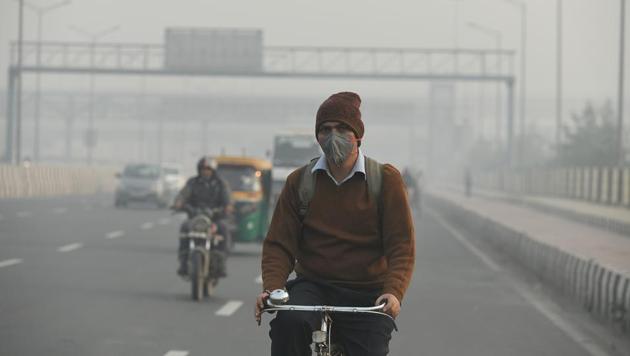
The air quality index (AQI) may plunge to the ‘severe’ band by Friday morning on account of low wind speed, ‘dense’ fog and a further drop in temperature -- and expected to remain like that for the next five days, government agencies warned.
The AQI as calculated by the Central Pollution Control Board’s (CPCB) 4 pm bulletin was 382, as against 296 in the ‘poor’ zone, the previous day. Previously, Delhi had breathed ‘very poor’ air on November 23 when the AQI was 312.
As per CPCB data, 16 of the 38 monitoring stations in Delhi already showed deep red in the ‘severe’ category at 6 pm, including Anand Vihar, ITO, Ashok Vihar, Dilshad Garden, Vivek Vihar and Wazirpur, among others.
The air quality had started plunging from Wednesday evening. The levels of PM 2.5 -- the most harmful aerosols in Delhi’s air -- shot up to 245ug/m3 at 8 pm on Thursday from150 ug/m3 at the same time the previous day.
According to the CPCB-led taskforce, which met on Thursday in the wake of the deteriorating air quality, the surface wind speed remained around 4 kmph, which is not allowing dispersion of local pollutants trapped in the air.
“Present wind direction is from North and is expected to shift to North-East from Friday. This may result in further deterioration in the air quality in the national capital region (NCR) and the AQI may fall to the lower end of ‘severe’ category,” V K Soni, senior scientist at the India Meteorological Department (IMD) told CPCB, as per minutes of the task force meeting held on Thursday.
The air quality is expected to improve only around December 11, when rainfall and thunderstorm may occur in Delhi-NCR, said Soni.
According to IMD scientists, the presence of anti-cyclonic wind pattern resulted in the slowing of winds. Besides, moisture-laden light easterly winds were also blowing over Delhi.
“During the transition period from monsoon to winter, an anti-cyclonic wind pattern usually forms when winds travel from Punjab, Haryana and turn into Delhi to further go to Rajasthan. The turning of the winds slows down its speed. During the morning hours the winds are calm (zero speed) and hence dispersion of pollutants does not take place,” said Kuldeep Srivastava, IMD’s head of regional weather forecasting centre.
This, in addition to the moisture from easterly winds, allows further trapping of pollutants, which results in pushing up the pollution levels. Also, the dip in mercury adds to stagnant weather conditions, which too favours accumulation of pollutants, he added.
On Thursday, the night temperature was recorded at 7.6 degrees C -- the lowest minimum of the season so far. The day temperature was 23.6 degrees C, a notch below the season’s average.
The minimum temperature is likely to fall further to 7 degrees C on Friday. Also, ‘dense’ fog may occur on Friday morning, reducing visibility, as per IMD.
The System of Air Quality and Weather Forecasting and Research (Safar), a unit of the union ministry of earth sciences (MoES), saud the share of stubble burning in neighbouring Haryana and Punjab to the overall pollution in Delhi was 9% on Thursday.

Stay updated with all top Cities including, Bengaluru, Delhi, Mumbai and more across India. Stay informed on the latest happenings in World News along with Delhi Election 2025 and Delhi Election Result 2025 Live, New Delhi Election Result Live, Kalkaji Election Result Live at Hindustan Times.


