
 E-Paper



1 year of Delhi budget under BJP: Progress on welfare but slow movement on infra promises
Delhi's ₹1 lakh crore budget for 2025-26 shows mixed results: progress in welfare but delays in infrastructure and key policy projects.


Last year, chief minister Rekha Gupta had said that her government was presenting an “unprecedented and historic” budget of ₹1 lakh crore for the year 2025-26 — 31.5% percent higher than the year before. She said that 72% of the budget had been allocated for revenue and 28% for capital expenditure. A look back at the Bharatiya Janata Party(BJP)-led government’s maiden financial plan, pitched as a roadmap for a “self-reliant and developed Delhi”, reveals a mixed record, with steady progress in welfare and service delivery but slower movement on several high-visibility infrastructure and policy promises.
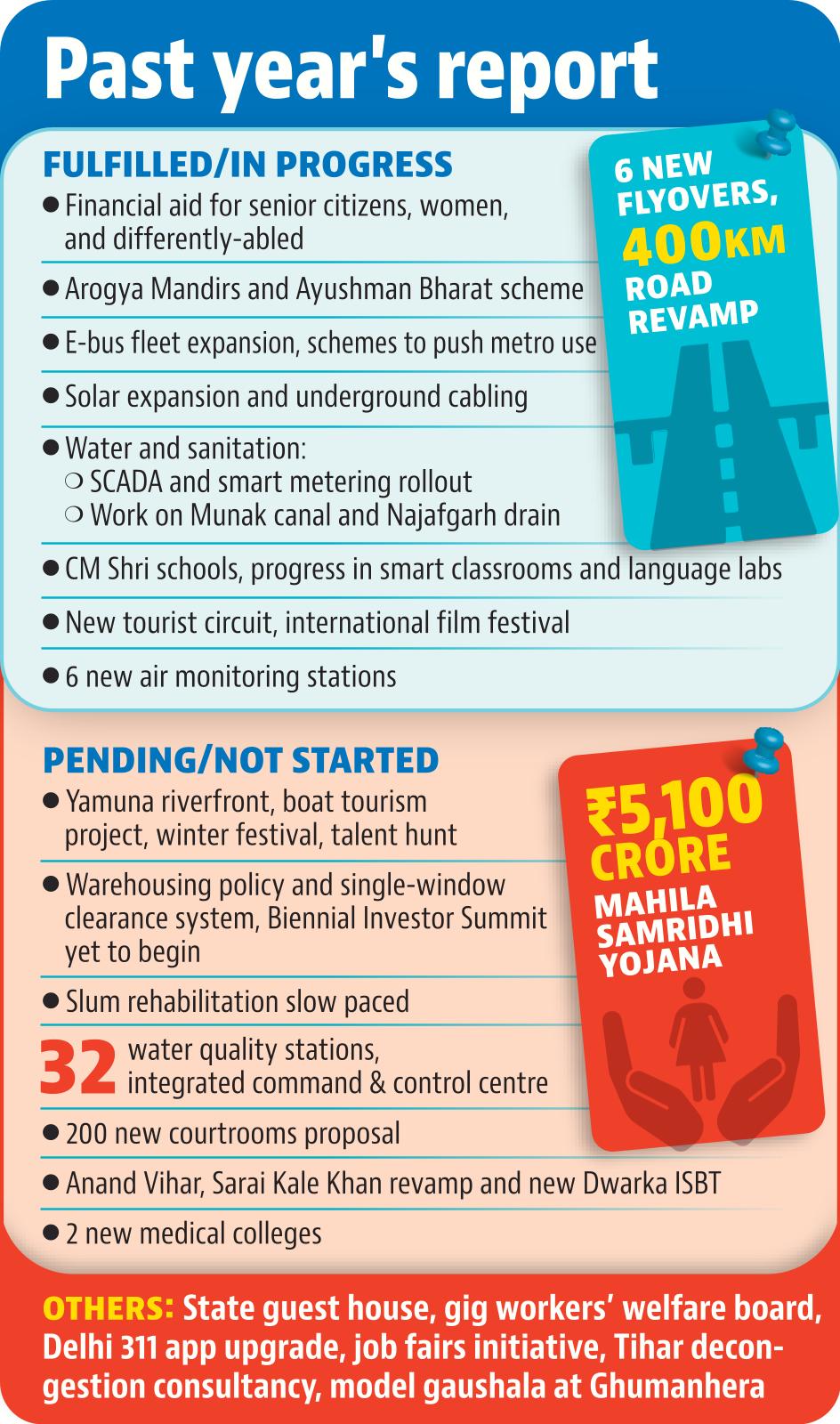
Financial assistance schemes for senior citizens, women in distress, and persons with disabilities have continued with expanded coverage, targeting over 9.5 lakh beneficiaries. For instance, after the cabinet cleared the Ayushman Bharat scheme, ₹2,144 crore was allocated.
“The government has operationalised around 700 Ayushman Arogya Mandirs, generated over 7.03 lakh health cards under Ayushman Bharat and Vay Vandana Yojana, and empanelled 200 hospitals. Disbursal of more than ₹45 crore to beneficiaries indicates early-stage roll-out momentum,” the CM told HT in an interview last month.
In education CM Shri schools have begun operations with an allocation of ₹100 crore, while curriculum additions such as language laboratories, smart classrooms and “science of living” modules are being gradually introduced. Technical education schemes, backed by ₹618 crore, are also underway.
In roads and transport, under the ₹3,843 crore earmarked for road and bridge infrastructure, projects including six new flyovers and redevelopment of nearly 400 km of roads have been announced or initiated.
Public transport spending, pegged at ₹12,952 crore, has largely been utilised, with a steady expansion of the electric bus fleet and continued investment in metro network augmentation. In the power sector, ₹3,847 crore has supported early work on solar expansion and underground cabling, with pilot work launched in areas such as Shalimar Bagh.
Water and sanitation, with an allocation of ₹9,000 crore, have seen multiple parallel interventions. These include supervisory control and data acquisition (SCADA)-based monitoring systems, intelligent metering, upgrades to sewage treatment plants, sewer line replacement, and drain desilting using newly procured machinery. Work on key channels such as the Munak canal and Najafgarh drain has also begun, though most projects remain at various stages of implementation rather than completion.
Urban development and environment lag behind targets
Despite higher allocations of ₹696 crore for slum development, progress in rehabilitation has been slow. While demolitions in unauthorised colonies have taken place, redevelopment and resettlement efforts have not kept pace.
Similarly, environmental commitments have seen partial progress. While six new air quality monitoring stations and 32 water monitoring units have been installed, the proposed integrated command and control centre remains pending. The ₹300 crore earmarked for pollution control has yet to translate into a comprehensive, visible framework.
Plans to expand judicial infrastructure, including 200 additional courtrooms backed by ₹490 crore, also remain in the pipeline without significant on-ground advancement.
Several policy-level announcements have seen limited movement. The proposed industrial policy, warehousing framework, trader welfare board and single-window clearance system remain under deliberation. Similarly, plans for a biennial investor summit and schemes to promote cottage industries have not been formally rolled out.
In tourism, despite an increased allocation of ₹117 crore, marquee announcements such as Yamuna riverfront boat tours and a winter festival are yet to materialise. However, smaller steps, including a new tourist circuit covering Kartavya Path and associated landmarks, have been initiated, and an international film festival is scheduled in the coming week.
Among the most prominent unfulfilled commitments is the “Mahila Samridhi Yojana”, for which ₹5,100 crore was allocated to provide ₹2,500 monthly assistance to eligible women. The scheme has not yet been launched.
Other pending projects include the model gaushala in Ghumanhera village, redevelopment of ISBTs at Anand Vihar and Sarai Kale Khan, a new ISBT in Dwarka, two proposed medical colleges, a state guest house and additional public infrastructure such as auditoriums and stadiums, many of which were announced without dedicated budgetary provisioning.
Smaller allocations, including those for a gig workers’ welfare board, Delhi 311 app upgrade, job fairs and prison decongestion consultancy are at varying stages but remain incomplete.



Stay updated with all top Cities including, Bengaluru, Delhi, Mumbai and more across India. Stay informed on the latest happenings in World News along with Delhi Election 2025 and Delhi Election Result 2025 Live, New Delhi Election Result Live, Kalkaji Election Result Live at Hindustan Times.


