
 E-Paper



NCR village’s prehistoric roots fade into obscurity
Haryana’s first Palaeolithic site was discovered in the village in 1986, a memory that barely a handful recollect

 Prefer HTon Google


A vortex of unpaved streets, with overflowing sewage, leads to the heart of the Anangpur village in Faridabad, located around 30 kilometres from the national capital. Teeming with people, queries regarding the village’s historical significance draw blank stares from all quarters. Haryana’s first Palaeolithic site was discovered in the village in 1986, a memory that barely a handful recollect.
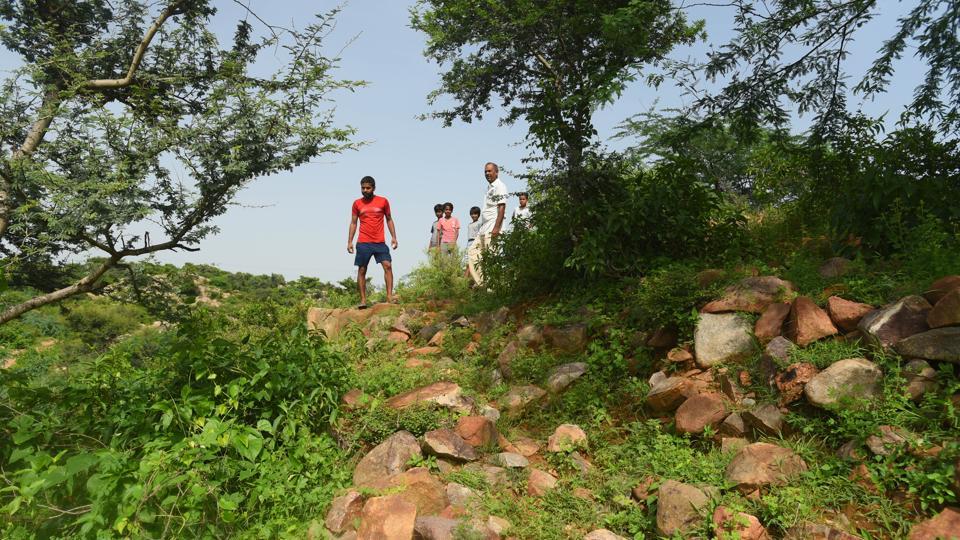
Excavations in the village by the Archaeological Survey of India (ASI) in 1991 also unearthed tools from the late Acheulean period.
Experts said that evidence from the lower to upper Paleolithic Age was found in Anangpur, and that late Acheulian tools belonging to the lower Paleolithic period were discovered here, and with the recent discovery of cave paintings and tools from the Upper Palaeolithic age in the Aravalli ranges, there is a renewed focus on the importance of granting protection to such pre-historic sites and increasing awareness about them. But residents of the village are mostly oblivious to Anangpur’s connections to the region’s prehistoric lineage.
“There is no such site or connection to an excavation of this nature,” said Kashmiri. This is a common refrain from several middle-aged and elderly residents of the village, many of whom lived there during ASI’s investigations.
“I don’t recall any such excavation that was undertaken here. We used to visit the mountains daily for labour but never heard about any discovery here,” said Savitri, an octogenarian resident, while sitting at the entrance of her house. Her neighbours nod in agreement and shift focus to the more contemporary issues plaguing the village.
“Look at the broken roads here. The sewage is overflowing and there is no direct water supply. There is absolutely nothing to suggest here that an important historical finding took place here,” said Kashmiri, a woman in her 70s. Married at the age of 14, she has lived in the village for five decades now. “The generations before us might have seen something worthwhile, but all that we found were stones of no value,” said Kashmiri.
The women are not alone. Despite being imbued in history that predates modern civilisation, awareness of the findings made by ASI remains scant among most residents, except those who were lucky to have witnessed the excavations nearly three decades ago.
Gyan Chand, a 49-year-old, recalls watching the excavations as a curious teenager in the early 190s. He recalled how a team led by the ASI undertook extensive surveys and over two weeks.
“Digging was carried out for nearly 15-20 days. They used to collect stones and take them every day. We were told that the tools demonstrated human evolution and were being sent to a lab,” said Chand.
But, he added, the team never returned and the site was left unattended over the next three decades.
“We never dwelled much on what followed but it’s worth pondering. What was the outcome of the excavations that were undertaken here? If the discovery was historically significant, why were there no follow-ups? It almost seems like the exercise never happened or was covered up. We never heard back anything about the site here and our village never became famous,” said Chand.
Satveer, 42, another resident who faintly recalls the excavations, shared that he and many others thought the team was looking for treasure. He said that people’s interest waned as they realized that no such treasure was being searched. “Who cares about stones? We were under the impression that gold and silver were possibly hidden in the mountains. Once we realised that they were only looking for stones, people stopped caring,” recalls Satveer, who goes by his first name.
Shyam Babu, who was 15 when the team visited, shared that the team was looking for some things in the vicinity of the already-existing fortifications in the area.
“The team came every day for 15-20 days. They used to dig out stones. I don’t recall if they shared the significance of the stones. There are big boulder-like stones here even today. It seems that the place was used as a workshop by early humans, but one can’t be sure, because the team never came back. Most people don’t even recall the excavations now,’ said Babu, who used to accompany his grandfather to the site.
While the site was discovered in 1986, ASI undertook excavation at the site in the early 90s. AK Sharma, who discovered the site, was accompanied by former joint director general of ASI SB Ota and other experts from ASI’s prehistoric branch.
According to the report published by Sharma and Ota, the interesting feature noticed in Anangpur was that the working point of the handaxes was broken due to usage.
The absence of abraded tools and occurrence of a large amount of waste products such as cores and flakes clearly suggest that the site at Anangpur was a habitation and factory of Early Man,” said the report, published in 1991.
Ota said that while it was always known that there was a possibility of Acheulean sites in Aravalli, Anangpur was the first site where a large number of artifacts had been found. He, however, added that it was crucial to determine the significance of such sites.
“If you look at the richness of the site, there are probably more than 1,000 sites that are better than Anangpur in the country. If you explore the complete Aravalli area, you may find more than 200 sites similar to Anangpur. Hence, it’s important to weigh the strategic importance since it’s not possible to grant protection to so many sites,” said Ota.
Banani Bhattacharyya, deputy director of the Haryana department of archaeology and museums, said that the site was not under state protection. She said that it was crucial to understand that the approach towards conservation of pre-historic sites differed when compared to the protection proceedings that are undertaken for historic sites.
“Pre-historic sites exist in a scattered manner. Since the individuals were hunter-gatherers, they used to travel over a huge area. It is not possible for us to grant protection to such sites based on contemporary boundaries unless the sites are concentrated in the same area,” said Bhattacharyya.
She added that pre-historic sites required meticulous documentation due to which taking such sites under protection required a lot of time. “Each and everything needs to be meticulously documented. The processes take time. Documentation at Bhimbetka caves is taking place even today. The methodologies for conservation of pre-historic sites are slightly different. Ever
Despite multiple attempts, ASI officials could not be reached for comment.


